

Cops Poured Coffee on a Black Woman Outside Court — Then Froze When He Took the Bench as Judge
Coffee
close
arrow_forward_ios
Read more
00:00
00:02
01:31
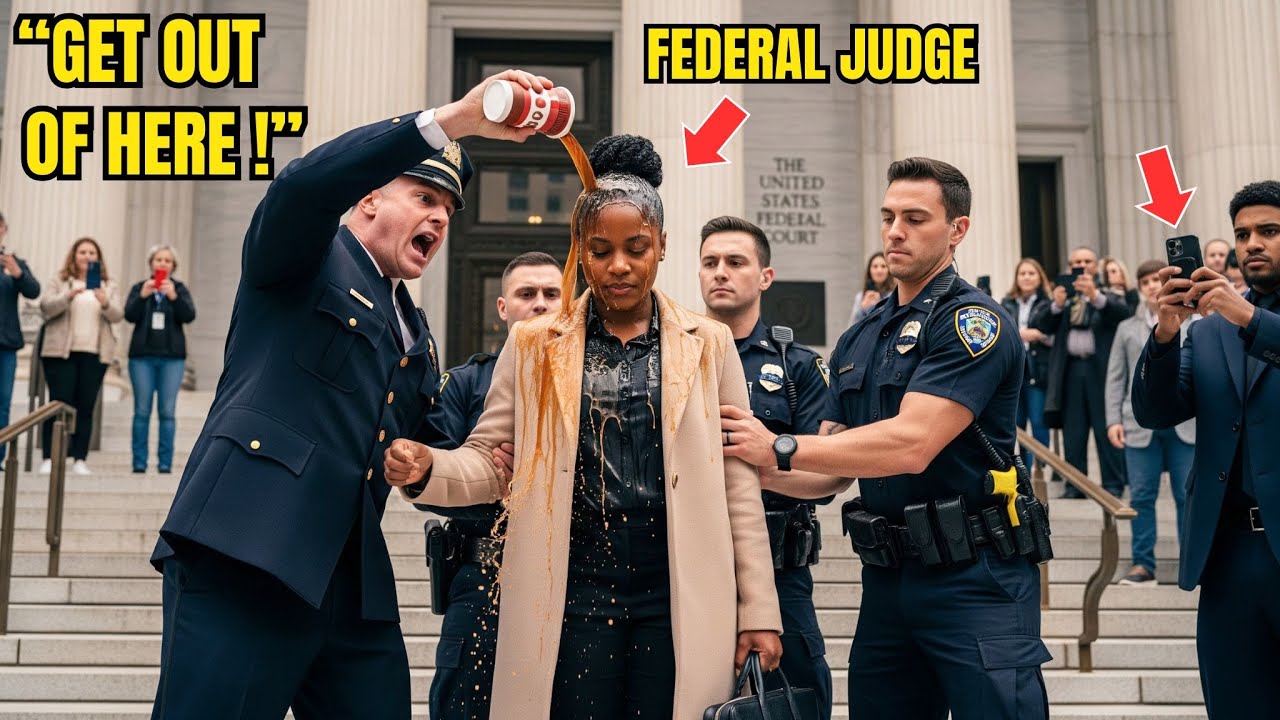
Move it, courthouse trash. Know your place. Officer Marcus Sullivan smirked as he deliberately poured his lukewarm coffee directly onto the black woman’s shoulder. The liquid soaked through her expensive coat, staining the fabric dark brown as it dripped onto the pavement below.
She stood there calmly, coffee pooling at her feet, and simply asked for his badge number. Sullivan laughed. Good luck with that complaint, sweetheart. You’re nobody. It was 6:30 a.m. in the shared parking lot between two courouses. The woman had been walking toward the federal building’s rear entrance, briefcase in hand, when Sullivan decided she needed to be taught a lesson.
To him, she was just another entitled civilian who thought she could walk around his territory without consequence. He had no idea who she really was because what happened next would destroy Sullivan’s career and expose a pattern of abuse that had been hidden for years. 3 hours later, officer Marcus Sullivan was spinning the story of his life.
Sitting across from internal affairs detective Lisa Carter in the sterile conference room at the local police station, Sullivan painted himself as the victim of an aggressive woman who clearly didn’t respect law enforcement. “Look, Detective Carter, I’ve been walking this beat for 15 years. I know troublemakers when I see them,” Sullivan began, his voice carrying the practiced confidence of someone who’d never been seriously challenged.
“This woman comes barreling through the parking lot like she owns the place. I’m standing there with my morning coffee, minding my own business after a long night shift, and she deliberately bumps into me.” Sullivan leaned back in his chair, his arms crossed defensively. I mean, these courthouse workers think they run everything.
Coffee
Defense attorneys, clerks, parillegals, they’re all the same. They walk around with this attitude like they’re better than the people who actually keep the streets safe. Detective Carter made notes, her expression neutral. Tell me exactly what happened with the coffee, Officer Sullivan. She knocked into my arm and my coffee spilled on her coat.
Pure accident. Sullivan shrugged as if the incident was barely worth discussing. But instead of apologizing for bumping into me, she gets all aggressive, starts demanding my badge number, making threats about filing complaints. Classic entitled behavior. What Sullivan didn’t mention was the deliberate way he’d tracked the woman’s movement across the parking lot.
He didn’t describe how he’d positioned himself directly in her path or how he’d calculated the exact moment to pour the coffee. In his version, he was just an innocent officer who happened to be in the wrong place at the wrong time. She was clearly looking for trouble, Sullivan continued. The way she was dressed, the expensive briefcase, walking toward the federal courthouse like she had some kind of special privileges.
These people need to learn that badges matter. Respect matters. Officer Johnson, Sullivan’s patrol partner, who had arrived at the scene shortly after the incident, shifted uncomfortably in his chair. When Detective Carter turned to him for corroboration, Johnson’s voice lacked the confidence of his colleague. I I arrived right after it happened,” Johnson said slowly.
Sullivan was upset, said this woman had bumped into him, and then got confrontational when he tried to explain about the coffee accident. Johnson avoided eye contact as he spoke, his discomfort with the assault claims evident in his body language. Back at the federal courthouse, security guards were having a very different conversation.
Federal Security Chief Marcus Torres was reviewing the duty roster with his team when one of the guards mentioned something significant. Chief, you know Judge Williams came back from her family leave today, right? 3 months caring for her mother after the surgery. She was heading in through the rear entrance around 6:30 this morning when that incident happened in the parking lot. Torres looked up sharply.
Judge Williams. Federal judge Amara Williams. Yes, sir. She had her key card and went straight to the federal side, but there was some kind of altercation with a local patrol officer in the shared parking area. Something about coffee being spilled. Meanwhile, Sullivan was doubling down on his story. I filed a counter complaint against her for disorderly conduct and threatening a police officer.
This woman needs to learn that you can’t just attack cops and expect to get away with it. Detective Carter paused her note-taking. You’re characterizing this as an attack, Officer Sullivan? Absolutely. She was aggressive, hostile, clearly looking to cause problems. I’ve seen this pattern before with these courthouse types.
They think their jobs make them untouchable. Sullivan’s voice took on a harder edge. Some of these people need to be reminded that respect goes both ways. The racial undertones in Sullivan’s language weren’t lost on Detective Carter, who had been investigating police misconduct for over a decade. She’d heard similar justifications before, the coded language officers used when they wanted to explain away interactions that had gone wrong.
“Officer Sullivan, you mentioned a pattern. Have you had other incidents with courthouse personnel?” Sullivan waved dismissively. Nothing official. Just the usual attitude problems you get from certain types of people. Defense attorneys who think they can mouth off. Clerks who act like they’re running the place.
Sometimes you have to establish boundaries. What Sullivan didn’t realize was that his boundaries had left a trail. Detective Carter had already begun pulling incident reports, looking for patterns in Sullivan’s patrol logs. Over the past 5 years, there had been 12 complaints filed against him, all involving black civilians, all dismissed or reduced to minor infractions, all following remarkably similar patterns.
As Sullivan continued his story, painting himself as a dedicated officer, unfairly targeted by an aggressive civilian, he had no idea that security cameras from the federal courthouse had captured the entire incident. He didn’t know that his text messages from that morning were already being preserved as evidence, and he certainly had no clue about the true identity of the woman he’d chosen to humiliate.
“Look, Detective Carter, I’ve been doing this job for 15 years without any serious problems,” Sullivan concluded. “I patrol the courthouse district every night. I know the troublemakers, and I know when someone is looking to cause problems for law enforcement. This woman was clearly one of those people.” Officer Johnson remained silent throughout most of Sullivan’s account, occasionally nodding when prompted, but never adding details that might contradict his partner’s version of events. His discomfort was becoming more
apparent as Sullivan embellished the story, turning a deliberate assault into a tale of officer victimization. “Is there anything else you’d like to add, Officer Johnson?” Detective Carter asked. Johnson glanced nervously at Sullivan before responding. I just I arrived after it happened. I saw Sullivan was upset and the woman seemed calm.
Maybe too calm, if you know what I mean, like she was planning something. Detective Carter closed her notebook. Thank you, officers. I’ll need to review security footage from the area and interview the complainant. You’ll be notified if we need additional information. As Sullivan left the conference room, he felt confident that his version of events would stand.
After all, it was his word against some courthouse worker who’d probably never filed a complaint before. He had no idea that within 48 hours his entire career would be over, and his name would become a case study in police accountability training programs across the country. The truth, as Sullivan would soon discover, had a way of surfacing, especially when it was captured on highdefinition security cameras and when the victim happened to hold one of the most powerful positions in the federal justice system.
Judge Amara Williams sat in the same sterile conference room where Sullivan had spun his tail just hours earlier. But unlike the officer’s defensive posture and elaborate justifications, Amara’s testimony was measured precise and devastatingly accurate. Her coffee stained coat hung on the back of her chair, a silent witness to Sullivan’s assault. At approxima
Coffee
tely 6:28 a.m., I was walking from my vehicle to the rear entrance of the federal courthouse. Amara began, her voice carrying the calm authority of someone accustomed to being heard and believed. I had parked in space F7 of the shared lot as I have done for the past 15 years when using the federal building. Detective Carter looked up from her notes.
15 years? Yes, I’ve been working in the federal courthouse system since 2008. Amara’s response was matter of fact, revealing nothing about her actual position. This morning marked my return after a 3-month family medical leave to care for my mother following her surgery. The precision of Amara’s language immediately set her apart from typical civilian complaints.
She spoke in the measured tones of someone familiar with legal proceedings, someone who understood the weight of words and the importance of accuracy. As I approached the federal building, Officer Sullivan, badge number 4,729, positioned himself directly in my path. His movements were deliberate, not coincidental. Amara’s recall was photographic.
He was holding a white disposable coffee cup, approximately 12 ounces, with the Metro Coffee logo visible. Detective Carter paused her writing. The level of detail was extraordinary, far beyond what most civilians would notice or remember under stress. The officer made eye contact with me from approximately 15 ft away.
As I continued walking, he said, “Move it, courthouse trash. Know your place.” Amara repeated Sullivan’s words without emotion, letting their ugliness speak for itself. He then deliberately tilted his cup and poured the contents onto my left shoulder and coat. How can you be certain it was deliberate? The trajectory and timing. Officer Sullivan had to extend his arm and adjust his wrist angle to ensure the liquid reached my shoulder rather than falling to the ground.
The action required conscious coordination. Amara’s analysis was clinical, precise. Additionally, his positioning suggested premeditation. He had moved to intercept my path rather than maintaining his original position. Detective Carter was impressed by the clarity and detail of the account. In her experience, traumatized witnesses often struggled with specifics, but this woman spoke with the confidence of someone trained in observation and testimony.
What happened after the assault? I requested officer Sullivan’s badge number, which he provided verbally, 4,729. I also noted his patrol unit number, 47, and the timestamp on my phone, 6:31 a.m. Amara pulled out her device, showing the precise timing. Officer Sullivan then said, “Good luck with that complaint, sweetheart. You’re nobody.
” The final insult hung in the air. Detective Carter had heard variations of this phrase in dozens of misconduct cases, usually deployed by officers who believed their targets had no recourse, no power, no voice that mattered. Were there any witnesses to this incident? Dr. Michael Torres was entering the federal building at the same time.
He’s a courthouse psychiatrist who begins his rounds early. He witnessed the entire interaction from approximately 30 ft away. Amara’s knowledge of the courthouse personnel suggested deep familiarity with the federal system. Additionally, the rear entrance security cameras would have captured the incident.
I used my key card to enter at 6:33 a.m. Detective Carter made note of the key card detail. Access to the federal courthouse rear entrance was restricted to judges, senior staff, and security personnel. Typical defense attorneys and clerks used the main public entrance. Miss Detective Carter realized she hadn’t gotten the complainant’s full name yet.
Williams doctor Amara Williams. The title was delivered casually, but it carried weight. In the courthouse system, the title doctor usually indicated either a medical professional or someone with a law degree at the highest levels. Dr. Williams, you mentioned this was your first day back from family leave.
Where exactly do you work in the federal courthouse? Amara’s response was measured. I work in the judicial wing, third floor. I was returning to my chambers this morning to prepare for today’s docket. The word chambers hung in the air with particular significance. Only judges had chambers. Detective Carter felt a chill of realization beginning to form, but she continued with her standard questions.
Have you ever had any previous interactions with Officer Sullivan? No. Officer Sullivan patrols the local courthouse district. our paths would not typically cross as the federal and local systems operate independently. Amara’s knowledge of jurisdictional boundaries was another indicator of her deep familiarity with court operations.
Additionally, my 3-month absence would explain why officer Sullivan was unfamiliar with my identity. The interview continued for another 30 minutes with Amara providing detailed responses to every question. She described the temperature of the coffee, estimated the volume spilled, identified potential witnesses, and provided a timeline accurate to the minute.
Coffee
Most remarkably, she showed no anger, no desire for revenge, only a calm insistence on accountability. As the session concluded, Detective Carter couldn’t shake the feeling that there was more to this story. The complainant’s precise legal language, her access to restricted areas, her reference to chambers and docket, everything suggested this wasn’t just another courthouse employee who’d been harassed by an overzealous officer.
Doctor Williams, is there anything else you’d like to add to your statement? Amara considered the question carefully. Officer Sullivan’s behavior suggests a pattern of targeting individuals he perceives as vulnerable or powerless. His language indicated racial animus, and his confidence in avoiding consequences suggests this isn’t his first such incident.
She paused, her next words carrying particular weight. Justice requires accountability, Detective Carter. Not just for this incident, but for the pattern it represents. After Amara left, Detective Carter immediately began pulling security footage and cross-referencing Sullivan’s patrol logs. She also made a note to verify Dr.
Williams employment status with the Federal Courthouse Administration. Something about this case felt different, more significant than a typical misconduct complaint. What Detective Carter didn’t know was that she was about to uncover one of the most explosive police accountability cases in the city’s history. The woman who had been assaulted in the courthouse parking lot wasn’t just any federal employee.
She was about to become the judge who would oversee Sullivan’s downfall. By the end of the week, Sullivan’s name would be headline news. His career would be over, and his victim would be revealed as one of the most respected federal judges in the district. The coffee stains on Amara’s coat would become evidence in a federal civil rights case that would change police training protocols citywide.
But for now, Sullivan remained blissfully unaware that he had just assaulted a sitting federal judge and that his days of getting away with racially motivated misconduct were about to end forever. That evening, Judge Amara Williams sat in her home office, surrounded by the quiet symbols of a distinguished legal career.
Her federal judicial robes hung on a mahogany stand in the corner, partially visible behind stacks of law books. Diplomas from Harvard Law School and her judicial appointment certificate lined the walls. But tonight, her attention was focused on something far more troubling. On her computer screen was Officer Marcus Sullivan’s complete disciplinary record.
12 complaints over 5 years, all involving black civilians, all mysteriously dismissed or reduced to minor infractions. As a federal judge, Amara had access to law enforcement databases that most civilians could never see. and what she found painted a disturbing picture of systemic failure. Her phone buzzed with a text from her mother.
“How was your first day back, sweetheart? Are you taking care of yourself?” Amara smiled softly, remembering the 3 months she’d spent caring for her mother after surgery. Those quiet weeks had been a reminder of what truly mattered: family dignity, and ensuring justice for those who couldn’t fight for themselves. Her mother, a retired civil rights activist, had raised her with a simple principle.
When you have power, you use it to protect those who don’t. The first day was eventful. Mom, I’ll call you tomorrow. Love you. Returning to her research, Amara opened Sullivan’s patrol logs. The pattern was undeniable. Complaints filed by black civilians for aggressive contact during routine stops. Reports of accidental spills and unintentional physical contact.
Each incident dismissed as a misunderstanding. Each victim left without recourse. Case hash one. Mrs. Dorothy Jenkins, 67, complained that officer Sullivan deliberately knocked her grocery bags from her hands during a jaywalking stop. Sullivan claimed she resisted and the bags fell accidentally. Case dismissed. Case hash two.
Marcus Thompson, 24, alleged that Sullivan poured his drink on him during a traffic stop, claiming Thompson was uncooperative. Sullivan reported that Thompson knocked the beverage from his hand during aggressive movement, reduced to a written warning. Case hash three. Dr. Sarah Mitchell, 35, a pediatrician, reported that Sullivan shoved her against her car during a parking violation stop.
Sullivan stated she stumbled backward and he was helping steady her. No action taken. The files revealed a sophisticated pattern of abuse disguised as accidents and misunderstandings. Sullivan had learned exactly how to assault people while maintaining plausible deniability. Each incident was minor enough to avoid serious scrutiny, but together they painted a picture of deliberate racially motivated harassment.
Amara leaned back in her chair, studying the framed photo on her desk. herself and her mentor, retired federal judge Margaret Carter, at her confirmation ceremony 15 years ago. Judge Carter had been the one to encourage her to pursue the federal bench despite the barriers facing black women in the judiciary. Amara, Judge Carter had said that day.
The bench isn’t just about interpreting law. It’s about ensuring that law serves justice, especially for those who have no voice. Tonight, those words carried special weight. Amara picked up her phone and dialed Judge Carter’s number. Margaret, it’s Amara. I need to talk through something with you.
For the next hour, Amara described the morning’s incident and her subsequent research into Sullivan’s background. Judge Carter listened without interruption, her decades of experience recognizing the gravity of the situation. Amara, this isn’t just about your assault. This is about a pattern of civil rights violations that has been ignored for years.
What are you thinking of doing? I want to ensure this follows proper channels, no shortcuts, no special treatment because of my position, but I also want to make sure this pattern doesn’t continue. Amara’s voice was measured deliberate. How do I balance my role as a victim with my responsibilities as a federal judge? You recuse yourself from any direct judicial proceedings, but you ensure the system works as it should.
You file the complaint, provide the evidence, and let justice follow its course. Judge Carter paused. But Amara, you also use your knowledge and access to ensure that all the evidence comes to light. Those other victims deserve justice, too. After ending the call, Amara composed a detailed email to the Civil Rights Division of the Department of Justice.
She outlined Sullivan’s pattern of behavior, attached the relevant case files, and recommended a comprehensive investigation into the local police department’s handling of misconduct complaints. She also reached out to Dr. Michael Torres, the courthouse psychiatrist, who had witnessed the morning’s assault.
His testimony would be crucial, and as a federal employee, he would understand the significance of what he had seen. Looking at her reflection in the dark window, Amara saw a woman who had spent decades fighting for justice. First as a prosecutor, then as a defense attorney, and finally as a federal judge.
Tomorrow, she would face Officer Sullivan again, but this time he would discover exactly who he had chosen to assault. The coffee stains on her coat had been photographed and documented. The security footage was being preserved. The pattern of abuse was being exposed. And officer Marcus Sullivan, who had spent years believing he was untouchable, was about to learn that justice, like truth, has a way of surfacing when you least expect it.
Coffee
As Amara prepared for bed, she felt no anger towards Sullivan, only a quiet determination to ensure that his pattern of abuse would end with her. Tomorrow would bring revelations that would shock everyone except the woman who had spent her career ensuring that power could never hide from accountability. The truth began to unravel Officer Sullivan’s lies within 48 hours.
What started as his word against a courthouse clerk quickly became an avalanche of evidence that would bury his career and expose a systematic pattern of racially motivated abuse. Dr. Michael Torres was the first domino to fall. The courthouse psychiatrist had arrived at work early that Tuesday morning to prepare for a competency hearing, and he had witnessed the entire assault from the federal building’s entrance.
“When Detective Carter contacted him for an interview, his account shattered Sullivan’s fabricated story completely.” “I saw the whole thing,” Dr. Torres told Detective Carter, his voice carrying the measured authority of someone who testified regularly in federal court. Officer Sullivan deliberately positioned himself in the woman’s path.
There was no collision, no accident, no stumbling. He tracked her movement across the parking lot and intercepted her specifically to pour that coffee on her shoulder. Dr. Torres pulled out his phone, showing Detective Carter a photo he’d taken immediately after the incident. I documented this because the deliberate nature of the assault was so obvious. Look at his body position.
He had to extend his arm and angle his wrist to ensure the liquid hit her coat rather than the ground. The photo was devastating. It showed Sullivan’s calculated posture, Amara’s calm response, and most importantly, the clear distance between them that proved no bumping had occurred. Dr. Torres had unwittingly captured the moment that would destroy Sullivan’s defense.
But the real breakthrough came when Detective Carter obtained the security footage from the federal courthouse. The highdefinition cameras had captured every second of the encounter in crystalclear detail. What she saw made her stomach turn. The footage showed Sullivan spotting Amara from across the parking lot and deliberately altering his path to intercept her.
His movements were predatory, calculated. He waited for the perfect moment, then poured the coffee with obvious intent while delivering his racist insults. There was no ambiguity, no room for interpretation. This was a deliberate assault motivated by racial hatred. “Jesus Christ,” Detective Carter muttered as she reviewed the footage for the third time.
“In 15 years of investigating police misconduct, she had rarely seen such clear evidence of intentional abuse of power. The coffee temperature analysis provided another layer of damning evidence. The liquid was still warm enough to potentially cause burns, measuring 140° F when it hit Amara’s coat. Had it been hot coffee, the assault could have resulted in serious injury.
Coffee
Sullivan’s choice of lukewarm coffee suggested he knew exactly what he was doing, causing humiliation and harm without leaving obvious physical damage. But Detective Carter’s most explosive discovery came when she obtained a warrant for Sullivan’s phone records and text messages. What she found revealed a pattern of racist commentary that went far beyond a single incident.
Text message from Sullivan to officer Davis two hours before the assault. Another night watching the courthouse. These people think they run everything. Time to remind them who has the real power. Text message from Sullivan to officer Martinez 30 minutes after the assault. Taught another entitled some respect today.
Coffee works better than words sometimes. Text message from Sullivan to Officer Kim the following day. Internal affairs wants to talk about my incident yesterday. These courthouse parasites don’t know when to quit. The messages revealed not just racial animus, but a calculated mindset of someone who viewed assault as a tool for maintaining what he saw as the proper social order.
Coffee
Sullivan wasn’t just a racist. He was a predator who used his badge to terrorize civilians he deemed inferior. Officer Johnson, Sullivan’s patrol partner, finally cracked under the weight of the evidence. When Detective Carter confronted him with the security footage and text messages, his fabricated story collapsed immediately.
“Look, I didn’t want to lie, but Sullivan said it was just a misunderstanding,” Johnson admitted, his voice shaking. “When I got to the parking lot, he told me this woman had bumped into him and spilled his coffee, then got aggressive when he tried to explain, but I never actually saw what happened.” Johnson’s confession opened the floodgates.
Sullivan has this thing about courthouse people, especially black women. He calls them entitled and uppidity. He’s always talking about putting them in their place. I should have said something years ago. The revelation prompted Detective Carter to dig deeper into Sullivan’s history. And what she found was a horror show of systematic abuse.
The 12 previous complaints weren’t isolated incidents. They were part of a deliberate pattern of targeting vulnerable civilians. Mrs. Dorothy Jenkins, the 67year-old whose groceries Sullivan had accidentally knocked down, broke into tears when Detective Carter contacted her. I knew he did it on purpose, but who was going to believe me over a police officer? I’m just an old black woman trying to get home with her shopping.
Marcus Thompson, the 24year-old who had Sullivan’s drink poured on him during a traffic stop, was equally relieved to finally be believed. He looked me right in the eye when he did it, like he was daring me to say something. Then he smiled when I filed the complaint like he knew nothing would happen. Dr. Sarah Mitchell, the pediatrician who had been shoved against her car, was furious that Sullivan’s pattern had been allowed to continue.
I have medical training. I know the difference between an accident and an assault. He pushed me deliberately, then had the audacity to claim he was helping me. Each victim’s story followed the same pattern. Deliberate physical contact disguised as accidents, racist language masked as law enforcement authority, and complaints systematically dismissed by a system that chose to believe officers over civilians.
The breaking point came when Detective Carter discovered Sullivan’s training records. He had attended multiple seminars on deescalation and cultural sensitivity, meaning he knew exactly how inappropriate his behavior was. His actions weren’t the result of poor training or misunderstanding. They were conscious choices to abuse his power.
Chief of Police Morrison was called in for an emergency meeting when the full scope of Sullivan’s misconduct became clear. Faced with video evidence, racist text messages, witness testimony, and a pattern spanning 5 years, he had no choice but to recommend immediate suspension and federal investigation. This is a catastrophic failure of our oversight systems.
Chief Morrison admitted to Detective Carter. How did 12 complaints get dismissed without proper investigation? How did this pattern go unnoticed for 5 years? The answer was uncomfortable but clear. The system had been designed to protect officers like Sullivan, not the civilians he was sworn to serve. Complaints from black citizens were routinely minimized.
Witnesses were dismissed as biased, and officers were given the benefit of every doubt. As Detective Carter compiled her final report, she realized this case would change everything. The victim’s identity was still unknown to Sullivan, but her professional handling of the situation and the quality of evidence she had provided suggested someone with serious legal training.
Whoever she was, she had just handed the department the most comprehensive police misconduct case in its history. Sullivan remained confident that his 15-year career and clean record would protect him. He had no idea that his victim had access to federal databases, that security cameras had captured his assault, or that his own text messages had sealed his fate.
Most importantly, he had no clue that the woman he had humiliated in a courthouse parking lot was about to become the federal judge who would oversee his complete destruction. The evidence was overwhelming, undeniable, and devastating. Officer Marcus Sullivan’s days of racially motivated abuse were numbered, and justice was finally coming for the victims he had terrorized with impunity.
Friday morning, 9:00 a.m., Officer Marcus Sullivan strutdded through the federal courthouse doors for the first time in his career, still confident his story would stick. The investigation had escalated to federal jurisdiction, but Sullivan remained cocky. After all, it was his word against some courthouse clerk.
Just another dog and pony show, Sullivan told his attorney as they navigated unfamiliar hallways. 15 years on the force. They won’t throw that away over spilled coffee. His lawyer, David Morrison, looked worried. Marcus, the evidence is damning. We should consider a plea. Sullivan scoffed. For what? An accident with some entitled courthouse worker? Please.
Coffee
They followed a federal marshall down corridors lined with portraits of distinguished judges. Sullivan barely glanced at them, maintaining his arrogant swagger. He had no idea he was walking toward the most humiliating moment of his life. Federal courtroom 3A, the marshall announced, opening doors to reveal a stately room with mahogany paneling and the federal seal behind the judge’s bench.
Sullivan expected another routine hearing. Instead, he found himself in the formal setting where federal justice was dispensed, a place of power he had never respected. “All rise for the Honorable Judge Amara Williams,” the Baleo announced. Sullivan barely paid attention, focused on his prepared justifications.
He stayed seated until his lawyer grabbed his arm. Only then did Sullivan look toward the bench. The woman entering wore black judicial robes, but something seemed familiar. As she took her seat, Sullivan’s brain struggled to process what he was seeing. The robes, the authority, the calm expression he’d seen before.
Then recognition hit like a physical blow. Wait. Sullivan’s voice came out strangled. You’re You’re the woman from the parking lot. Judge Amara Williams looked down from the federal bench, her expression as calm as when coffee had dripped from her coat. The transformation was stunning from perceived powerless civilian to one of the most powerful positions in American justice.
Officer Sullivan, Judge Williams said, her voice carrying federal judicial authority. You poured coffee on a sitting federal judge. You called a Harvard law graduate and 15-year veteran of the federal bench courthouse trash. Color drained from Sullivan’s face. His mouth opened soundlessly. Around the courtroom, everyone grasped the implications of his catastrophic mistake.
Sullivan’s lawyer closed his eyes, realizing his client had committed spectacular career suicide. “Your honor,” Morrison began shakily. “My client had no idea of your identity.” “That’s precisely the problem,” Judge Williams replied calmly. “Officer Sullivan didn’t assault me because he knew I was a judge. He assaulted me because he assumed I was powerless.
He saw a black woman and decided she needed to be put in her place. Her quiet authority filled the courtroom. Everyone understood they were witnessing something extraordinary. Not just a spectacular mistake revealed, but hidden power displayed in full majesty. The question isn’t whether officer Sullivan would have behaved differently knowing my position.
The question is why he felt entitled to assault any civilian regardless of status. Sullivan found his voice barely audible. I I didn’t know. If I had known you were a federal judge,” Williams finished. “Would assault be acceptable if I were a defense attorney, court clerk, janitor, any citizen walking to work?” The questions hung in the air, driving home the fundamental injustice of Sullivan’s actions and assumptions.
Sullivan’s career, pension, freedom, everything crumbled as he stood before the woman he’d humiliated, who now held his fate. The parking lot where he’d felt powerful seemed like a different universe from this courtroom where real power resided. Judge Williams would recuse herself from presiding due to being the victim.
But her presence on that bench sent an unmistakable message. Justice had found its voice, and it belonged to the woman Sullivan had tried to silence with coffee and contempt. One week later, visiting federal judge Roberto Martinez presided over Sullivan’s formal hearing while Judge Williams, having properly recused herself, sat in the witness section.
What followed was a methodical dissection of 15 years of racially motivated abuse that had been hidden in plain sight. The federal prosecutor, Assistant US Attorney Sarah Carter, began with surgical precision. Officer Sullivan, you’ve testified this was an isolated incident, a misunderstanding. Let’s examine that claim. Sullivan, visibly shaken since discovering his victim’s true identity, tried to maintain his composure. Yes, ma’am.
Just an unfortunate accident that got blown out of proportion. An accident? Prosecutor Carter pulled out a thick file. Let’s discuss your pattern of accidents involving black civilians over the past 5 years. Sullivan’s attorney objected, but Judge Martinez overruled. The pattern was directly relevant to determining whether this was an isolated incident or part of systematic civil rights violations. Mrs.
Dorothy Jenkins, age 67, you knocked groceries from her hands during a jaywalking stop. Your report claimed she resisted and the bags fell accidentally. Do you remember Mrs. Jenkins? Officer Sullivan. Sullivan shifted uncomfortably. Vaguely. Like I said, she was uncooperative. Unooperative. Carter turned to the gallery. Mrs.
Jenkins, would you please stand? A dignified elderly woman rose from the back of the courtroom. Mrs. Jenkins, please tell the court what Officer Sullivan said when he knocked your groceries down. Mrs. Jenkins’s voice was clear and strong. He said, “Watch yourself, Grandma. These streets aren’t for your kind after dark.
” Then he deliberately swung his arm and scattered my groceries across the sidewalk. Sullivan’s face flushed. That’s not She’s misremembering. Marcus Thompson, age 24. Traffic stop. Carter continued relentlessly. You poured your drink on him, claiming he knocked the beverage from your hand during aggressive movement. Mr.
Thompson, please stand. A young man in a business suit stood up. Officer Sullivan looked me in the eye and said, “You need to learn some respect for authority, boy.” Then he dumped his entire Gatorade on my shirt and told me to drive away before he found something to arrest me for. Dr.
Sarah Mitchell, pediatrician, parking violation. Carter’s voice gained intensity. You shoved her against her car, claiming she stumbled backward and you were helping steady her. Dr. Mitchell. A professional woman in medical scrub stood. Officer Sullivan pushed me so hard against my car that I had bruises for a week. He said, “Doctors think they’re better than everyone else. You’re not special here.
One by one, Sullivan’s victims stood and shared their stories. Each account followed the same pattern. Deliberate physical contact, racist language, and official reports that transformed assault into accident. The cumulative effect was devastating. Sullivan’s attorney tried damage control. “Your honor, these are isolated incidents spread over years.
12 incidents in 5 years,” Carter interrupted. All involving black civilians, all involving deliberate physical contact, all dismissed or reduced by a system that chose to believe Officer Sullivan over his victims. Judge Martinez leaned forward. Officer Sullivan, how do you explain this pattern? Sullivan’s composure finally cracked.
These people, they don’t understand how law enforcement works. Sometimes you have to establish authority. They were all being difficult. Unoperative. Unoperative. Carter repeated the word like a weapon. Mrs. Jenkins was walking home with groceries. Mr. Thompson was sitting in his legally parked car. Dr. Mitchell was putting money in a parking meter.
What exactly were they being uncooperative about? They They had attitudes they didn’t show proper respect. Proper respect. Carter turned to Judge Williams in the gallery. Officer Sullivan, what proper respect did Judge Williams fail to show when she was walking to work? The question hung in the air like a blade. Sullivan had painted himself into a corner with no escape.
I She was I didn’t know she was a judge. So assault is acceptable as long as the victim isn’t a federal judge. Your testimony suggests you believe you have the right to physically attack civilians who don’t show you what you consider proper respect. Sullivan’s 15-year career unraveled in real time. Each question exposed another layer of abuse.
Another victim silenced by a system designed to protect officers over civilians. Police Chief Morrison took the stand, forced to admit that Sullivan’s complaints had been routinely dismissed without proper investigation. We failed these victims. We failed the community. Officer Sullivan’s pattern should have been stopped years ago.
The hearing revealed not just one officer’s racism, but an entire system’s complicity in allowing abuse to continue unchecked. Sullivan’s text messages were read aloud, his victims given voices they’d been denied for years, and his pattern of targeting those he perceived as powerless was exposed in devastating detail.
By the time cross-examination concluded, Sullivan’s defense lay in ruins. His attorney could only watch as years of hidden abuse were dragged into the light. And his client’s career ended not with honors, but with federal charges that would follow him forever. The federal courtroom was packed as prosecutor Sarah Carter rose for her closing argument.
In the gallery sat 12 victims of Sullivan’s abuse. Judge Williams among them, and dozens of community members who had come to witness justice finally served. The weight of 15 years of ignored complaints and dismissed concerns filled the room. Ladies and gentlemen, Carter began, her voice carrying the authority of the federal government.
This case is about more than one officer’s misconduct. This is about a systematic pattern of civil rights violations that was allowed to flourish because the victims were black and their voices were ignored. Sullivan sat at the defense table, his earlier arrogance replaced by the hollow look of a man watching his life crumble.
His attorney had advised him to accept a plea deal, but Sullivan’s pride had prevented him from admitting guilt. Now he faced the full force of federal prosecution. Officer Marcus Sullivan stands accused of violating 18 USC section 242 deprivation of rights under color of law. But the evidence shows this wasn’t a single incident.
This was a career-long pattern of using his badge to terrorize civilians he deemed inferior. Chen walked toward the jury, her voice gaining intensity. The defendant poured coffee on federal judge Amara Williams, not because he knew she was a judge, but because he assumed she was powerless. He saw a black woman and decided she needed to be humiliated.
Coffee
This assumption of powerlessness drove 15 years of abuse. The prosecutor turned to face Sullivan directly. 12 victims over five years, all black civilians, all subjected to deliberate physical contact disguised as accidents, all filing complaints that were systematically dismissed by a department more interested in protecting officers than citizens.
Judge Martinez maintained perfect judicial composure, but the gravity of the case was evident in his measured attention to every word. The evidence is overwhelming, Carter continued. security footage showing deliberate assault, text messages revealing racial animus, witness testimony exposing a pattern of abuse, and officer Sullivan’s own words in this courtroom admitting he believed these citizens needed to show him proper respect.
She paused, letting the implications sink in. Proper respect, as if respect is something that can be beaten into people with coffee, with drinks, with physical intimidation. as if a badge grants the right to assault civilians who don’t demonstrate sufficient subservience. The impact on the gallery was visible.
Mrs. Jenkins wiped tears from her eyes. Marcus Thompson clenched his fists. Dr. Sarah Mitchell nodded grimly. Each victim had waited years for this moment of accountability. Sullivan’s attorney, David Morrison, attempted a final defense. Officers make split-second decisions under pressure. My client made mistakes, but they weren’t motivated by racial hatred.
These were lapses in judgment, not federal crimes. Judge Martinez listened respectfully, but the defense felt hollow against the mountain of evidence. Morrison continued, “Officer Sullivan has served his community for 15 years. One moment of poor judgment shouldn’t destroy an entire career.” Chen rose for her rebuttal, her voice sharp with controlled anger.
“One moment, 12 documented incidents over 5 years, isn’t one moment. It’s a pattern. a career built on terrorizing citizens whose only crime was existing while black in Officer Sullivan’s presence. She turned to address the broader implications. This case sends a message that badges don’t grant immunity from consequences, that federal civil rights laws have meaning, that victims who were ignored for years finally have a voice that matters.
The courtroom fell silent as Judge Martinez prepared to deliver his verdict. Sullivan’s fate hung in the balance along with a message about whether police accountability was real or just another empty promise. Officer Marcus Sullivan, Judge Martinez began, his voice carrying the full weight of federal authority. You have been found guilty on all charges of civil rights violations under federal law.
The words hit Sullivan like physical blows. His shoulders sagged as the reality of federal conviction sank in. The evidence demonstrates a systematic pattern of racially motivated abuse spanning 5 years. You used your position of authority to terrorize citizens based on their race, then relied on institutional protection to avoid consequences.
Judge Martinez continued, his tone growing sterner. Federal conviction for civil rights violations under color of law carries serious penalties. You are sentenced to 3 years in federal prison, forfeite of all pension benefits, and permanent prohibition from law enforcement employment. The gallery erupted in quiet satisfaction.
Justice had finally been served after years of institutional failure. Additionally, Judge Martinez added, “This court recommends a comprehensive federal investigation into the police department’s handling of misconduct complaints. The systematic dismissal of legitimate grievances enabled Officer Sullivan’s pattern of abuse.
Police Chief Morrison, present for the verdict, looked visibly shaken. The institutional reckoning was just beginning. Judge Williams remained composed throughout the proceedings, but her presence sent an unmistakable message. The woman Sullivan had tried to humiliate with coffee and racial slurs had become the catalyst for federal accountability that would change police training nationwide.
As Sullivan was led away in handcuffs, the victims he had terrorized finally felt vindicated. Mrs. Jenkins smiled through her tears. Marcus Thompson exhaled deeply. Dr. Sarah Mitchell nodded with satisfaction. Their complaints, dismissed for years, had finally resulted in justice. The federal conviction meant Sullivan would serve real prison time, not the administrative leave and transfers that typically followed police misconduct.
His name would become a case study in civil rights violations, a cautionary tale taught in law enforcementmies across the country. But perhaps most importantly, 12 victims who had been told their experiences didn’t matter finally heard the federal government declare that their civil rights had value, their dignity deserved protection, and their voices would be heard.
Officer Marcus Sullivan entered federal prison 3 months later, serving as a reminder that no badge grants immunity from accountability when civil rights violations reach federal court. His 15-year career of abuse had ended with federal conviction, institutional reform, and a message that justice, however delayed, would ultimately prevail.
6 months later, Officer Marcus Sullivan began serving his three-year federal sentence. The man who spent 15 years terrorizing black civilians now wore an orange jumpsuit. His days of wielding a badge to intimidate were over forever. Judge Amara Williams continued her distinguished career, but her impact extended far beyond her courtroom.
The coffee stained coat became preserved evidence, symbolizing how hidden power emerges to deliver justice when least expected. The police department underwent massive reforms. Chief Morrison implemented new accountability measures. Bias training became mandatory, and complaint investigations transferred to independent civilian oversight.
Coffee
Sullivan’s abuse pattern had exposed systemic failures that could no longer be ignored. Most importantly, 12 silenced victims found their voices amplified nationwide. Mrs. Dorothy Jenkins became an advocate for elderly citizens rights. Marcus Thompson started a community organization supporting young men targeted by police misconduct. Dr.
Sarah Mitchell testified before Congress about racial profiling. Their stories, once dismissed as isolated complaints, became the foundation for federal legislation strengthening civil rights protections. Sullivan’s victims transformed from powerless targets into powerful voices for change.
The case became required reading in law schools nationwide. Harvard Law School created the Amara Williams Fellowship for civil rights students. The fellowship description read, “Justice delayed is not justice denied when courage meets opportunity.” The coffee shop outside the courthouse created the justice blend. Bold, strong, and impossible to ignore.
The owner, inspired by Judge Williams’ dignity under assault, donated profits to legal aid organizations serving marginalized communities. Sullivan’s story became a cautionary tale in policemies, reminding officers that badges grant authority to serve, not license to abuse. His text messages and testimony were used in training programs showing how racial bias corrupts law enforcement.
For Judge Williams, the incident reinforced her mother’s lesson about using power to protect the powerless. She continued hearing cases with the same measured dignity shown in that parking lot. Never forgetting that justice works best when it’s unexpected and absolute. The parking lot where Sullivan felt so powerful remained unchanged, but its meaning transformed.
Federal courthouse employees now pointed out to visitors, sharing how one officer’s assumption of powerlessness led to complete downfall. Sullivan’s prison sentence would end eventually, but federal conviction meant permanent prohibition from law enforcement. The badge that protected him for 15 years was gone forever, replaced by a criminal record following him for life.
This story proves justice isn’t about revenge. It’s about accountability. It’s about ensuring power can’t hide behind badges and dignity can’t be stolen with coffee and contempt. Everyday people face situations where power seems stacked against them. But as Judge Amara Williams demonstrated, real power often lies hidden, waiting for the right moment to emerge and restore balance to an unjust world.
If this story of justice served and accountability delivered inspired you, hit that like button. Share it with someone who needs to see that dignity always wins in the end. Subscribe to Black Soul Stories for more stories of hidden strength revealed and justice finally served. Hit the notification bell because you never know when the next story of unexpected justice will drop.