

manhdung838643-55 minutes 14/4/2026
Người gác cổng da đen kéo một tỷ đô la khỏi chiếc xe đang cháy – những gì cô ấy nói tiếp theo khiến anh ta quỳ gối
Ô tô và xe cộ
00:00
00:00
01:31
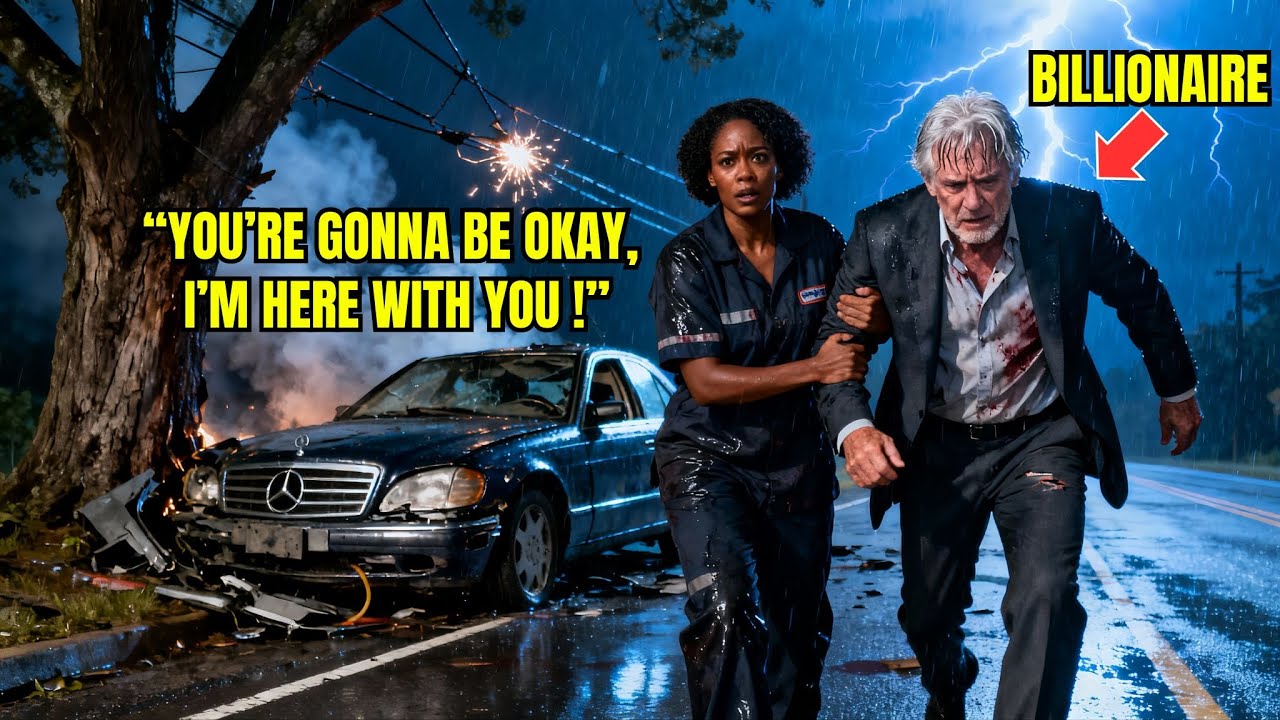
Hơi nước bốc lên từ kim loại xoắn. Thủy tinh lấp lánh như những viên kim cương vỡ trên đường nhựa ướt. Mùi xăng cắt qua cơn mưa tháng Chín. Bên trong chiếc Mercedes nhàu nát, một người đàn ông trong bộ vest trị giá 1.000 đô la treo lơ lửng bất tỉnh. Máu nhỏ giọt xuống trán anh ta. Hơi thở của anh ấy nông. Nguy hiểm. Rò rỉ nhiên liệu lan rộng hơn từng giây.
Tia lửa từ một đường dây điện bị rơi nhảy múa chỉ cách đó 10 ft. Một tia lửa sai lầm và điều này trở thành một đám tang. Hầu hết mọi người sẽ gọi 911 và chờ đợi sự giúp đỡ. Kesha Washington không chờ đợi. Cô ấy đã chạy về phía đống đổ nát, chìa khóa của người gác cổng của cô ấy kêu leng keng theo từng bước. Những gì cô ấy sắp làm sẽ cứu mạng người lạ này.
Nhưng những gì anh ấy nói sau khi cô kéo anh ấy ra, bảy từ đơn giản sẽ khiến anh ấy quỳ gối. Bởi vì người đàn ông bị mắc kẹt trong chiếc xe đang cháy đó không phải là bất kỳ ai. Anh ấy là người có chữ ký 15 năm trước đã phá hủy gia đình cô. và không ai trong số họ biết điều đó. Những gì xảy ra tiếp theo sẽ thay đổi mọi thứ.
Autos & Vehicles
But let’s go back to that morning when Kesha Washington had no idea this would be the day everything changed. The alarm screams at 4:30 a.m. Kesha’s eyes snap open in the cramped Detroit apartment she shares with her 17-year-old daughter. Water stains bloom across the ceiling like brown flowers, telling stories of winter leaks she can’t afford to fix.
Amara sleeps on the couch. The bedroom is barely big enough for one person, so Kesha gave it to her daughter years ago. Education comes first. Dreams need space to grow. Kesha pads to the kitchen, her bare feet silent on the worn lenolium. The college application deadlines circle November 1st and December 15th in angry red ink on her calendar.
Each date represents a dream that costs money she doesn’t have. Her chest tightens. Not panic exactly, more like a familiar weight she’s learned to carry. Three jobs keep them afloat. Night janitor at Morrison Financial Tower downtown. Morning cleaner at Doctor Peterson’s Dental Office. Weekend shifts at the community center.
18 hours a day, 7 days a week. Her hands tell the story. Permanently stained from industrial cleaners, calloused from floor buffers and mop handles. But they’re honest hands, working hands. She hums while she makes coffee. Old gospel songs her grandmother taught her. Keep your spirit light even when your load is heavy.
Family
The melody fills the empty apartment. Amara stirs on the couch. Honor roll student, debate team captain, perfect SAT scores, early acceptance to University of Michigan’s engineering program already in hand. But acceptance letters don’t pay bills. Morning, baby. Kesha whispers. Amara sits up, rubbing sleep from her eyes. Morning, mama.
Even with potential scholarships, there are costs. Application fees for backup schools, campus visits, housing deposits. The number keeps growing. Kesha’s calculated it obsessively. $3,000 minimum. At her current rate, working every available hour, she’s still $1,200 short. “You okay?” Amara asks, noticing her mother’s expression.
Education
“Always am when I see your face.” “It’s not a lie. Amara is everything good in Kha’s world. Brilliant, kind, determined. She deserves every opportunity Kesha never had.” Last week, Amara quietly slid a piece of paper across the breakfast table. community college programs. Maybe I should start here, Mom. Save money for two years, then transfer.
The selflessness in her daughter’s eyes broke Kesha’s heart. Don’t you dare give up on your dreams, she’d said. I’ll figure it out. You just focus on being brilliant. But inside, she’s terrified. How many brilliant kids never get their chance because of money? Every night at Morrison Financial Tower, Kesha cleans the executive floors.
Polished marble, designer furniture, oil paintings worth more than she makes in 5 years. She always pauses at the same portrait on the 40th floor. A distinguished older man with kind eyes. The name plate reads Morrison family legacy. around him. Photos of scholarship recipients, kids who look like Amara, dreams that became reality.
She wonders what kind of person builds schools and funds futures, what it must feel like to change lives with a signature. Despite her exhaustion, Kesha stops to help Mrs. Rodriguez carry groceries up three flights of stairs. Her arthritic hands can’t manage the weight anymore. “Miha, you work too hard,” Mrs. Rodriguez says, “Hard work never killed anyone.
” Kesha replies, “It’s the lack of opportunity that does the damage.” Sunday afternoons, she tutors neighborhood kids for free. Math, reading, whatever they need. When the community cent’s heating broke last winter, she organized a coat drive from her apartment. Even though her own winter jacket has holes in both elbows. Education is the one thing nobody can take away from you, she tells the kids.
It’s what her grandmother told her, what she tells Amara. This morning feels different, heavier. Amara’s college counselor called yesterday. Several schools want interviews. That means travel expenses, professional clothes, hotel rooms. Kesha’s been selling everything she can. Her grandmother’s jewelry, her father’s old tools, the wedding ring from a marriage that didn’t survive poverty’s grinding pressure. It’s not enough.
She watches other parents write checks for SAT prep courses and college tours. No hesitation, no calculation, just signatures on pieces of paper that unlock their children’s futures. At breakfast, Amara looks up from her application essays. Mom, the University of Michigan wants to interview me in person.
Kesha’s heart soarses and sinks simultaneously. This is what they’ve worked for, but plane tickets to Ann Arbor cost money they don’t have. That’s wonderful, baby. We’ll make it work. Amara’s eyes search her mother’s face. She’s 17, not seven. She understands the weight of money. Maybe I could do the interview over video call instead. Absolutely not.
You’re going to walk onto that campus and show them exactly who you are. Kesha doesn’t know how she’ll pay for it, but she’ll find a way. She always does. What Kesha doesn’t know is that 20 m away in a boardroom overlooking the Detroit River, a decision made this morning will put her directly in the path of the one person who can change everything.
But first, she has to survive what’s coming next. At 2:47 p.m., as Kesha finishes her shift at Dr. Peterson’s dental office. The radio in her 2003 Honda Civic crackles with breaking news that will put her exactly where she needs to be. Severe thunderstorm warning for Metro Detroit. Multiple accidents reported. Emergency crews responding to priority calls only.
The September storm hits like a wall. Rain hammers her windshield faster than the wipers can clear it. Most people would head straight home. Wait it out. But Kesha promised Mrs. Carter she’d pick up her blood pressure medication before the pharmacy closes. The elderly woman hasn’t driven since her husband died.
Some promises matter more than comfort. Her GPS chirps with a reroute due to accident on I75, taking alternate route. Route 9 winds through Bloomfield Hills, old money territory. Trees older than the city itself line both sides of the road like cathedral pillars. In good weather, it’s beautiful. In storms like this, it’s dangerous.
Kesha’s never driven through here before. The houses peek through gates and walls. Each one worth more than her entire neighborhood. Different world, different problems. She rounds a curve and slams her brakes. The Mercedes sedan sits crumpled against a massive oak tree like a broken toy. Black paint gleams through the rain.
License plate reads MFC1. The front end is completely destroyed. Steam pours from the hood in ghostly wisps. The smell hits her first. Gasoline, sharp and dangerous. Kesha pulls over, hazards flashing. Her hands shake as she dials 911. 911. What’s your emergency? Car accident on Route 9 just past Maple Road. One vehicle wrapped around a tree.
Autos & Vehicles
Driver appears unconscious. Ma’am, we have units on route, but due to the storm, we’re experiencing delays. Estimated response time 15 to 20 minutes. 20 minutes. The smell of gas is getting stronger. Through the spiderwebed windshield, she sees him. Mid-50s. Silver hair. expensive suit torn and bloody.
His head tilts at an odd angle against the deflated airbag. No movement. Something about his profile seems familiar. Maybe she’s seen him in the building where she works. Rich men in suits all look similar when you’re emptying their trash cans at midnight. 10 feet from the car, a power line lies across the road. Sparks jump and dance every few seconds.
Each one makes her heart race. The fuel puddle spreads wider. Dark liquid mixing with rainwater creeping toward the sparking wire. Kesha calls 911 again. This is urgent. There’s fuel leaking and a downed power line. This car could explode. Ma’am, we understand the urgency. Units are on route.
But 20 minutes might as well be 20 hours. She could wait. Should wait. She’s not a paramedic. What if moving him makes his injuries worse? What if she causes permanent damage? But what if the car catches fire? What if those sparks reach the fuel? A massive spark arcs across the gap. It fizzles out in the rain, but the next one might not.
The driver’s door is completely jammed. The passenger side is pinned against another tree. She walks around the vehicle looking for options. The back window has a golf ball-sized hole from the impact. That’s her only way in. As she gets closer, she notices something on the dashboard. A small framed photo, cracked but visible.
It shows the same man, younger, shaking hands with someone at what looks like a graduation ceremony. Behind them, a banner she can barely make out. Morrison Educational Foundation. Morrison. That name means something. The building where she works. The foundation that gives scholarships to kids like Amara.
Education
Another spark, bigger this time, lasting longer. She runs to her trunk and grabs the tire iron. Her father taught her to change tires when she was 16. “Every woman should know how to take care of herself,” he’d said. “She’s never broken a car window before, but she’s seen it done in movies. Aim for the corner. That’s where the glass is weakest.
First hit. The tire iron bounces off. The window spider cracks but holds. Second hit. The cracks spread wider. Third hit. Glass explodes inward, sparkling like diamonds in the rain. She clears the jagged edges carefully. Cuts her palms anyway. Blood mixes with rainwater. But she doesn’t feel the pain.
Autos & Vehicles
The unconscious man stirs slightly. A soft moan escapes his lips. He’s alive. That’s what matters. As she prepares to crawl through the broken window, Kesha has no idea she’s about to save the life of the man who 15 years ago signed a document that destroyed her family or that he’s about to wake up and recognize her for reasons she couldn’t possibly imagine.
Because some connections run deeper than coincidence. Some meetings are written in the stars long before we understand their meaning. And sometimes the person who needs saving most isn’t the one trapped in the wreckage. Glass cuts her palms as Kesha climbs through the window, but she doesn’t feel the pain.
What she doesn’t realize is that every move she makes in the next 4 minutes will be remembered by this man for the rest of his life. Inside the car, the smell of gasoline is overwhelming. Like breathing liquid fire, the man’s chest rises and falls in shallow breaths. Good sign. His pulse beats strong and steady when she checks his wrist. Better sign.
But there’s blood from a head wound. His left leg is trapped under the twisted dashboard, bent at an unnatural angle. She remembers basic first aid from her community center training. Check airway first. Clear. Check consciousness next. He’s stirring, eyelids fluttering. Sir, can you hear me? His eyes open slowly, confused, unfocused.
Family
What? What happened? Car accident. You’re hurt, but you’re going to be okay. I need to get you out of here. He tries to move and winces. My leg. I can’t feel my leg. We’ll worry about that later. Right now, we need to move. Outside, another massive spark jumps from the power line. This one lands closer to the fuel puddle.
The rain extinguishes it, but barely. The dashboard has him pinned, but there’s just enough space to slide him out if she can lift the metal slightly. She positions the tire iron as a lever, bracing it against the seat frame. The metal won’t budge. Her arms burn with effort. Sweat mixes with rain on her face.
Another spark, bigger, lasting longer. She remembers something her father taught her about leverage when he was still alive, still working construction. Force isn’t about strength, baby girl. It’s about angles. She repositions the tire iron, finds a different fulcrum point against the door frame, pushes with everything she has.
The dashboard lifts just enough. Okay, I’m going to slide my arms under your shoulders. Try to keep your head still. He’s heavier than she expected, but adrenaline makes her stronger than she’s ever been. She maneuvers him toward the broken window, careful to keep his neck aligned. Leave me, he says weakly. Get yourself out.
That’s not happening. My mama didn’t raise me to leave people behind. You don’t understand. If this car explodes, then we both get out, or neither of us does. Now, help me help you. As she supports his weight, his suit jacket falls open. She glimpses a distinctive pen in his breast pocket, gold with an engraved M and what looks like a small compass rose.
Something about it tickles her memory, but she’s too focused on survival to process it. Just as they reach the window, a massive spark arcs across the gap. It lands in the fuel puddle. For a terrifying moment, flames dance on the surface before the rain kills them. Next time they might not be so lucky.
Getting him through the window is the hardest part. She goes first, then reaches back to pull him through. The jagged glass tears his expensive suit. scratches his arms, but he’s out. She drags him 20 ft from the car. Both of them collapse on the wet grass, breathing hard. For 30 seconds, they just lie there, watching the car, waiting for an explosion that doesn’t come. The rain continues.
Emergency sirens wail in the distance, finally getting closer. “You saved my life,” he says, turning to look at her. anyone would have done the same. No. His voice is certain. They wouldn’t have. He studies her face with an intensity that makes her uncomfortable. What’s your name? Kesha Washington. And yours? He pauses for a moment as if the name means something to him.
William Morrison, but my friends call me Bill. The name hits her like a physical blow. Morrison as in Morrison Financial Tower where she empties trash cans and mops floors every night. As in Morrison Educational Foundation, whose scholarships send kids like Amara to college? She’s looking at one of the most powerful men in Detroit.
Education
Morrison, she repeats, like the foundation. Yes, that’s that’s my foundation. Before she can process what this means, paramedics swarm the scene. Two ambulances, a fire truck, police cars. The professionals have arrived. Ma’am, we need to check you both for injuries, a paramedic says. Morrison grabs the paramedic’s arm. Her first.
Check her first. She saved my life. Sir, you were in a major accident. We need to I don’t care what you need to do with me. take care of her first. The paramedic looks between them, confused by the dynamic. A billionaire in a $1,000 suit, demanding that a woman in a cleaning uniform receive priority medical care.
They examine Kesha’s hands, clean and bandage the cuts from the glass. Check her for shock, concussion, any sign of trauma. She’s fine. Scratched, but fine. Morrison insists on staying conscious during his examination, watching as they check her over. His leg is definitely broken, possible concussion, but he’ll live. Mr. Morrison, we need to get you to Detroit General for X-rays and in a minute.
He turns to Kesha. I need to see you again. There’s something. He pauses, his eyes searching her face. There’s something I need to tell you. What do you mean? But before he can answer, the paramedics insist on loading him onto the stretcher. Possible spinal injury. No more delays. As they wheel him toward the ambulance, he grips her hand with surprising strength.
Autos & Vehicles
Kesha Washington, he says as if memorizing the name. I won’t forget what you did today. Take care of yourself, Mr. Morrison. The ambulance doors close. Red lights disappear into the rain. Kesha stands alone beside her Honda Civic, processing what just happened. She saved a man’s life. Not just any man. William Morrison. The William Morrison.
The man whose foundation might hold the key to Amara’s future. But there was something in his eyes when she said her name. Recognition. Guilt. She can’t shake the feeling that he knew her somehow. As she drives away from the accident scene, Kesha has no idea that William Morrison is lying in that ambulance, staring at the ceiling, wrestling with a memory that’s about to change both of their lives forever.
Because her name isn’t just familiar to him. It’s connected to a decision he made 15 years ago. A decision he’s about to remember in vivid, horrible detail. 3 days later, as Kesha scrubs floors on the very building that bears his name, she has no idea that William Morrison has been looking for her since the moment he woke up in the hospital.
She hasn’t told anyone about the rescue. Not Amara, not her neighbors, not even Mrs. Rodriguez, who notices everything that happens in their building. It feels surreal, like something that happened to someone else. She saves a billionaire’s life, then goes back to mopping floors in his building at midnight.
Every night she walks past his portrait on the 40th floor. Now she knows that face intimately. The way his eyes crinkled with pain. The way he looked at her with such gratitude and something else she couldn’t identify. Recognition, maybe? The stress is mounting at home. Amara’s college application deadlines loom like storm clouds.
Early admission forms need submission next week, but they still don’t have money for application fees. Kesha counts and recounts the crumpled bills in her kitchen drawer. $180. Not enough for even two applications. University of Michigan wants 300 just for the application fee. Friday morning arrives with a knock at her door.
A courier in a crisp uniform holds an envelope. Official letterhead, Morrison Financial Group. Kesha Washington. That’s me. Delivery for you, ma’am. Inside a personal check for $25,000. Her hands shake as she reads the amount. Twice, three times. $25,000. A handwritten note accompanies it. Kesha, no amount of money could repay what you did for me.
Please accept this small token of my gratitude. I hope it helps your daughter achieve her dreams. With profound thanks, William Morrison. She stares at the check for 20 minutes. It’s more money than she makes in a year. More than she’s ever seen in one place. This would cover all of Amara’s application fees, campus visits, firstyear expenses, books, housing deposits, everything they’ve worried about for months.
But something feels wrong about accepting it. Her grandmother’s voice echoes in her memory. Do right because it’s right, not because someone’s watching or paying. She helped him because he needed help. Taking money for it would change the meaning of what she did. That afternoon, Amara finds the check on the kitchen table. Mom, where did this come from? Kesha explains about the accident, the rescue.
She leaves out Morrison’s identity. Just says it was someone grateful. “We have to keep this,” Amara says, tears forming in her eyes. “Mom, this is my future. This is everything we’ve worked for.” Kesha sees the hope blazing in her daughter’s face. This check would solve everything. No more 18-hour days.
No more choosing between groceries and application fees, but accepting money for saving a life feels like selling her soul. She makes the hardest decision of her life. The next day, she takes the check to Morrison Financial Tower. She wears her best dress, actually her only dress bought for Amara’s high school graduation ceremony.
The receptionist looks confused. You want to return a check to Mr. Morrison? That’s right, ma’am. I’ll need to verify. Mr. Morrison is in meetings all day. I can leave a message with his assistant. That’s fine. Just make sure he gets this. Kesha leaves the check with a note.
Thank you for your generosity, but I can’t accept this. What I did wasn’t for money. I’m glad you’re okay, K. Washington. As she turns to leave, something in the lobby catches her eye. a new display case with photos from Morrison Educational Foundation scholarship ceremonies. One photo stops her cold. It shows a younger William Morrison shaking hands with a young man at what looks like a graduation ceremony.
Education
The name plate reads James Washington, full scholarship recipient, class of 2010. James Washington, her brother’s name, her brother who died in Afghanistan 3 years later. her brother, whose scholarship was mysteriously revoked after his first semester, forcing him to enlist. She stares at the photo, hands trembling.
That scholarship revocation bankrupted her family. Her parents lost their house trying to pay back the foundation. Her father’s heart attack came 6 months later. Stress and shame killed him. William Morrison, the man she just saved, the man who signed the order that destroyed her family. The painful irony cuts deep. She should hate him.
Part of her does, but she also knows what kind of man he is now. The gratitude in his eyes, the way he insisted paramedics treat her first, the genuine care in his handwritten note. People change, circumstances change. Maybe there’s more to the story. What she doesn’t know is that Morrison has just received her returned check and note, and for the first time in 15 years, he’s about to learn the unintended consequences of a decision he barely remembers making.
Family
The weight of that knowledge is going to change everything. While Kesha struggles with her discovery, William Morrison sits in his private office, holding her note and wrestling with a memory that’s been haunting him since he learned her last name. Washington. That name has been echoing in his mind for 3 days.
He’s had his assistant pull every piece of information they can find on Kesha Washington. Age 38, single mother, three jobs, no credit issues, but significant financial stress, clean background check, spotless work record. But it’s her address that stops him cold. 12047 Riverside Drive, Apartment 3B. He knows that address. 15 years ago, he signed foreclosure papers for that property.
The owner was a maintenance worker named David Washington, who defaulted on his mortgage after falling behind on payments to the Morrison Educational Foundation. Morrison’s hands shake as he asks his assistant to pull the original scholarship files. There it is. James Washington, scholarship recipient, 2010. Funding revoked due to new academic standards implemented mid-semester.
Reason for revocation dropped below required 3.5 GPA after struggling with PTSD from childhood trauma. The memory floods back now. 2010 was a brutal year for the foundation. Economic downturn meant smaller endowments, tighter budgets. They had to cut costs somewhere. The board recommended raising academic standards, retroactive evaluation of existing recipients.
Morrison signed the directive without reviewing individual cases, just signatures on papers, numbers on spreadsheets. He didn’t think about the faces behind those numbers. The files show what happened next. James Washington, devastated by losing his scholarship, enlisted in the army to earn money for college through the GI Bill, killed in action, Afghanistan, 2013.
His father, David, took out loans against his house to pay back the foundation. Trying to honor his son’s obligations even after the boy died. When David couldn’t make the payments, Morrison Financials lending division foreclosed. The cruel irony hits him like a physical blow. His own company, through a subsidiary he rarely interacted with, foreclosed on the family of the scholarship recipient whose funding his foundation had revoked.
David Washington died of a heart attack while trying to negotiate with creditors. The family lost everything. Morrison pulls out the pen Kesha had noticed in the wreckage, his father’s compass pen engraved with the family motto, “True North is found through service to others.” His father started the educational foundation with that principle.
Somehow Morrison had lost sight of it. He has two choices now. pretend he doesn’t know the connection. Let Kesha continue her life unaware that he inadvertently destroyed her family or find a way to make amends that goes far beyond a simple thank you check. Morrison realizes that Kesha didn’t just save his life in that car wreck.
Education
She saved the life of the man who was responsible for her family’s destruction. And she did it without knowing, without hesitation, because that’s who she is. What he decides to do next will either heal 15 years of unintended harm or potentially reopen wounds that Kesha has spent years learning to live with.
But first, he needs to understand exactly what kind of person she really is. Morrison spends the next week doing something he’s never done before, personally investigating one of his employees. What he discovers about Kesha’s character will force him to confront the most difficult decision of his career.
He doesn’t use private investigators or corporate resources. Instead, he goes to her neighborhood himself. Something that shocks his security detail. Sir, that area isn’t exactly I need to understand who she really is. At the corner market where Kesha shops, Morrison learns that she pays for groceries when elderly neighbors can’t afford them. Mrs.
Carter, the pharmacist, tells him Kesha organized prescription pickups for homebound seniors during the pandemic. She’s got three jobs, but still finds time to help others. Mrs. Carter says that’s rare in this world. At the community center, Morrison discovers Kesha tutors kids for free every Sunday. She organized the winter coat drive that helped 200 families.
Family
When the heating system broke, she rallied the neighborhood to find temporary solutions. Miss Kesha saved our program, says Marcus, an 8-year-old working on math homework. She makes sure nobody gets left behind. But it’s the meeting with Amara that changes everything. Morrison arranges it under the pretense of a preliminary scholarship interview.
The Morrison Foundation does conduct early assessments for potential recipients. Nothing unusual about it. What he finds is a brilliant 17-year-old who speaks passionately about engineering solutions for urban poverty. Her science fair project, a water filtration system for low-income communities, shows both technical skill and social consciousness.
My mom works three jobs so I can focus on school, Amara tells him in her high school guidance office. College brochures and application deadlines surround them like promises waiting to be kept. She never complains, never makes me feel guilty about the sacrifices she makes. She says, “Education is the one thing nobody can take away from you.
” The irony cuts Morrison deeper than any physical wound. During the interview, Amara mentions her uncle James. Her voice grows quiet, respectful. He lost his scholarship years ago. It broke my grandpa’s heart. He died trying to pay back money my uncle never even got to use for graduation. She shows Morrison her uncle’s photo.
Autos & Vehicles
Young man in military dress blues, proud smile, dreams cut short. But mom always says we can’t live in the past. We can only control how we respond to what happens to us. Morrison excuses himself early, overwhelmed by the realization that this brilliant young woman, this family, has been living with the consequences of his decision for 15 years.
James died because of the path Morrison’s policy change set in motion. David died from the stress. The family lost everything. And yet, Kesha saved his life without hesitation. That evening, Morrison convenes an emergency board meeting. His seven board members gather in the 42nd floor conference room, confused by the urgency.
I need to tell you about something that happened this week. Morrison begins. He tells them about the accident, the rescue, the connection he’s discovered, the weight of unintended consequences that have haunted one family for 15 years. She saved my life, he concludes. She saved the life of the man who destroyed her family, and she did it without hesitation.
That tells me everything I need to know about her character and everything I need to know about mine. The room falls silent. Board member Thomas Wright, the CFO, voices what they’re all thinking. Bill, if we acknowledge wrongdoing, we could face lawsuits from dozens of other families affected by that policy change. Legal liability could be enormous, add Sarah Martinez, the general counsel.
Morrison expected this resistance. What’s the liability of doing nothing? What’s the cost of continuing to be an institution that harms people without taking responsibility? Margaret Carter, Morrison’s longest serving board member, speaks quietly. She’s the one person who remembers his father’s original vision.
Your father would have done the same thing, Bill. True North is found through service to others. We lost our way 15 years ago. This is how we find it again. Morrison outlines his proposal. Full scholarship for Amara covering four years plus graduate school, a memorial scholarship in James Washington’s name, financial restitution to address the family’s losses, and a personal apology that acknowledges the foundation’s role in their suffering.
But it goes beyond one family, Morrison continues. We’re going to review every scholarship revocation from that period, reach out to other affected families, implement new policies to prevent this from happening again. One by one, each board member weighs in, some reluctantly, others with genuine enthusiasm.
Margaret Carter makes it unanimous. Motion carries. We proceed with full transparency and humility. As the meeting ends, Morrison understands this isn’t just about making amends to one family. It’s about fundamentally changing how his foundation operates. They’re going to become an institution that heals rather than harms.
Family
But there’s still the question of approach. How do you tell someone that you know their family’s deepest tragedy, that you were responsible for it, that you want to make it right? Morrison decides on the community center. neutral ground, surrounded by the work Kesha does to help others. He’ll tell her everything and let her choose how to respond.
What Morrison doesn’t anticipate is how Kesha will react when she learns that he knows, that he’s known for a week, that he’s been investigating her life, learning about her family’s tragedy, making decisions about her future without her input. Because some revelations require more than good intentions.
They require courage to face the consequences of truth. When Morrison walks into that community center tutoring session, he has a speech prepared. What he doesn’t expect is for Kesha to look up from helping that young boy and immediately know exactly why he’s there. Mr. Morrison, she says calmly, not missing a beat as she finishes explaining fractions to 8-year-old Marcus.
I wondered when you’d show up. The room has 12 kids, ages 6 to 17, all looking between the two adults with curiosity. Kesha gently tells them to work on their assignments independently for a few minutes. Sometimes grown-ups need to have important conversations, she explains. Morrison steps closer, his prepared speech suddenly feeling inadequate. You knew I was coming.
I’ve been expecting you ever since I saw James’s picture in your lobby. You didn’t hire a private investigator very quietly, Mr. Morrison. Mrs. Carter at the market told me a nice man in an expensive suit was asking questions about me. The weight of preparation hits him. Kesha has had time to process everything, the connection, the implications, his investigation of her life.
She’s known for days that he knows about James, about her family’s loss, about the foundation’s role in their tragedy. I need to know something first, she says, her voice steady but her eyes intense. When you wrote me that thank you note, did you already know who I was? Morrison meets her gaze directly. No, I didn’t make the connection until after you returned the check.
When I saw your name and address, that’s when I remembered the files. And when you figured it out, your first instinct was to investigate my life rather than simply call and explain. He acknowledges the mistake. I wanted to understand who you really were before I approached you. I was afraid you’d think any offer I made was motivated by guilt rather than genuine gratitude and respect.
Kesha’s response cuts through his corporate reasoning like a blade. Guilt would be the right motivation, Mr. Morrison. What happened to my family wasn’t an accident. It was a policy decision that real people made about real families without thinking about the human cost. The children watch in fascination as this conversation unfolds.
They sense something important happening, even if they don’t understand the details. Morrison sets down a leather portfolio. Then, to the shock of both Kesha and the children watching, he drops to his knees in the middle of the tutoring room. Kesha Washington, I am profoundly sorry for the pain my decisions caused your family. James deserved better.
Your father deserved better. You deserved better. The sight of this powerful man kneeling in front of her in a room full of inner city kids hits her harder than any words could. This is the moment the title promised. The moment that drops him to his knees. Young Marcus whispers loudly enough for everyone to hear.
Miss Kesha, why is that man saying sorry to you? The innocence of the question underscores the gravity of the moment. Kesha helps Morrison to his feet. Apologies are important, but they’re just the beginning. What matters is what comes next. Morrison opens the portfolio. Inside are detailed documents outlining the board’s unanimous decision.
Full scholarship for Amara, he begins. All expenses covered for her engineering degree plus graduate school if desired. Kesha reads carefully, asking questions. The children continue working on math problems, occasionally glancing over. The James Washington Memorial Scholarship, an annual full ride scholarship in your brother’s name, prioritizing students who’ve faced trauma or family hardship.
Family
Her fingers trace her brother’s name on the official letter head. Financial restitution. $300,000 to address your family’s losses from the foreclosure and years of financial hardship. The number is staggering. More money than she’s made in her entire working life. A position as community outreach director for the Morrison Educational Foundation.
You’d help design policies that prevent institutional harm. Housing assistance. A fully paid mortgage on a home in the school district of your choice. Kesha processes each document methodically. This offer would transform not just her life, but Amara’s entire future. “What about the other families?” she asks suddenly. “How many other scholarship recipients lost their funding that year?” 47 students were affected by the policy change.
“We’re tracking down every one of them and their families. We’re prepared to offer similar packages to address any hardship our decisions caused.” This surprises her. This isn’t just about her family. It’s about systemic change. I’ll consider your offer, but only if you make one change. I don’t want a job title.
I want a seat on your foundation’s board. If you’re serious about preventing this from happening again, you need people like me making decisions, not just implementing them. Morrison realizes that Kesha isn’t just accepting his offer. She’s negotiating from a position of moral authority. She understands that her voice needs to be part of the decision-making process.
Deal, Morrison says, extending his hand. But I have one condition of my own. You keep running this tutoring program. We’ll fund it, expand it, but you keep running it. These kids need you. As they shake hands, young Marcus looks up from his worksheet. Miss Kesha, does this mean you don’t have to work so much anymore? The question captures the human scale of what’s just happened.
Education
Kesha turns to the room of students. How would you all like to meet some college students next week? Mr. Morrison’s foundation is going to help us bring some engineering students here to show you what’s possible. The children cheer. Dreams suddenly feel achievable. What neither Morrison nor Kesha anticipates is how quickly news of this unprecedented corporate accountability action will spread.
How it will inspire other institutions to examine their own policies and practices. This handshake is about to become a model for restorative justice that reaches far beyond one family story. 6 months later, as Kesha reviews scholarship applications in her new office on the 40th floor of Morrison Financial Tower, she sometimes pauses at the window and marvels at how farreaching the consequences of that rainy afternoon have become.
Her hands look different now, clean, soft, no longer stained from industrial cleaners. She wears professional clothes and sits in boardroom meetings where her voice carries equal weight with corporate executives. Before, three jobs, 18-hour days, counting pennies for application fees. After, board member and community outreach director, influencing policy for a $200 million educational foundation.
Amara thrives at University of Michigan. Freshman year, 4.0 GPA. She’s already involved in research on sustainable urban infrastructure. Her professor calls her exceptional and driven by purpose. But what matters most to Kesha is that Amara volunteers every weekend at the same community center where her mother still runs expanded tutoring programs.
Education gave me opportunity. Amara tells the kids. Now I want to create opportunities for others. The James Washington Memorial Scholarship funded 24 recipients in its first year. Each student selected not just for academic merit but for resilience in overcoming trauma. Maria Santos whose parents were deported when she was 16.
Kevin Brooks who aged out of foster care but maintained straight A’s. Students who represent the second chances James never got. The story broke when a local news reporter noticed unusual language in Morrison Foundation’s annual report. a full page acknowledging institutional harm and outlining reparations paid to 47 families.
The honesty was unprecedented. It became a national story. Foundation takes responsibility for past harm ran in the Detroit Free Press. Then the Washington Post, CNN, the story spread because corporate accountability at this level simply doesn’t happen. Other foundations and corporations began reviewing their own policies.
Harvard University established a commission to examine scholarship revocations from the past two decades. Goldman Sachs announced a similar review of their programs. The Morrison Foundation now requires that any policy change affecting existing recipients must include individual case reviews, family impact assessments, appeals processes, and transition support.
Family
Never again will signatures on papers destroy lives without consideration of human cost. The community center expanded from one room to five buildings across Detroit. 300 volunteer tutors now serve 1,200 students annually. Morrison Foundation provides funding but Kesha insists on maintaining the grassroots approach.
Real change comes from the community up, not the corporation down, she tells board meetings. Unexpected ripple effects emerged. Other car accident survivors reached out, sharing stories of trauma and unexpected human kindness. Kesha started a monthly support group at the community center. Morrison attends every meeting, still processing his experience of being saved by someone he’d unknowingly harmed.
David Washington’s grave now has a proper headstone. The inscription reads, “Devoted father and grandfather. His legacy lives on through education.” Kesha visits monthly with fresh flowers and updates about Amara’s progress. The neighborhood transformed around the community center’s success. A health clinic opened, a small business incubator, a community garden where families grow fresh vegetables.
Kesha’s old apartment building was renovated into affordable housing with educational support services on site. Morrison sold his suburban mansion and bought a modest home six blocks from the community center. He walks to work most days, stopping to chat with neighbors, learning names and stories he never bothered to learn in 20 years of corporate leadership.
Autos & Vehicles
Kesha recruited three other community advocates to join the Morrison Foundation board. Former scholarship recipients, parents of students, community organizers. Board meetings now include perspectives that were never represented in corporate decision-making. Every September on the anniversary of the accident, Morrison and Kesha return to the crash site.
They’ve planted a memorial garden there, not for trauma, but for second chances. It’s become a place where other accident survivors and their families come to process their experiences. Amara’s high school created the Kesha Washington Community Service Award for students who demonstrate exceptional dedication to helping others.
Marcus, the boy who asked why Morrison was apologizing, is now in 8th grade and serves as a peer tutor for younger kids. He tells new students that the community center is where rich people come to learn from smart people. his own understanding of transformed power dynamics. But the most profound change can’t be measured in dollars or programs or policy reforms.
It’s the shift in how both Morrison and Kesha understand forgiveness, accountability, and the complex ways that individual actions can either harm or heal entire communities. Some rescues save one life. This one saved hundreds. One year after that rainy September afternoon, as Kesha watches Amara walk across the stage at her high school graduation, she reflects on a question that still surprises her.
What would have happened if she hadn’t stopped that day? Amara’s validictorian speech echoes across the packed auditorium. She speaks about engineering justice, designing systems that serve people rather than institutions. My mother taught me that the most important engineering happens in our communities, not our laboratories.
Education
She showed me that sometimes the bravest thing you can do is stop your car in the rain and help a stranger, even when you have every reason not to. William Morrison sits three rows back, applauding with genuine pride for a young woman he now considers family. He’s kept his promise to attend every milestone in Amara’s education, but always with humility about his role in making this possible.
After the ceremony, three families approach Kesha. Their children are starting college in the fall with James Washington memorial scholarships. They want to thank her, but also to ask advice about honoring the responsibility that comes with second chances. Remember where you came from, she tells them.
Use your education to lift others up. That’s how we change the world. The community cent’s tutoring program now serves as a model for educational nonprofits in 12 cities. Kesha travels monthly to consult on programs, always insisting that real community development must be led by community members themselves. That evening, Kesha and Morrison meet at the memorial garden for their annual reflection.
The oak tree that nearly killed him now anchors a space where families come to process trauma and celebrate resilience. I’ve been thinking, Morrison says, about what my father would say about all this. He built the foundation to help people find their paths. I somehow turned it into a barrier instead of a bridge. Institutions are just people making decisions, Kesha replies.
When the people change, the decisions change. Your father would be proud that you found your way back to his values. Amara joins them at the garden, fresh from her graduation celebration. She’s been accepted to University of Michigan with full scholarship, but she’s also committed to spending her summer expanding the tutoring program.
Family
The next generation continues the cycle of service, but with new voices guiding it. As they stand together in the garden, it starts to rain lightly. The same kind of September shower that brought them together. But this time, instead of crisis and danger, the rain nourishes the memorial garden they’ve built together.
Kesha looks at Morrison and asks the question that brings everything full circle. If it happened again tomorrow, if you saw someone in danger, what would you do? Stop the car, he answers without hesitation. Every time the story ends not with dramatic conclusions, but with quiet certainty that both of them understand their obligation to help others, regardless of who those people are or what history they might share.
Because some rescues save one life, others save the rescuer’s soul. Kesha’s choice to stop her car in that storm reminds us that we all pass moments every day when we can choose to help or to keep driving. We can choose to see people as individuals worthy of dignity or as problems to be managed. One act of kindness, 4 minutes of courage in a rainstorm transformed not just two lives but dozens of families, entire communities, and even corporate policies that affect thousands of people.
What car crash moments are you driving past? What opportunities to help are you missing because you’re too busy, too afraid, or too convinced that someone else will handle it? The world needs more people like Kesha. People who stop the car, who do what’s right without calculating the cost, who believe that every person deserves help in their moment of crisis.
If this story moved you, share it with someone who needs to be reminded that small acts of courage can change everything. Like this video if you believe kindness still matters. Subscribe if you want to see more stories about ordinary people doing extraordinary things. Because somewhere tonight, someone needs you to be the person who stops the car. Will you?
Autos & Vehicles