

Cop Handcuffs Black Woman in Court — Until the General Pulled Out His Pentagon Badge
Security Products & Services
00:00
00:00
01:31
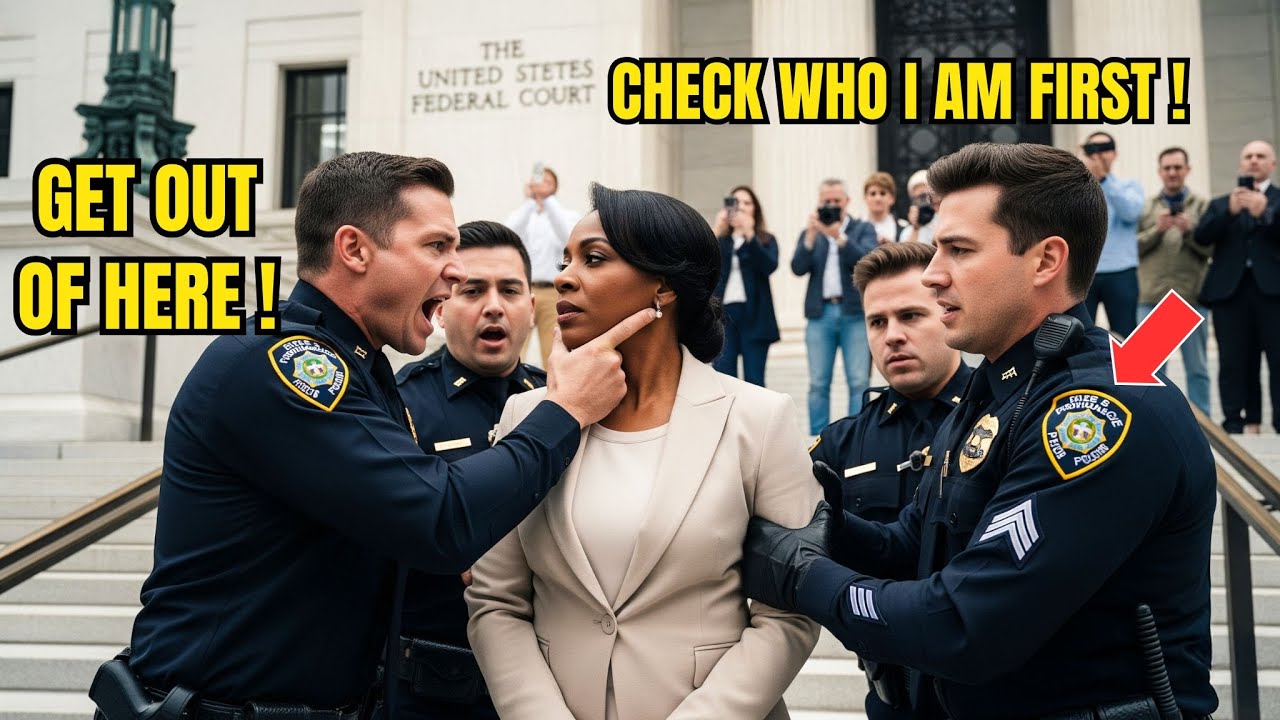
You people always use kids for your dirty work. Officer Martinez’s words cut through the morning air outside Montgomery County Courthouse. But what had just happened to provoke such venom? Seconds earlier, a six-year-old black boy had stepped into traffic. Angela Washington launched herself forward, snatching him from the truck’s deadly path.
Government
Blood trickled from his knee as she cradled him protectively. Martinez had watched the entire rescue. Now he stepped over the sobbing child pointing at Angela. Turn around. Hands behind your back. Cold metal handcuffs clicked shut on the courthouse steps. The woman who had just saved a life was now in chains. Her militaryra first aid kit lay scattered equipment no ordinary citizen carries.
She touched the small pin on her blazer with her cuffed hands. Phones emerged from the gathering crowd, recording every second. Have you ever saved a life and been arrested for it? What you’re about to discover will shock you. 3 weeks later, Officer Martinez sat confidently in the witness chair, his uniform pressed to perfection. The courtroom was packed.
Angela Washington sat at the defendant’s table in handcuffs, the same ones that had clicked shut on those courthouse steps. Officer Martinez, the prosecutor began, please tell the court what happened on the morning of September 15th. Martinez cleared his throat, his voice steady and authoritative.
Your honor, I was conducting routine patrol around the courthouse when I witnessed what appeared to be a staged accident involving a minor child and the defendant, Angela Washington. He gestured toward Angela with practiced disdain. The defendant positioned herself strategically near the courthouse entrance. When the child who I believe was working with her stepped into traffic, she executed what looked like a rehearsed rescue operation.
Security Products & Services
Discover more
Military
Law Enforcement
Gadgets & Portable Electronics
The prosecutor nodded encouragingly. What made you suspicious, officer? Several red flags, sir. First, her response was unnaturally professional. Most civilians panic in emergencies. She didn’t. She moved with military precision like someone trained for exactly this scenario. Martinez’s eyes narrowed. Second, she had equipment.
Not a simple first aid kit you’d buy at the pharmacy, militaryra supplies, trauma bandages, surgical instruments, emergency medications. Why would an ordinary citizen carry such specialized equipment unless they were planning something? A murmur rippled through the courtroom. Several jurors leaned forward. Third, Martinez continued.
She was surveilling the area. Security footage shows her standing on those courthouse steps for nearly 10 minutes before the incident, watching, waiting. That’s not normal behavior for someone just arriving at court. The prosecutor held up a photograph. Is this the equipment you’re referring to? Yes, sir. That’s her kit.
I’ve seen similar setups used by organized trafficking rings. They stage rescue scenarios to gain trust with families, then exploit that relationship to access children. Martinez’s voice grew harder. These people have turned child endangerment into a profitable business model. Angela’s public defender, a young woman who looked overwhelmed, scribbled notes frantically.
She seemed unprepared for the complexity of Martinez’s accusations. Officer Martinez, the prosecutor continued, you mentioned these people. Can you elaborate? Martinez shifted in his chair, his expression becoming more calculated. In my 15 years of law enforcement, I’ve seen this pattern repeatedly in certain communities.
Individuals who exploit racial sympathy to manipulate situations. They know that if they’re arrested while appearing to help a child, it will generate outrage and media attention. It’s a sophisticated form of manipulation. Several white spectators in the gallery nodded along. An elderly woman whispered loudly enough for others to hear.
I’ve read about these trafficking rings in the news. When I approached the defendant, Martinez testified, “Her behavior confirmed my suspicions. She was too calm, too collected. Real heroes shake with adrenaline after saving a life. She didn’t. Instead, she started giving me orders about proper medical procedure, as if she was trying to establish authority and control the narrative.
He paused for effect, scanning the jury. “That’s when I knew I was dealing with a professional criminal, not a good Samaritan.” “What happened when you attempted to question her?” the prosecutor asked. She became evasive. When I asked for identification, she claimed to work for the government, but refused to specify which agency or provide credentials.
classic deflection tactic used by con artists who create fake personas to seem more credible. Martinez leaned forward, his voice taking on an urgent tone. Your honor, I want to be clear about something. I didn’t arrest Angela Washington because she was black. I arrested her because her behavior matched textbook patterns of organized child exploitation that I’ve been trained to recognize.
The fact that she happened to be black is irrelevant criminals come in all colors. This statement drew approving nods from several jurors. The prosecutor smiled slightly. Officer, you mentioned in your report that the defendant resisted arrest. Can you describe that for the court? Absolutely. When I attempted to place her in custody for questioning, she initially refused to comply.
She kept insisting she had done nothing wrong and demanding to know the charges. This is classic guilty behavior. Innocent people cooperate with law enforcement. They don’t argue and make demands. Martinez’s voice grew more passionate. I had to physically restrain her because she was creating a scene, getting the crowd agitated.
These trafficking networks rely on public sympathy, so they train their operatives to appear victimized when caught. The defendant knew exactly what she was doing. The courtroom was silent, hanging on his every word. I want to emphasize something crucial. Martinez continued. The safety of that child was my primary concern.
Once I realized what was happening, I had to act fast. These traffickers work in teams. For all I knew, her accompllices were nearby, ready to abduct the boy once she had gained the family’s trust. He looked directly at Angela, who sat motionless, her expression unreadable. The defendant’s sophisticated equipment, her unnatural calmness, her evasive answers, her resistance to questioning.
All of these factors pointed to one conclusion. I had interrupted a trafficking operation in progress. The prosecutor nodded gravely. Officer Martinez, in your professional opinion, what would have happened if you hadn’t intervened? That little boy would have disappeared within hours? Martinez replied without hesitation.
the defendant would have approached the grateful parents, gained their trust, perhaps offered to provide follow-up medical care or counseling. That’s how these networks operate. They exploit parental fear and gratitude to gain access to vulnerable children. Several jurors looked horrified. One woman covered her mouth with her hand.
“Your honor,” Martinez concluded. “I’ve been protecting this community for 15 years. I’ve received commendations for my work with at risk youth and my efforts to combat human trafficking. When I see a threat to children, I act. That’s what I did that morning, and I’d do it again without hesitation. The prosecutor smiled with satisfaction.
Thank you, Officer Martinez. Nothing further. As Martinez stepped down from the witness stand, he walked past Angela’s table with barely concealed contempt. The chains on her handcuffs clinkedked softly as she adjusted her position. Angela’s public defender stood up hesitantly. “Your honor, we’d like to call our first witness.
Security Products & Services
” But the damage was done. Martinez had painted a convincing picture of a sophisticated criminal operation disguised as heroism. His 15 years of experience, his knowledge of trafficking patterns, his detailed observations, it all seemed to add up to one inescapable conclusion. Angela Washington wasn’t a hero.
She was a predator who had finally been caught. The only question now was whether the truth would ever come to light. Angela Washington rose from her chair with quiet dignity. The handcuffs had been removed for her testimony, but the red marks on her wrists remained visible. She walked to the witness stand with measured steps, her posture straight despite everything she had endured.
“Miss Washington,” her public defender began nervously. “Before we discuss the events of September 15th, how is the child doing?” Angela’s expression softened immediately. “Thank you for asking. Timothy Johnson is recovering well. His parents told me yesterday that his scraped knee has healed completely and he’s sleeping through the night again without nightmares about the truck.
Several jurors exchanged surprised looks. This wasn’t the cold, calculating criminal Martinez had described. “You’ve been in contact with the family?” the defense attorney asked. “His mother, Sarah Johnson, has been very kind. She brings Timothy to visit me in detention. He draws me pictures of superheroes.
Angela’s voice remained steady, but there was genuine warmth when she spoke about the boy. The first thing he said to me was, “Thank you for saving my life. Children see things simply. Adults sometimes complicate the truth.” Her words carried weight. In the gallery, heads turned toward Martinez, who shifted uncomfortably in his seat.
Miss Washington, please tell the court what happened that morning in your own words. Angela folded her hands calmly. I had just arrived at the courthouse for an unrelated civil matter when I heard tires screeching. I looked up and saw a small child directly in the path of an oncoming delivery truck.
There was no time to think, only to act. What did you do? I moved to intercept. In situations like that, every second matters. The truck was approximately 15 ft away when I reached Timothy. I swept him laterally out of the vehicle’s path and immediately assessed him for injuries. The prosecutor interrupted. Objection, your honor.
The defendant is using unusually technical language for a civilian. Sustained. Miss Washington, please use everyday terms. Angela nodded respectfully. Of course. I grabbed the little boy and pulled him to safety, then checked to make sure he wasn’t badly hurt. Her defense attorney continued, “You had medical supplies with you.
Can you explain why? I work for the government in crisis response situations. My job requires me to be prepared for medical emergencies at all times.” Angela’s answer was precise, but deliberately vague. The supplies I carry are standard issue for my line of work. What type of government work do you do? Angela paused, her eyes briefly scanning the courtroom.
In the back, a man in a military dress uniform sat perfectly still, watching intently. Their eyes met for just a moment, a connection so subtle most people missed it entirely. I work in emergency response and crisis management, she said carefully. My specialty involves high stress situations where lives are at risk. The prosecutor leaned forward.
This vagueness was exactly what Martinez had described. Evasion and misdirection. Miss Washington, her attorney pressed. Officer Martinez claims your response was unnaturally professional. How do you respond to that? Angela’s expression didn’t change, but something flickered in her eyes. I suppose that depends on what you consider natural.
In my experience, when a child’s life is in danger, you don’t hesitate. You don’t panic. You act with whatever training you have. Training? What kind of training? I have extensive experience with emergency medical protocols, crisis deescalation, and high pressure decision-making. Angela touched the small military pin on her lapel, the same gesture she’d made while handcuffed.
Security Products & Services
My work has taken me to challenging environments where these skills are essential. The man in military uniform in the back row shifted slightly, his jaw tightening. Miss Washington, Officer Martinez testified that you were surveilling the courthouse area. Is that accurate? I was waiting for my taxi to arrive.
I had finished my business inside and called for transportation home. While I waited, I observed the typical activity you’d expect around a government building. People coming and going, traffic patterns, general situational awareness. Angela’s tone remained calm, but her word choices were precise, almost tactical. In my line of work, you develop habits of environmental awareness.
It’s not surveillance, it’s survival. Her defense attorney looked puzzled by the military-style language, but pressed on. When Officer Martinez approached you, what was your impression? I was surprised by his hostility. I had just prevented a serious injury to a child, possibly saved a life. I expected questions about the incident, maybe a request for a statement.
Instead, Officer Martinez seemed more interested in making accusations than understanding what had actually occurred. How did you respond to his questions? Angela’s expression grew thoughtful. I answered truthfully, but found his assumptions troubling. He seemed to have already decided I was guilty of something before asking what had happened.
When someone approaches you with that mindset, cooperation becomes complicated. Complicated how? When I told him I worked for the government, he demanded specific details I’m not authorized to share publicly. When I explained my medical training, he characterized it as suspicious. When I remained calm under his questioning, which is how I’ve been trained to respond in high stress situations, he interpreted that as evidence of guilt.
The courtroom was quiet, listening intently. Miss Washington, when Officer Martinez placed you under arrest, how did you respond? Angela’s voice remained steady. But for the first time, a hint of steel entered her tone. I was shocked. I had just saved a child’s life and was being treated like a criminal.
I asked what charges I was being arrested for. I requested to see his supervisor. I asked why helping a child was being treated as a crime. Did you resist arrest? I asked questions in my training. Asking for clarification and understanding legal procedures is considered appropriate behavior. If Officer Martinez interpreted my questions as resistance, that says more about his expectations than my actions.
Her attorney glanced at his notes. You mentioned your training several times. Without going into classified details, can you tell us more about your background? Angela was quiet for a long moment, as if weighing her words carefully. I’ve spent my career in service to this country. My work has taken me to places where children are often caught in dangerous situations, conflict zones, disaster areas, humanitarian crises.
Protecting vulnerable people, especially children, isn’t just my job. It’s who I am. She looked directly at the jury. The idea that I would ever harm a child or use a child for any criminal purpose is not just false. It’s the complete opposite of everything I’ve dedicated my life to achieving.
The man in military uniform in the back row nodded almost imperceptibly. Miss Washington, is there anything else you’d like the court to know? Angela adjusted her pin one more time, a gesture that seemed automatic. Only this. Timothy Johnson is alive and healthy today because when I saw danger, I acted.
If protecting a child makes me a criminal in Officer Martinez’s eyes, then perhaps the problem isn’t with my actions. As she returned to her seat, the courtroom buzzed with quiet conversation. Her testimony had been calm, professional, and strangely compelling, but questions remained. Who was Angela Washington really? And why did her every word and gesture suggest there was much more to her story than anyone imagined? That evening, Angela sat in her small apartment, the weight of the day’s testimony heavy on her shoulders. The walls were covered
with photographs that told a story few would ever see. Images of children from around the world. Afghan girls learning to read in a bombed out school. Iraqi boys playing soccer in a refugee camp. Syrian families crossing to safety. In every photo, Angela stood among them. Sometimes in military fatings, sometimes in civilian clothes, always with the same protective presence.
Her phone buzzed. The caller ID showed only classified. Angela, I watched the live stream of today’s testimony. The voice belonged to General Patricia Hayes, her mentor and former commanding officer. You’re walking a dangerous line. Revealing your identity will compromise three active operations and potentially endanger assets in the field.
Angela picked up a framed photo from her desk herself as a 10-year-old girl, standing outside a run-down apartment building in Detroit. She was wearing a torn dress, holding the hand of her younger brother, who had died from preventable illness because they couldn’t afford healthcare. Some battles are more important than cover stories, General Angela said quietly.
I know what it feels like to be that child, poor black, dismissed by people who should protect you. Timothy Johnson deserves better than what I got. Angela, think about this. You’ve spent 15 years building the perfect cover identity. Your work with International Child Rescue Operations depends on nobody knowing who you really are. If you blow that now, then maybe it’s time for a different kind of mission.
Angela opened a classified briefcase on her kitchen table. Inside were documents that could change everything. Military commendations, rescue operation reports, testimonials from families whose children she had saved across four continents. She pulled out a particular file marked with the highest security clearance.
Inside were photos of her leading a joint task force that had rescued over 50 children from trafficking rings in Southeast Asia. Another showed her carrying a wounded Afghan girl to safety during a Taliban attack on a school. General, do you remember Operation Guardian Angel? There was a pause. Of course, your finest work.
But Angela, 18 children, the youngest was four years old. I carried each one of them out of that compound personally. Angela’s voice carried the weight of those memories. When I saw Timothy Johnson in that street, when I saw that truck bearing down on him, I didn’t see a stranger’s child. I saw every child I’ve ever saved, every child I’ve ever failed to save in time.
She looked at another photo a group shot from her promotion ceremony at the Pentagon. The same military pin she wore everyday was clearly visible on her dress uniform, surrounded by generals and senior officials. The media is already picking up the story, General Hayes warned. They’re calling it racial profiling, excessive use of force.
Government
If you reveal who you are, it becomes an international incident. A decorated general arrested for saving a child. That’s front page news worldwide. Angela’s phone chimed with a text message. She read it and smiled for the first time all day. It was from Sarah Johnson, Timothy’s mother. Timothy drew you another picture today. He says you’re his guardian angel.
The court hearing is tomorrow at 9:00 a.m. We’ll be there to tell everyone the truth. General, I’ve spent my entire career in the shadows, protecting children that the world never knew needed protecting. Maybe it’s time the world saw what real child protection looks like. And if you compromise ongoing operations, if children die because our networks are exposed.
Angela was quiet for a long moment. She pulled out one more document, her original enlistment papers from 25 years ago. At the bottom, she had written her reason for joining, to protect those who cannot protect themselves. Then I’ll live with that consequence. But I won’t live with Timothy Johnson thinking that saving children is a crime or that people like Officer Martinez get to define heroism.
She closed the briefcase and locked it. Tomorrow she will bring these documents to court. Tomorrow the world will learn who Angela Washington really was. Her phone chimed again. This time it was from the man who had been sitting in the back of the courtroom. General Robert Thompson, her current commanding officer. The message was simple.
The choice is yours, Angela. But if you do this, you have my full support. Some missions are bigger than secrecy. – RT Angela stood and walked to her bathroom mirror. The woman staring back had spent decades protecting children in the world’s most dangerous places. She had been shot at, bombed, threatened, and betrayed.
But she had never backed down from a fight that mattered. Tomorrow, Officer Martinez would learn what happens when you mistake a guardian angel for a criminal. Angela touched her military pin one last time, then turned off the lights. Tomorrow would change everything, but some battles she had learned long ago were worth any price.
The next morning brought a packed courtroom and a surprise that would shatter Martinez’s carefully constructed narrative. Angela had hired new counsel overnight, a sharp-eyed attorney named David Carter, who walked into court carrying a stack of evidence that would change everything. “Your honor,” Carter announced.
The defense calls Sarah Johnson to the stand. A young black woman rose from the gallery, her hand firmly holding that of 6-year-old Timothy. The boy looked healthy and brighteyed, a stark contrast to the bleeding child from the courthouse steps three weeks earlier. “Mrs. Johnson, Carter began, please tell the court what you witnessed on September 15th.
Sarah Johnson’s voice was clear and strong. I saw that woman saved my baby’s life. She pointed directly at Angela. Timothy had gotten away from me for just a second. Before I could reach him, he ran into the street. That truck was coming fast, and I thought her voice broke slightly. I thought I was going to watch my son die.
What happened next? She moved like lightning. I’ve never seen anyone move that fast. She grabbed Timothy and rolled with him behind a parked car, then immediately started checking him for injuries. Her hands were so gentle, but she knew exactly what she was doing. She probably saved his life twice. Once from the truck and once by making sure he didn’t have internal bleeding.
Timothy tugged on his mother’s dress. She leaned down and he whispered something in her ear. Timothy wants to say something to the court,” Sarah said. “Is that okay?” The judge nodded kindly. “Of course.” Timothy stepped forward, his small voice carrying clearly through the courtroom. The nice lady saved me. She told me I was brave and that everything would be okay.
She stayed with me until the ambulance came. She’s a hero. A murmur of emotions swept through the gallery. Several jurors were visibly moved, but Carter was just getting started. Your honor, I’d like to present evidence that directly contradicts Officer Martinez’s testimony. We have security footage from three different angles.
The courtroom’s large screen came to life, showing the street scene from a camera mounted on a nearby building. The timestamp showed the events unfolding in real time. This footage clearly shows Ms. Washington. Arriving by taxi at exactly 9:47 a.m. She paid the driver, walked up the courthouse steps, and stood waiting. She made two phone calls, both to the taxi company, requesting pickup for her return trip.
The video showed Angela checking her phone, looking around casually, exactly like someone waiting for transportation. Officer Martinez testified that she was surveilling the area. The evidence shows she was simply waiting for her ride as any normal person would do. Chen advanced the video. At 9:52 a.m., Timothy Johnson appears on the sidewalk.
Watch carefully. You can see Miss Washington doesn’t even notice him at first. She’s looking at her phone. The footage showed the moment everything changed. Timothy suddenly darted into the street. The delivery truck appeared, brakes screeching. Angela’s reaction was instantaneous and heroic. Note the speed and precision of her response, Carter continued.
This isn’t someone who planned a staged rescue. This is someone with exceptional training reacting to save a life. But then Carter played audio that would destroy Martinez’s credibility forever. Your honor, this next recording comes from Officer Martinez’s own radio transmission immediately after the incident.
We obtained it through a Freedom of Information Act request. Martinez’s voice crackled through the courtroom speakers, unaware he was being recorded. Yeah, I got another situation here. Black woman causing trouble playing the victim card with some kid. These people always think they can manipulate the system. The courtroom erupted.
Martinez went pale, his confident demeanor crumbling. Chen wasn’t finished. There’s more, your honor. This is Officer Martinez speaking to his partner, Officer Williams. Approximately 2 minutes later, the audio continued. Martinez to Williams. I’m about to arrest this black woman for child endangerment or some She’s got the whole crowd feeling sorry for her. You know how these women operate.
They use kids to run scams on white people. Several jurors looked disgusted. The judge’s expression grew stern. And finally, Carter said, “This recording captures the moment Officer Martinez placed Ms. Washington under arrest. The audio was crystal clear.” Angela’s voice calm and reasonable.
Officer, can you please tell me what law I’ve broken? I just saved a child’s life. Martinez’s response was harsh. Turn around and put your hands behind your back. You people always have an excuse for everything. Angela, still composed. I’m happy to cooperate, but I’d like to understand the charges. Martinez, increasingly aggressive.
The charge is being a smartmouth black woman who thinks she’s better than everybody else. Now, turn around before I make this worse for you. The sound of handcuffs clicking shut was audible to everyone in the courtroom. The silence was deafening. Martinez’s own words had convicted him of exactly what Angela had claimed racial bias and abuse of power.
Security Products & Services
But Carter had saved the most damning evidence for last. Your honor, we also have footage from Officer Martinez’s own body camera. Despite his testimony that it malfunctioned, the device was working perfectly. The footage was automatically uploaded to the department server. The screen showed Martinez’s perspective as he approached the scene.
The footage clearly captured him walking past Timothy Johnson, who was crying and bleeding on the ground without offering any assistance whatsoever. Instead, Martinez went straight for Angela, who was kneeling beside the injured child, providing first aid. The body camera audio picked up Martinez’s first words to Angela.
Step away from the kid. You’re under arrest for child endangerment. Angela’s response was measured. Officer, this child needs medical attention. I’m trained in emergency medicine. Can we call an ambulance first? Martinez, I said step away. For all I know, you caused this accident. The footage showed Angela complying immediately, raising her hands to show she wasn’t resisting, but continuing to speak calmly.
Officer, I understand your concerns, but this child has a possible head injury. He needs professional medical care immediately. Martinez, what are you, some kind of doctor? Let me guess. You’re going to tell me you’re a nurse or something. I’ve heard it all before from your kind. The final piece of evidence was the most shocking.
Camcorders
The body camera showed Martinez forcibly handcuffing Angela while Timothy lay on the ground still bleeding and crying for his mother. Not once in the entire video did Martinez check on the child’s condition, call for medical assistance, or show any concern for Timothy’s welfare. His only focus was on arresting and humiliating Angela.
When the video ended, the courtroom was silent, except for the sound of Sarah Johnson crying softly. Chen addressed the jury directly. Ladies and gentlemen, you’ve now heard Officer Martinez’s version of events, and you’ve seen what actually happened. This wasn’t a staged rescue or a trafficking scheme. This was a hero saving a child’s life while a police officer ignored the victim and arrested the hero.
He gestured toward Angela, who sat with quiet dignity despite having been publicly vindicated. Officer Martinez didn’t arrest Ms. Washington because she was suspicious. He arrested her because she was black, because she was educated, because she didn’t show him the difference he thought he deserved.
Martinez’s attorney frantically shuffled papers, trying to find some way to counter the overwhelming evidence. Chen concluded, “The evidence speaks for itself.” Angela Washington is a hero who saved Timothy Johnson’s life. Officer Martinez is a man who let his racial bias blind him to the truth and turn a rescue into an arrest.
As the implications of the evidence sank in, one question remained unanswered. If Angela Washington was capable of this level of heroism and composure under pressure, who was she really? That question would be answered sooner than anyone expected. The courtroom was still buzzing from the devastating evidence when Angela Washington stood up.
Her attorney looked surprised. This wasn’t part of their planned strategy. “Your honor,” Angela said, her voice carrying a new authority that made everyone stop talking. “I request permission to present additional credentials to the court.” The judge looked puzzled. Miss Washington, your attorney can handle. With respect, your honor, there are certain protocols that require me to present this information personally.
Martinez, still reeling from the audio recordings, watched with growing confusion as Angela walked to the evidence table. For the first time since the trial began, he looked genuinely uncertain. Angela reached for the small military pin on her lapel. The same pin she had touched while handcuffed on the courthouse steps.
The same pin she had adjusted during her testimony. With deliberate precision, she removed it and placed it on the evidence table. The courtroom fell completely silent. Your honor, my name is Brigadier General Angela Washington, United States Army Special Operations Command. The words hit the courtroom like a physical blow.
Martinez’s jaw dropped open. Several jurors gasped audibly. The prosecutor knocked over his water glass. Angela continued with military bearing, her voice now carrying the unmistakable tone of command. For the past 15 years, I have served as the commanding officer of Joint Task Force Guardian Angel, a classified unit specializing in child rescue operations in combat zones and humanitarian crises.
She reached into her briefcase and produced a leather folder bearing the seal of the Pentagon. These are my official military credentials, security clearance documentation, and service record, all properly sanitized for public disclosure. The judge, visibly stunned, accepted the documents. As he reviewed them, his expression grew increasingly amazed.
Government
The equipment officer Martinez characterized as suspicious, Angela continued, “is standard issue for military personnel trained in combat medicine and emergency child rescue operations. My unit has extracted over 200 children from dangerous situations across four continents.” The man in a military dress uniform who had been sitting quietly in the back row suddenly stood up.
The entire courtroom turned to look at him. Your honor, the man announced. I am General Robert Thompson, Deputy Chief of Staff of the United States Army. I can confirm that Brigadier General Washington is one of our most decorated officers and a specialist in exactly the type of emergency response she demonstrated on September 15th.
Angela nodded respectfully to her superior officer. General Thompson oversees my current assignment, which involves developing training protocols for law enforcement agencies on constitutional rights and deescalation techniques. The irony was not lost on anyone in the courtroom. Martinez had arrested a military officer who literally trained police on how to do their jobs properly.
Officer Martinez, Angela said, turning to face him directly for the first time. You asked what kind of doctor I was. I hold advanced degrees in emergency medicine, child psychology, and international law. My doctoral dissertation was on trauma response in pediatric victims of violence. Martinez looked like he wanted to disappear into his chair.
You questioned why I remained calm during our encounter, Angela continued. I have been shot at by Taliban fighters while evacuating wounded children from bombed schools. I have performed emergency surgery on a 7-year-old girl while under artillery fire. I have carried injured children through minefields to reach medical evacuation helicopters.
Her voice remained steady, but the power behind it was unmistakable. Dealing with one hostile police officer was frankly not particularly challenging compared to my usual operational environment. The prosecutor was frantically whispering to his assistant, clearly trying to figure out how to proceed now that his key witness had been revealed as someone who had arrested a decorated war hero.
Your honor, Angela said, I want to be absolutely clear about something. I did not reveal my identity to avoid consequences or seek special treatment. I revealed it because the court and the jury deserve to understand exactly who Timothy Johnson was saved by that day. She looked directly at the jury. I have dedicated my entire adult life to protecting children who cannot protect themselves.
I have rescued American children from overseas kidnappings. I have saved foreign children from war zones and brought them to safety. I have trained hundreds of soldiers, police officers, and emergency responders in proper child protection protocols. Angela’s voice grew stronger. The idea that I would ever harm a child or use a child for criminal purposes is not just false.
It is the exact opposite of everything I have sworn to uphold as an officer in the United States military. General Thompson stepped forward. Your honor, if I may add something, Brigadier General Washington was personally recommended for the Medal of Honor for her actions during Operation Safe Haven in Afghanistan, where she single-handedly rescued 18 children from a Taliban compound under heavy fire.
She declined the medal, stating that protecting children was simply her duty, not heroism. The courtroom was dead silent. Martinez looked physically ill. Angela picked up her military pin and pinned it back to her lapel. Officer Martinez arrested a United States Army general for saving a child’s life. I believe that fact speaks for itself.
As she returned to her seat, the only sound in the courtroom was Martinez’s heavy breathing and the scratching of reporters pens as they frantically took notes. The woman who had been handcuffed on the courthouse steps was one of the most decorated military officers in America. And now everyone knows it.
Security Products & Services
The revelation that Angela Washington was a brigadier general had left Martinez visibly shaken. But her military attorney, Colonel Sarah Mitchell, was just getting started. She stood up with a thick folder that would expose the true scope of Martinez’s misconduct. “Officer Martinez,” Colonel Mitchell began, her voice carrying the same authoritative tone as her client.
You testified that you have 15 years of exemplary service. Is that accurate? Martinez shifted uncomfortably. Yes, ma’am. Let’s examine that service record, shall we? Mitchell opened her folder. According to internal affairs documents obtained through official military channels, you have received seven formal complaints in the past 5 years.
Were you aware I had access to these records? Martinez’s attorney started to object, but the judge waved him off. I want to hear this. Seven complaints, Mitchell continued. All involving African-Amean women, all involving children. Isn’t that an interesting pattern? Officer Martinez. Those complaints were investigated and found to be dismissed due to lack of evidence, Mitchell interrupted.
Let’s look at them individually. Case number one, Sherice Williams arrested for child abandonment while waiting for her son outside his school. The charges were dropped when security footage showed she was exactly where she said she was. Your report stated she was acting suspiciously in a school zone. Martinez’s face was flushing red.
I was protecting children. Case number two, doctor Patricia Brown, a pediatrician, arrested for impersonating a medical professional while treating her own daughter’s asthma attack at a playground. You handcuffed a licensed physician while her child struggled to breathe. The charges were dismissed when she produced her medical license.
Colonel Mitchell’s voice grew harder. Case number three, Maria Santos, arrested for child trafficking while babysitting her neighbors children at the park. You separated three crying children from the woman they knew and trusted because you assumed she couldn’t possibly be their legal guardian. The pattern was becoming undeniable.
Each case showed Martinez making assumptions based on race and then doubling down when challenged. Officer Martinez, what do these cases have in common? I was doing my job. They were all black or Latina women caring for children. In every single case, you assumed criminality where there was none.
In every case, the charges were eventually dismissed. And in every case, you put children through unnecessary trauma based on your biases. Martinez was squirming now. That’s not I don’t see race. Colonel Mitchell pulled out another document. This is a screenshot from your social media account posted 3 months before you arrested General Washington.
I quote, “These welfare mothers need to stop using their kids as meal tickets. Some people shouldn’t be allowed to have children.” End quote. The courtroom buzzed with disapproval. Several jurors shook their heads in disgust. And this post from last year, “Political correctness is destroying law enforcement.
We can’t even do our jobs anymore without being called racist.” Does this sound familiar, Officer Martinez? I have a right to my opinions. You absolutely do. But your opinions become relevant when they affect your professional judgment. Tell me, Officer Martinez, in your 15-year career, how many white women have you arrested for child-related offenses while they were actually caring for children? The silence stretched out.
Martinez’s attorney was frantically scribbling notes. I’m waiting for an answer, officer. I don’t keep track of. The answer is zero. Zero white women, but seven black and Latina women. Seven women who were doing exactly what mothers and caregivers are supposed to do, protecting and caring for children. Colonel Mitchell walked closer to the witness stand.
Officer Martinez, you testified that General Washington’s calm demeanor made you suspicious, but isn’t it true that her confidence and education threatened your authority? No, that’s not. You testified that her professional medical equipment was suspicious, but isn’t the truth that a black woman being better prepared and more capable than you challenged your assumptions about who gets to be the expert in emergency situations? Martinez was sweating now.
I was following protocol. Whose protocol? Show me the police manual that says arresting someone for saving a child’s life is standard procedure. The courtroom waited. Martinez had no answer. Officer Martinez, you never completed the mandatory bias training required by your department, did you? I was going to. Yes or no.
Did you complete the training? Uh, no. You also failed to complete the deescalation certification program, correct? I was busy with other duties. and you never attended a single continuing education course on constitutional rights despite being required to do so annually. Martinez was completely deflated. No.
Colonel Mitchell turned to face the jury. Ladies and gentlemen, Officer Martinez didn’t arrest General Washington because she was suspicious. He arrested her because in his mind, black women aren’t supposed to be heroes. They’re not supposed to be more qualified than he is. They’re not supposed to command respect. She gestured toward Angela, who sat with quiet dignity.
But General Washington is a hero. She is more qualified, and she deserves respect. Officer Martinez couldn’t handle that reality, so he tried to destroy it. The devastating cross-examination was complete. Martinez wasn’t just wrong about Angela. He was systematically wrong about black women. and now everyone could see it.
The time had come for final arguments. The prosecutor, clearly rattled by the complete collapse of his case, offered a brief, half-hearted closing that basically conceded defeat. Everyone in the courtroom knew the real drama would come from Angela’s response. Angela stood up once more, but this time she did something unexpected.
She dismissed her military council with a respectful nod. Your honor, I request permission to address the court directly for my closing statement. The judge, who had been visibly moved by the day’s revelations, nodded immediately. Permission granted, General Washington. Angela walked to the center of the courtroom, her bearing now unmistakably that of a commanding officer.
But when she spoke, her voice carried both authority and deep emotion. Your honor, members of the jury, I want to tell you about a little girl I once knew. She was 10 years old, living in Detroit, watching her baby brother die because her family couldn’t afford his medicine. That little girl learned early that the world doesn’t always protect those who need protection most.
She paused, letting the personal revelation sink in. That little girl grew up and dedicated her life to making sure other children wouldn’t face what her brother faced. She became a soldier, then an officer, then a general. She spent 15 years in the world’s most dangerous places, rescuing children who had been forgotten by everyone else.
Angela looked directly at the jury. I am that little girl, and Timothy Johnson is alive today because I never forgot what it feels like to be powerless. Her voice grew stronger. Officer Martinez saw me save Timothy’s life, and his first instinct was to punish me for it. Not because I had broken any law, not because I had acted suspiciously, but because in his worldview, people who look like me don’t get to be heroes.
She turned toward Martinez, who couldn’t meet her eyes. Officer Martinez, you handcuffed me on those courthouse steps while a child I had just saved was still bleeding. You called me a criminal while I was being a soldier. You tried to destroy my reputation while I was living my values. Angela’s voice carried the weight of years of service.
Security Products & Services
I have served this country in Afghanistan where I rescued American soldiers children from Taliban kidnapping attempts. I have served in Iraq where I evacuated entire orphanages under rocket fire. I have served in Syria where I personally carried wounded children across minefields to reach medical care. The courtroom was absolutely silent, hanging on every word.
And when I came home to America, the country I have bled for, the country I have sacrificed for, I was handcuffed for saving an American child’s life on American soil. Angela walked closer to the jury box. But this case isn’t really about me. It’s about Timothy Johnson, and every child likes him. It’s about whether we live in a country where saving a child’s life is celebrated or criminalized based on the color of the rescuer’s skin.
She gestured toward the gallery where Sarah Johnson sat holding Timothy’s hand. Timothy knows the truth. His mother knows the truth. The security cameras captured the truth. Officer Martinez’s own body camera recorded the truth. Angela’s voice grew passionate but remained controlled. The truth is simple.
I saw a child in danger and I acted not as a general, not as a soldier, but as a human being who believes every child deserves to live. She turned back to Martinez. Officer Martinez, you had a choice that morning. You could have thanked me for saving Timothy’s life. You could have called an ambulance. You could have comforted a frightened child.
Instead, you chose to see criminality where there was heroism. You chose to see a threat where there was service. You chose to see guilt where there was honor. Angela faced the judge directly. Your honor, I don’t want Officer Martinez punished because he wronged me. I want accountability because his actions endangered Timothy Johnson.
Camcorders
While he was focused on arresting me, that child was bleeding and traumatized. His priorities were completely backward. She walked to the evidence table and picked up the pile of Martinez’s disciplinary files. Seven other women. Seven other cases where Officer Martinez let his biases override his duty to protect and serve. Seven times when children were put at risk because he couldn’t see past his prejudices.
Angela set the files down firmly. How many more children will suffer if this pattern continues? How many more heroes will be handcuffed for doing the right thing? Her voice rang with conviction. I have spent my career proving that service has no color, that courage has no gender, that heroism belongs to anyone willing to risk themselves for others.
I will not let Officer Martinez’s biases diminish that truth. Angela looked at each juror individually. You have the power to send a message today. You can tell Timothy Johnson that his rescue was heroic, not criminal. You can tell Sarah Johnson that the woman who saved her son deserves honor, not handcuffs.
You can tell every parent in America that when their child is in danger, they want someone like me to be there, someone trained, someone capable, someone who will act without hesitation. She returned to her table, but remained standing. I ask for your verdict, not as a general seeking vindication, but as a human being seeking justice.
Justice for Timothy. Justice for every child who deserves protection. Justice for the truth. The judge called for a recess while the jury deliberated, but everyone in the courtroom knew the verdict before they even left the room. 47 minutes later, the jury returned. “Has the jury reached a verdict?” the judge asked. We have, your honor, the four-woman replied.
On all charges, we find the defendant not guilty. The courtroom erupted in applause. Sarah Johnson was crying. Timothy was clapping. General Thompson stood at attention, but the real justice came next. The judge looked directly at Martinez. Officer Martinez, your conduct during this incident and throughout your career represents a fundamental failure to uphold your oath to protect and serve.
I am referring this case to the Department of Justice for federal civil rights investigation. Martinez was led out of the courtroom in disgrace while Angela was surrounded by well-wishers and supporters. Justice finally had been served. 6 months after that courthouse victory, the world had changed in ways nobody could have predicted.
Officer Martinez was facing federal civil rights charges and had been terminated from the police force. His 15-year career ended in disgrace, but more importantly, his case had triggered a Department of Justice investigation into the entire police department. Seven other officers were under review for similar patterns of racial bias.
The ripple effects went far beyond one man’s downfall. Timothy Johnson, now 7 years old, had become something of a local celebrity. His mother, Sarah, started a nonprofit organization called Timothy’s Angels, connecting military veterans with child protection services. The first volunteer was Brigadier General Angela Washington.
Miss Angela, Timothy said during a recent visit, I told my class that a real general saved my life. My teacher didn’t believe me until she saw you on the news. Angela smiled, ruffling his hair. Timothy, the most important thing isn’t that a general saved you. It’s that when someone needs help, help comes. That’s what America should be.
The story had indeed made national news. Angela’s case became a symbol of something larger. The need for law enforcement reform and the danger of letting biases override basic human decency. Congress took notice. Angela was invited to testify before the House Judiciary Committee about racial profiling in police work.
Her recommendations led to the passage of the Guardian Angel Act, requiring all law enforcement agencies receiving federal funding to implement mandatory bias training and constitutional rights education. But perhaps the most meaningful change happened at the grassroots level. Police departments across the country began inviting Angela to conduct training seminars.
The woman who had been handcuffed for heroism was now teaching officers how to recognize real threats versus perceived threats, how to separate facts from assumptions, and how to serve communities rather than police them. The first lesson I teach, Angela told one class of rookie officers, is this.
Security Products & Services
Your job is to protect people, not to validate your prejudices. When you see someone helping a child, your instinct should be gratitude, not suspicion. The military pin that had started as a small detail in a larger tragedy had become a symbol. Angela now wore it openly, proudly as she traveled the country, speaking about justice, service, and the courage to do what’s right, even when it’s difficult.
In her most recent interview, she said something that perfectly captured the entire experience. I spent 15 years protecting American children overseas. It shouldn’t have taken a trial to prove I was qualified to protect an American child at home. The courthouse where she was once handcuffed now displays a plaque commemorating her service and the importance of presuming good intentions when someone is helping others.
Timothy Johnson, meanwhile, announced to his second grade class that when he grows up, he wants to be either a general or a superhero. His teacher smiled and told him that sometimes they’re the same thing. Angela’s story proves that heroism comes in many forms. Sometimes it’s saving a life in a split second. Sometimes it’s standing up to injustice in a courtroom.
Sometimes it’s changing an entire system one training session at a time. But always, always, it’s about choosing to protect those who need protection, regardless of what color they are or what color you are. Real heroes don’t see differences when lives are at stake. They just see people who need saving. And that’s a lesson worth sharing.
Have you ever witnessed injustice like this? Share this story if you believe courage and heroism have no color. Subscribe to Black Soul Stories for more stories of people who changed the system by refusing to accept it. Hit that notification bell because these are the stories that matter.
Stories of ordinary people doing extraordinary things when it counts most. What would you have done in Angela’s situation? Tell us in the comments below. And remember, the next time you see someone helping another person, maybe your first instinct should be gratitude, not suspicion. Because in a world that needs more heroes, the last thing we should do is handcuff the ones we