

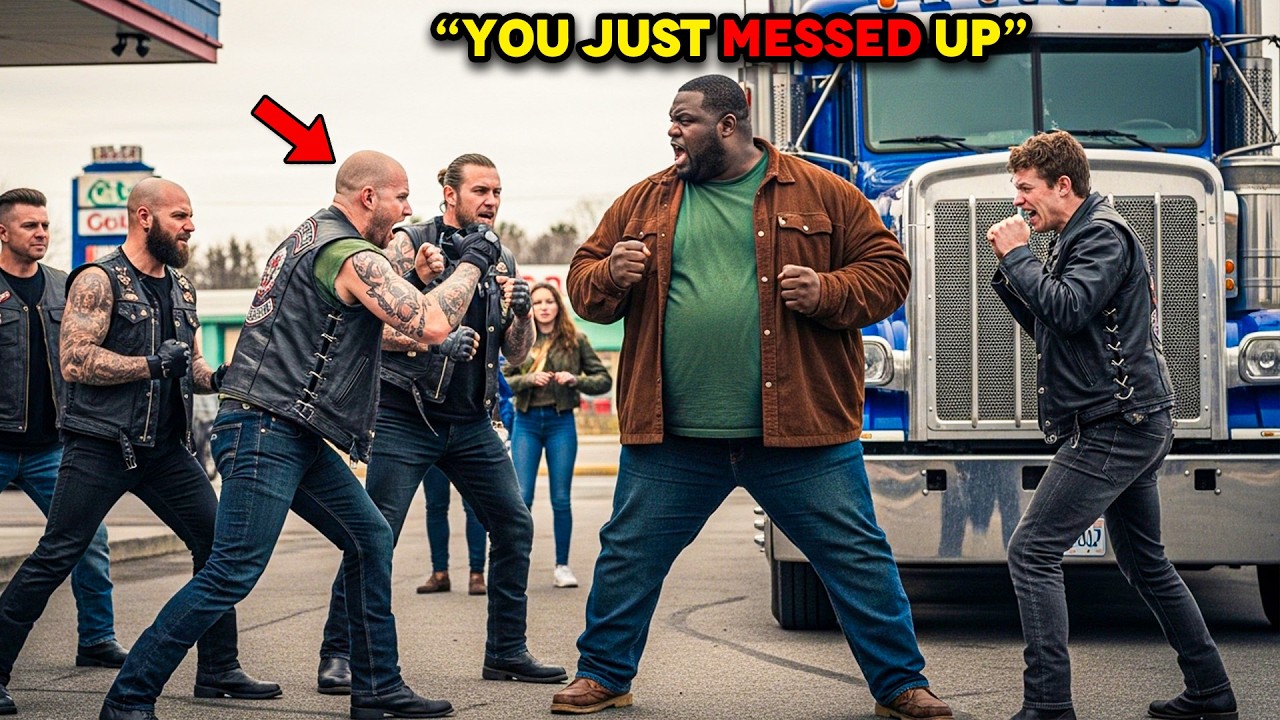
Gang Targets Fat Black Trucker—Regret It When They Find Out He’s Former Navy SEAL
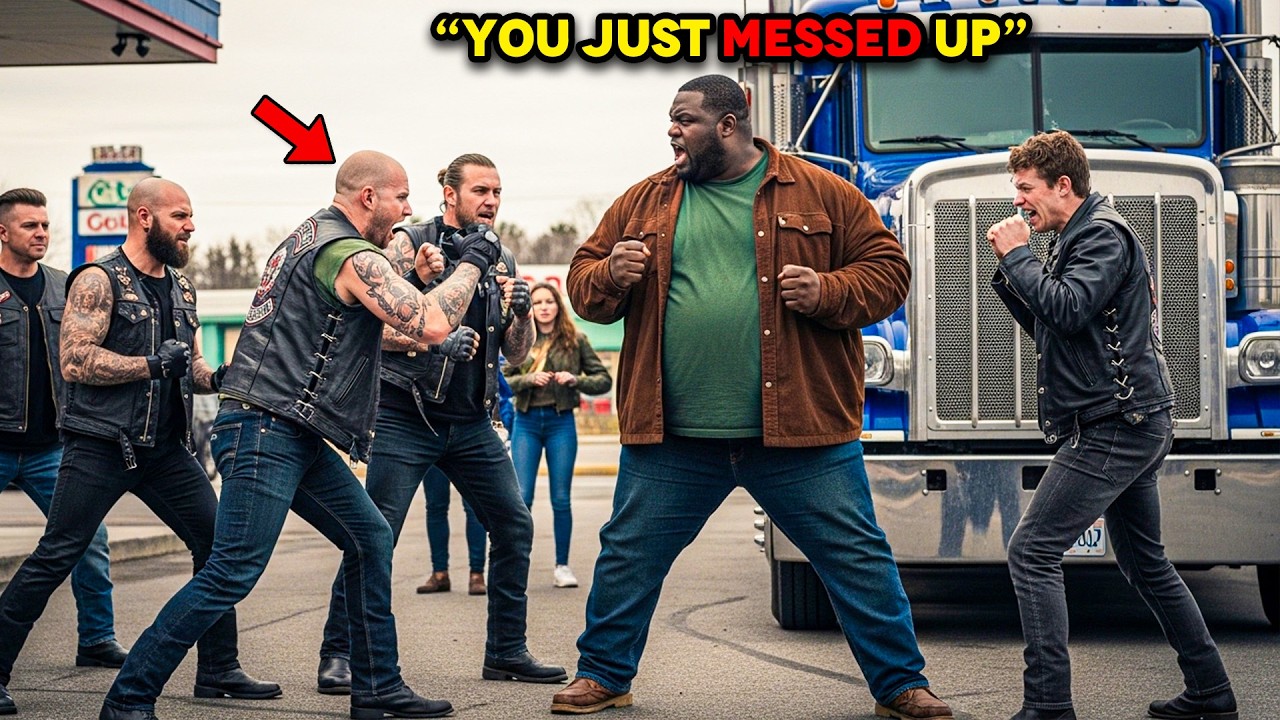
1,200 for road tax. Tubby, you don’t need me to spell it out, right? Ricky’s grin stretched wide as he stepped out of the darkness. Three men fanning out behind him. He drove his palm hard into Marcus Callaway’s shoulder. All 320 lb of him barely rocking. Marcus said nothing. His hands stayed at his sides. His breathing stayed even.
But what Ricky and the three lackeyis couldn’t see was that the overweight trucker standing quietly under these yellow parking lot lights had spent 22 years doing things to enemy combatants that would never appear in any newspaper. Before continuing, comment where in the world you are watching from and make sure to subscribe because tomorrow’s story is one you can’t miss.
The Holland fuel stop appeared out of the Tennessee dark like the last ember of a dying fire. Marcus Callaway eased his foot off the accelerator and let blue thunder bleed down to a crawl. The big cobalt Peterbuilt groaned as it rolled off I40, tires crunching over cracked asphalt that hadn’t seen a repair crew in years.
He checked his mirrors out of habit. Nothing behind him but black highway and cold sky. No other rigs, no headlights, nothing. Just him and the road and 12 miles of silence in every direction. He pulled up to the pump island and killed the engine. The cab went quiet. Marcus sat there for a moment the way he always did, just listening.
Wind moving through the treeine. a loose piece of metal siding on the fuel stop’s roof ticking in the breeze. That was it. That was all. He checked his watch. 12:15 a.m. He climbed down from the cab carefully, the way a big man learns to do after enough years of bad knees and cold nights. 320 lb of him descended the steps with practiced patience.
He zipped his jacket against the November chill and walked toward the diner’s front door, gravel crunching under his boots. The bell above the door chimed when he pushed through. The place was almost empty. Fluorescent lights buzzed overhead, washing everything in pale yellow. Four stools at the counter, six booths along the window.
A pie case with two sad slices left in it. a handlettered sign on the wall that reads open for 24 hours since 1987. The woman behind the counter, Lauren Holland herself, all 67 years of her, looked up when Marcus walked in. She was a small black woman with reading glasses pushed up into silver hair and a dish towel over her shoulder.
Her face was the kind that had smiled a thousand times and earned every line doing it. But right now she was not smiling. Her hands were shaking just slightly. But Marcus noticed. He noticed everything. Evening, he said. Evening, honey. Her voice was steady enough on the surface. Practiced. Everything is fine. Coffee, please.
He settled onto a stool at the counter and pulled off his cap. Marcus Callaway looked every bit of his 48 years. Broad through the shoulders, heavy through the middle, with the kind of stillness about him that most people mistook for slowness. He wasn’t slow. He was just a man who had learned a long time ago that you didn’t spend energy unless you needed to.
While Lauren poured, he took a slow look around the diner the way a man does when he’s pretending not to. That’s when he saw the boy in the corner booth. Young, mid-20s at most, Hispanic, work jacket, worn boots, the look of a longhaul driver, still dusty from the road. He was sitting completely still with both hands wrapped around a coffee mug like it was the only warm thing left in the world.
His bottom lip was split and crusted dark. His right eye had the early yellow shadow of a bruise forming underneath it. He was staring at nothing. Marcus drank his coffee. He let a few minutes pass. Then he picked up his mug and moved to the corner booth and sat down across from the young man. The boy looked up, startled, weary. “You all right?” Marcus asked.
The boy looked at Lauren. She turned away to wipe the counter. He looked back at Marcus. I’m fine, he said. Marcus nodded slowly. He wasn’t going to push. He just sat there and drank his coffee. Patient as a man with nowhere urgent to be. It took about 4 minutes. “They took everything I had,” the boy said quietly. ” $800, cash.
just walked up to my truck and took it. His voice was tight, controlled, like he was working hard to keep it from cracking. Four of them said it was a road tax. Said every independent driver on this stretch pays or they get the same treatment. He touched his lip without thinking about it. I filed a report. Deputy came out, looked around, said there wasn’t much he could do tonight, and left.
He let out a breath that wasn’t quite a laugh. I’ve been sitting here for 3 hours. His name was Eddie Garza, and Marcus Callaway listened to every word. He didn’t say much. He asked a few quiet questions. What the men were wearing, what they were riding, what exactly they said. Eddie answered all of it.
By the time Marcus finished his coffee, he had a clear picture. Not the whole picture, but enough. He stood. He put 220s on the table without being asked. “You file that report again in the morning,” he said. “Don’t let them tell you no.” He nodded once to Lauren. She nodded back, something grateful and heavy in her eyes that she didn’t put into words.
Marcus pushed through the front door, back out into the cold Tennessee dark. Blue Thunder was waiting for him. Marcus had his hand on the fuel cap when they stepped out of the dark. Four of them moving in from the gaps between the rigs like they’d been waiting there the whole time. Patient, practiced, comfortable, the kind of men who had done this exact thing many times before, and never once been surprised by how it ended.
They wore leather vests over hooded sweatshirts, iron covenant patches on the back, a skull split down the middle, the words Harland County stitched beneath it in red. The biggest one led. He was maybe 6’2, thick in the chest with a shaved head and a beard that hadn’t been trimmed in months. He walked with the loose, easy swagger of a man who had never once in his adult life been made to feel small.
He stopped about 4 ft from Marcus and looked him up and down slowly, deliberately. Then he grinned. “Well, look at this big old boy.” He glanced back at his crew. “They’re getting bigger every year, ain’t they?” Two of the others laughed. The fourth one, younger, jumpier, with a patchy beard and mean little eyes, moved around to Marcus’s left, cutting off the path back to the diner.
Marcus didn’t move. He kept his hand resting on Blue Thunder’s fuel cap and watched all four of them the way a man watches weather coming in off the horizon. Road tax, the big one said. He pulled the words out slowly, like he was explaining something to someone who might not be keeping up. Every independent rig running this corridor pays.
That’s just how it works out here. He tilted his head. rig your size. 1,200 cash. Marcus said nothing. You hear me, big fella? 1200 dollars. The man held up both hands and wiggled his fingers like he was counting for a child. Or we have ourselves a real bad night. The jumpier one on Marcus’s left snorted.
Don’t think he understands the concept, Ricky. Maybe he’s slow. Another one offered. Ricky, the big one, took a step closer. Close enough now that Marcus could smell cigarettes and motor oil and the particular sourness of a man who enjoyed this. What do you think, Tubby? Are you slow? Because from where I’m standing, you look like a man who spends a lot of time sitting on his backside eating whatever’s in front of him.
He looked pointedly at Marcus’s midsection. Lot of front of him, too. More laughter. Marcus looked at Ricky. Then he looked at the man on his left. Then the two behind Ricky. He did it slowly, calmly, taking each face in for exactly one second. Then he said quietly enough that only the four of them could hear it.
I’m going to give you exactly one chance to walk away. Ricky blinked. Then his grin came back wider this time. Almost delighted. He turned to his crew like Marcus had just said the funniest thing he’d ever heard. Did this fat boy just He turned back. “Boy, do you have any idea who you’re talking to? Do you understand what we will do to you out here?” “Walk away,” Marcus said again.
Same volume, same tone. Ricky’s grin flickered. Something shifted behind his eyes. Not fear, not yet, but the first faint edge of uncertainty. He didn’t like it. He stepped forward and drove his palm hard into Marcus’s shoulder. Marcus rocked back half a step. He steadied himself. He rolled his neck once, a slow, deliberate rotation, like a man settling in for something that required his full attention.
and his eyes went somewhere else entirely. Not angry, not wild, something much quieter than that, something that had no temperature to it at all. Ricky saw it. His grin died completely. He opened his mouth. The fourth man, the jumpy one on Marcus’s left, reached for Marcus’s jacket. That was the last decision any of them made for a while.
The fourth man ran. His boots slapped the asphalt and he was gone into the dark between the rigs without looking back. Marcus watched him go. He didn’t move to follow. He stood at the side of Blue Thunder and looked down at the three men on the ground with the same unhurried calm he’d carried in through the diner door 20 minutes ago.
Ricky was on his back, staring up at the black Tennessee sky with an expression that was mostly confusion. Marcus dusted his jacket off with one hand. 11 seconds. That was all it had taken. Here is what 11 seconds looked like. The jumpy one on Marcus’ left grabbed for his jacket with his right hand. That was his mistake. Reaching instead of striking, the way amateurs always did.
Marcus didn’t step back. He stepped into it, rotating at the hip, and took the reaching wrist in both hands. One sharp controlled motion downward against the joint. The crack was quiet and definitive like a green branch snapping. The man folded sideways, making a sound that wasn’t quite a word. One. Ricky was already moving. A big man’s charge.
Head low, shoulders forward. He had weight and anger and absolutely nothing else. Marcus s sideestepped with more speed than a 320-lb man was supposed to have, used Ricky’s own momentum, and redirected him face first into the asphalt with a flat palm between his shoulder blades. Ricky hit the ground hard and didn’t bounce.
Two, the third man was smarter. He hung back for a half second, recalibrating. That half second was all Marcus needed. He closed the distance in two steps, got an arm across the man’s chest before he could set his feet, and walked him backward into Blue Thunder’s front grill. He pinned him there with a forearm the size of a railroad tie pressed across his collarbone, not crushing, just completely and utterly immovable.
The man’s feet scrambled at the asphalt and found no purchase. Three. Marcus held him there and turned his head toward the fourth man. The fourth man ran. Marcus released the third man who slid down Blue Thunder’s grill and sat on the asphalt with his back against the bumper, breathing in shallow, stunned pulls. Marcus stepped back and looked at all three of them.
Ricky face down and groaning. The jumpy one curled over his broken wrist, the third one sitting against the truck like his bones had stopped working. There was no rage in Marcus’s face. No satisfaction either, just the flat, finished calm of a man who had done a necessary thing and was now done doing it.
He checked each of them quickly and efficiently. Pulse, breathing, pupil response on Ricky, who’d hit the ground hard. Nobody was dying. Nobody had a neck injury. They were going to hurt for a while, but they would all go home. He reached down and picked up the roll of cash that had fallen from Ricky’s jacket pocket when he hit the ground.
He didn’t count it. He just held it for a moment, then walked back across the lot toward the rigs. Inside the diner, two faces were pressed against the window glass. Lauren had both hands flat on the counter, her body completely still. Beside her, a teenage waitress named Amy, maybe 17, dark ponytail, a Holland fuel stop apron, stood with her mouth open, and her order pad hanging forgotten from one hand.
In the corner booth, Eddie Garza was on his feet, staring out the window with an expression caught somewhere between disbelief and something that looked almost like hope. Marcus pushed through the door. The bell chimed. He walked to Eddie’s booth and set the cash roll on the table without ceremony. It was more than $800. Ricky had apparently been having a good night. “That’s yours,” Marcus said.
Eddie stared at it. Marcus looked at Lauren. Call 911. Tell them there are three men in your parking lot who need a deputy and possibly an ambulance. Don’t tell them anything else. Lauren nodded. Her hands had stopped shaking. You. Amy started, then stopped, staring at Marcus like he had just stepped out of a television set.
Marcus looked at Eddie one more time. File that report again in the morning, he said. Walk in there and put it on the desk and don’t leave until somebody takes it. You hear me?” Eddie nodded. His jaw was working like he wanted to say something and hadn’t found it yet. Marcus put his cap back on and walked out.
He had Blue Thunder moving by 12:47 a.m. The on-ramp for I40 East was empty. Marcus merged into the right lane and settled in. One hand easy on the wheel, the big engine finding its rhythm beneath him. Behind him, the lights of Holland Fuel stop shrank in the side mirrors and disappeared around a curve in the tree line. Ahead was nothing but black highway and white centerline markings ticking past in the headlights, one after another, like seconds being counted off. Marcus drove.
He didn’t look back. 40 miles east of Harlem, the highway opened up, and the tension in Marcus’ shoulders began slowly to unwind. He drove the way he always drove at this hour, steady in the right lane, no radio, just the engine and the road, and the particular kind of quiet that only existed in the middle of the night on an empty interstate.
The kind of quiet that didn’t ask anything of you. He thought about the three men in the parking lot. He thought about Eddie Garza’s split lip. He thought about the way Lauren’s hands had been shaking. Then he pressed the Bluetooth button on the steering wheel and dialed Nia. She answered on the second ring. Hey, Daddy.
Her voice filled the cab like warm light, and Marcus felt something in his chest loosen that he hadn’t even realized was tight. Hey, baby. I wake you? No. a soft laugh. I was up studying. Miss Patterson moved the history test to Thursday, and I’m only halfway through the chapter. Thursday? You’ve got time. Daddy, it’s already Tuesday.
Then you better stop answering the phone. She groaned, the dramatic, full-bodied groan of a 16-year-old who felt deeply misunderstood. I needed a break. My eyes were crossing. A pause. the sound of her closing a textbook. Where are you? Eastern Tennessee. Just made a stop. Heading toward Knoxville. Same stretch again. Same stretch, Daddy.
Her tone carried the particular combination of affection and exasperation that she had been perfecting since she was about 14. You know, there are other roads. I know the exits on this one, he said. She laughed, and it was so much like her mother’s laugh, the shape of it, the warmth of it, that Marcus went quiet for just a moment.
“How’d the game go?” he asked. “We won.” Jasmine made the last shot with 4 seconds left and everybody completely lost their minds. She paused. “I almost called you, but it was late. You can always call me, even at midnight. Especially at midnight.” He could hear her smiling through the phone. Coach said if we win Friday, we go to regionals.
The whole school is going crazy about it. You going to the game? Obviously. Jasmine would never forgive me. A beat. You’re not going to make it back for it, are you? I’ll try, baby. You always say that. I always mean it. He said sometimes the road has other ideas. She accepted that the way she always did.
not entirely happy about it, but understanding. She had grown up watching him leave and come back, leave and come back, with the patient rhythm of someone who had learned early that loving a trucker meant getting comfortable with distance. They talked for a while after that, the easy, unhurried kind of talking that didn’t need a reason.
Nia described the history chapter she was struggling through something about the civil rights movement that she actually found interesting but couldn’t make herself memorize properly. Marcus listened and then carefully quietly started telling her things that weren’t in the textbook, things he knew from his own grandmother. Things passed down like furniture carried from one generation to the next.
Nia went quiet and listened. That happened sometimes. This particular stillness she got when she realized her father knew something nobody had thought to write down. Why don’t they put that part in the book? She asked. Because somebody decided what went in the book, Marcus said simply. A pause. That’s kind of messed up. Yes, it is.
She laughed softly. Then Daddy, are you okay? You sound, I don’t know, different. He kept his voice easy. Long night. I’m fine. Okay. She didn’t fully believe him. She never fully believed him when he said fine. But she let it sit. I’m going back to studying. Good. Drink some water. Don’t stay up past midnight. It’s already past midnight.
Then don’t stay up past 1:00. Deal. A smile in her voice. Love you, daddy. Love you, baby. Lock the doors. I always locked the doors. The call ended, and Marcus drove in comfortable silence, the cab warm with the echo of her voice, the particular kind of peace that only his daughter’s laugh could put in him. He thought about the history chapter.
He thought about Friday’s basketball game. He thought about trying to make it back in time. He drove like that for 40 minutes. At 3:11 a.m., his phone rang. The number on the console display was Laurens’s. Marcus frowned and answered. Lauren. She didn’t say hello. Her voice was stripped down to just the necessary words.
The voice of a woman holding herself together by will alone. “He came back,” she said. “Julius Hargrove himself. this morning, just after dawn, had six men with him. He knew about your rig, the color, the make. Asked me questions. I didn’t tell him anything, Marcus. I swear I didn’t. I know you didn’t, Marcus said. What did he say? A pause. He could hear her breathing.
He left a message. Her voice dropped. He said, “Tell the fat man we know about his daughter. Tell him Nia is a pretty name. The highway stretched out ahead of Blue Thunder, long and dark and empty. Marcus said nothing. Marcus didn’t pull back onto the highway. He sat with both hands on the wheel and the engine idling and Lauren’s words hanging in the cab like smoke.
The hazard lights clicked on automatically when he’d stopped. Orange light pulsing across the dark asphalt in front of him. steady and rhythmic, counting off seconds. He let 90 of them pass. Not from shock. Marcus Callaway did not shock easily. He sat still because stillness was how he thought. And right now, thinking clearly was the only thing that mattered.
He went through it methodically. What he knew, what he didn’t know, what needed to happen in the next 10 minutes. Julius Hargrove had Nia’s name. That meant he had more than her name. A man like Julius, careful, methodical, running a criminal operation across four counties for years without a serious legal challenge, did not throw names around as empty theater.
If he knew Nia’s name, he knew where she went to school. He knew her routine. He knew enough. Marcus reached for his phone. He dialed Nia’s number and listened to it ring. His jaw set, his breathing slow and controlled. She picked up on the third ring, her voice groggy now, the studying having finally lost the battle with sleep. Daddy, is everything okay? Hey, baby.
He kept his voice exactly the same as it had been 20 minutes ago. Warm, easy. Sorry to call back so soon. Change of plans on this end. I need you to do something for me. What? Slightly more awake now. You remember your friend Tamara? The one on Prescott Street? Yeah, of course. I need you to stay at her place tonight instead of home.
Pack a bag in the morning before school and go straight thereafter. Don’t go back to the house until I call you. A pause. Longer than he wanted. Daddy, what’s going on? Nothing for you to worry about, he said. I just need to know you’re not home alone for a few nights. Can you call tomorrow in the morning? She won’t mind.
But Nia, his voice stayed gentle, but it carried the particular weight that told her clearly and without argument that this was not a discussion. Call Tamara in the morning. Don’t go home alone. Can you do that for me? Another pause. He could hear her working through it, weighing the urge to push against the thing in his voice that she had learned over 16 years to take seriously. Yeah, she said quietly.
I can do that. Good girl. Get some sleep. I’ll call you tomorrow. He ended the call and sat for a moment with the phone in his hand. Then he scrolled to a contact that had no name attached to it, just two initials. VO, a number he had not dialed in 6 years. He looked at it for exactly 3 seconds. He pressed call.
It rang twice. Marcus. The voice that answered was deep and unhurried with the faint trace of a Ganaan accent worn smooth by decades of American living. Victor Norris had been many things over the course of his life. He was currently the owner of a private security and intelligence firm operating out of Atlanta.
More importantly, he had once been the man covering Marcus’ left side on operations in places that didn’t make the news. He asked no unnecessary questions. That had always been one of his best qualities. Victor Marcus said, “I need information on a criminal organization, white supremacist biker gang. Name is the Iron Covenant operating out of Harland County, Tennessee.
Leader goes by Julius Hargrove.” He paused. “They’ve threatened my daughter.” “A brief silence, not hesitation. Processing.” “How deep do you need it?” Victor asked. “Everything,” Marcus said. members, operations, finances, political cover, law enforcement connections, everything you can find. Give me 12 hours. I’ll be in Knoxville by 9.
Call me when you have something. Marcus. Victor’s voice dropped a register just slightly. How bad is it? Marcus looked out through the windshield at the empty Tennessee highway stretching away into the dark. He thought about Ricky and his three friends in the parking lot. He thought about Julius Hargrove showing up at Lauren’s diner with six men before dawn.
He thought about the way those words had sounded in Lauren’s voice. Tell him Nia is a pretty name. I don’t know yet, Marcus said. That’s why I need 12 hours, he ended the call, clicked off the hazard lights, put Blue Thunder in gear. The highway opened up ahead of him, and Marcus drove east toward Knoxville, steady and silent in the dark.
Already thinking three moves ahead, Marcus delivered his load to a distribution warehouse on the eastern edge of Knoxville at 8:52 a.m. He backed Blue Thunder into the receiving dock with the mechanical precision of a man who had done it 10,000 times, climbed down, signed the paperwork, and exchanged exactly 12 words with the dock supervisor.
Then he pulled the rig to the far end of the truck stop lot across the street. cut the engine and waited. He ate a sandwich from the cooler behind his seat. He drank two cups of coffee from his thermos. He watched the lot fill up and thin out as the day moved through its hours. Morning rush, giving way to the midday lull, the lull giving way to the afternoon.
Drivers came and went. Nobody paid him any attention. A big man in a cobalt truck parked and quiet. He called Nia at 3:00. She was between classes, her voice bright and distracted the way it got when the school hallway was loud around her. She confirmed she was going to Tomorrow’s after the final bell. She asked if everything was okay. He said yes.
She said okay in the tone that meant she still didn’t entirely believe him, but she trusted him enough to let it go. He told her he’d call that evening. He meant it. At 9:47 p.m., Victor called. “Talk to me,” Marcus said. Victor talked for 22 minutes without stopping. Marcus listened to every word without interrupting once.
The Iron Covenant was not a biker gang. That was the first and most important thing Victor established. It had the appearance of one, the vests, the patches, the motorcycles, the rural Tennessee territory. But underneath the surface, it was a functioning criminal enterprise, structured and deliberate, with income streams and a hierarchy and long-term strategic thinking behind every move it made.
63 active members across four counties. Leadership concentrated in Harland County under Julius Hargrove with regional captains overseeing operations in the surrounding areas. The extortion corridor along I40 had been running for 4 years. In that time, 11 independent truckers had been driven off the route permanently. Some by violence, some by sustained intimidation, some by having their loads stolen until continuing simply wasn’t financially viable.
Not one successful prosecution, not one conviction. The organization’s financial backbone was a company called Harland Freight Solutions, a legitimate trucking dispatch business that the Covenant had absorbed through a campaign of threats and property destruction against the original owner, a 61-year-old man named Gerald Pittz, who had sold at a catastrophic loss just to make it stop. through Harland Freight.
Extortion proceeds were laundered alongside legitimate dispatch revenue and fed into three other businesses. A car wash, a storage facility, and a small construction company. All of them clean on paper. All of them owned by men connected to Julius Hargrove by blood or loyalty. County Commissioner Dale Gandler sat on the Harlem County Budget and Oversight Committee and had been receiving payments from the Covenant for three years.
His influence kept the county sheriff’s office politically neutered, underfunded, understaffed, and acutely aware that certain investigations were not going to be rewarded. The FBI had noticed an organized crime task force agent out of the Memphis field office. Agent Diane Thorson had been building a RICO case for 18 months.
She was smart and aggressive, and she had at one point a credible cooperating witness, a former mid-level Covenant member named Terry Chavez, no relation to the commissioner, who had been willing to testify about the financial structure of the organization. 6 weeks ago, Terry Chavez disappeared. No body, no trace. The case stalled.
Julius Hargrove, Victor said, former Tennessee Department of Corrections, prison guard for 11 years at Riverbend Maximum Security, terminated after a brutality investigation, inmate injuries that were documented, but never fully prosecuted. He spent three years building the Covenant after that. He is not impulsive.
He does not make mistakes out of ego. Every move this organization makes has been calculated well in advance. A pause. Marcus. These are not the four men in the parking lot. I know. Marcus said there are 63 of them. I heard you the first time. Victor was quiet for a moment. What are you going to do? Marcus looked out through the windshield at the dark lot.
A light rain had started sometime in the last hour, tapping softly against the cab roof. Somewhere across the lot, a rig was idling, its running lights burning amber and red in the wet dark. He thought about Eddie Garza sleeping in his cab. He thought about Laurens shaking hands. He thought about Nia packing a bag and not knowing why.
I don’t know yet, Marcus said, but I’m going to figure it out. Morning came gray and cold over Knoxville. Marcus was back on I40 by 7, but he wasn’t making time. He wasn’t running freight. He had called his dispatcher the night before and pushed his next pickup back 2 days, personal matter, he’d said, and left it at that.
He had the corridor to himself, and he intended to use it. He drove west, back toward Harland, back the way he’d come. But this time he stopped everywhere. Every independent truck stop. Every fuel station still run by a family name instead of a corporate logo. Every diner with a gravel lot and handpainted hours on the door. He pulled Blue Thunder in slowly, parked, went inside, ordered coffee, and listened.
When the timing felt right, he asked quiet questions. He didn’t explain who he was or what he was doing. He just asked and he listened to what came back. What came back was bad. At a fuel stop outside of Cookville, he found Eddie Garza. The young man was in his cab, not sleeping, just sitting, engine off, staring out the windshield at a concrete wall.
Marcus knocked on the passenger window. Eddie startled, then recognized him and unlocked the door. You’re still here, Marcus said. I made my delivery yesterday, Eddie said. He looked worse than he had two nights ago, paler with the hollowedout look of a man running on no sleep and too much fear. I should go home. My wife’s been calling. He paused.
I just keep thinking about what they said. That it doesn’t matter where I go. That they’ll find me if I come back through. Do you drive this corridor regular? Every 2 weeks. Same route. I’ve been doing it for 3 years. He rubbed his face with both hands. I don’t know what I’m going to do. Marcus sat with that for a moment.
You’re going home, he said. Today. Your wife needs you home. He held Eddie’s eyes until the younger man nodded. I’m working on the rest of it. He left Eddie’s cab and kept moving. He found Walt Hudson at a truck stop outside of Baxter. A big weathered white man of 61 with broad shoulders gone soft and a face that had the permanent squint of someone who had spent decades reading the road.
He was sitting at the counter of a roadside diner nursing black coffee, his rig parked outside with a load he hadn’t picked up yet. He had no particular reason to be sitting in Baxter. He just wasn’t ready to go back on the corridor. Marcus sat next to him. They talked the way truckers talk, slow and indirect at first, circling the real subject.
Walt got there eventually. Two months ago, the Iron Covenant had stopped his rig on a lonely stretch between Cookville and Harland and taken the entire load, $40,000 in consumer electronics. Walt had been hauling it on contract for a midsize retailer. The contract had a loss clause that put the liability on the driver when law enforcement couldn’t recover the cargo.
Walt ate the full loss. His wife Meredith had been diagnosed with breast cancer 8 months ago. The treatment costs were manageable barely when Walt was working steady. After the load theft, they were not manageable at all. I filed the report, Walt said. He wasn’t angry when he said it. He was past angry. He had moved into the flat, exhausted country on the other side of it.
Deputy took the statement, never heard another word. Commissioner’s office told me there was an active investigation when I called. That was 8 weeks ago. He turned his coffee cup slowly in both hands. Meredith’s next round of treatment is in 3 weeks. I don’t know how we’re covering it. Marcus didn’t say anything for a moment. Then he quietly asked Walt for his fuel stop preference and paid the man’s tab and two nights of lot parking without drawing any attention to the act.
Walt looked at the receipt the cashier slid back to him. He looked at Marcus. You don’t have to do that, he said. I know, Marcus said. By the end of the second day, Marcus had spoken with nine drivers. nine separate accounts of robbery, intimidation, assault, and extortion along the same stretch of highway.
Most were too frightened to file formal statements. Some had tried. None of it had mattered. That night, parked in a rest area outside of Lebanon, Marcus called Victor. “I have firsthand accounts from nine drivers,” he said. “The actual number affected is closer to 11, maybe more. Victor was quiet for a moment. “What are you planning to do with all of it?” Marcus looked out at the dark tree line beyond the rest area lights.
“I’m still deciding,” he said. Marcus pulled Blue Thunder back into Holland Fuel stop the following morning, just after 8. The breakfast crowd, such as it was, had already thinned out. Two older men in work jackets shared a booth by the window, talking about nothing in particular. A single driver sat at the counter with his back to the door.
Lauren was behind the register, and when she saw Marcus come through the door, her whole body visibly relaxed, the way a person does when they’ve been waiting on something without admitting they were waiting. She poured his coffee before he sat down. He ate eggs and toast and let the diner settle around him.
When the two men in the booth paid their tab and left, Lauren came around the counter and sat across from Marcus. She kept her voice low out of habit, even though there was nobody close enough to hear. “There’s something I should have given you before,” she said. She reached into the front pocket of her apron and set a business card on the table between them.
White card, federal government seal, clean black type, special agent, Diane Thorson, FBI, organized crime task force, Memphis field office. She came through here about 6 months ago, Lauren said. Sat right where you’re sitting, ordered coffee, asked quiet questions. Careful woman. Didn’t say much about what she was building, but she was building something.
Lauren tapped the card once with one finger. I didn’t give her much. I was scared. Still am. She paused. But you’re not. Marcus picked up the card and looked at it. He sat with it for nearly an hour after Lauren went back to work, turning it over, thinking through what Victor had told him about the stalled investigation, the disappeared witness, the 18 months of work that had gone nowhere.
An FBI agent who wanted Julius Harrove badly enough to drive 80 m into Harland County and sit in a diner asking quiet questions, was an agent who had run out of easier options. that meant she might be willing to work with what he had. He stepped outside to the parking lot and made the call.
Thorson answered on the second ring. Her voice was crisp and professional and immediately sharply alert the moment Marcus said the words Iron Covenant. Whatever she had been doing before he called, she stopped doing it. Who is this? She said. Someone with current intelligence on the covenant’s operations along I40. Patrol routes. Extortion schedule.
Two laundering transactions in the last 30 days. He paused. I want to meet. A brief silence. He could hear her thinking, assessing, weighing, deciding. When? She said. Today. Somewhere between here and Memphis. Neutral ground. They agreed on a truck stop diner in Jackson, Tennessee, 80 mi west of Harlem. Anonymous enough, busy enough that two people having a quiet conversation at a corner table wouldn’t attract any attention. Marcus drove straight there.
He arrived first, took a table in the back corner, ordered coffee, and waited. Thorson walked in 40 minutes later. She was in her early 40s, medium height, with dark hair pulled back, and the kind of face that gave nothing away without deciding to. She wore civilian clothes, jeans, a dark jacket, but she moved through the diner like a person accustomed to reading rooms.
She spotted Marcus immediately and came directly to the table without any pretense of looking around. She sat down, put nothing on the table, and looked at him with clear, measuring eyes. You’re not a federal informant, she said. It wasn’t a question. No, law enforcement. Former military. Which branch? Navy. She studied him for another moment.
What do you want out of this? The same thing you want, Marcus said. Julius Harrove in federal custody and his organization dismantled. “And if I ask why, they threatened my daughter,” Marcus said simply. Something shifted in Thorson’s expression. “Not softness exactly, but a recalibration.” She leaned forward slightly. “Tell me what you have.
” Marcus told her. He laid it out cleanly and in order. The patrol routes he had personally observed. the extortion schedule. Eddie and the other drivers had described, the specific timing and location of two cash transactions he had traced to front businesses in the Harland freight network through Victor’s intelligence.
He gave her names, dates, and license plate numbers from memory. By the time he finished, Thorson was sitting very still. “How long did it take you to gather this?” she said. “4 days.” She looked at him steadily. My team has been working this case for 18 months. I know, Marcus said. She absorbed that without reacting to it. Then I want to continue sharing intelligence. Regular contact.
Agreed, Marcus said. But all contact goes through your personal cell, not your office line, not your official channels. He held her eyes. Personal cell only. She frowned slightly. Why? Marcus kept his expression neutral. He had his reasons. He wasn’t ready to share them yet. Not until he was more certain. Call it caution, he said.
Thorson looked at him for a long moment. Then she took out a pen, wrote a number on a paper napkin, and slid it across the table. “Personal cell,” she said. They parted in the parking lot 20 minutes later. Marcus stood at Blue Thunder’s door and watched Thorson’s dark sedan pull out onto the highway and disappear west toward Memphis.
He stood there for a long moment after her tail lights faded. The Jackson truck stop hummed around him. Diesel engines, distant CB chatter, the ordinary sounds of the road. He got in the cab. He sat with both hands in his lap and stared at the windshield. Something about the meeting had gone well. He knew that something about it also sat slightly wrong in a way he couldn’t fully name yet.
He put Blue Thunder in gear and headed back east. Two days passed without incident. Marcus ran a short freight hall out of Nashville, a routine load 200 m round trip, partly to keep money coming in and partly to give himself legitimate reason to be moving through the corridor. He checked in with Nia each evening. She was settled at Tamara’s, annoyed about the history test she felt she’d underperformed on, and asking with increasing frequency when she could go back home. He told her soon.
He meant it as a promise, not a comfort. He and Thorson exchanged two brief calls, operational details, nothing sensitive. She confirmed she was cross-referencing his intelligence with existing case files. She sounded focused and encouraged. Marcus told her nothing about Victor. He told her nothing about the financial records he and Victor had begun discussing as a potential next move. He kept the calls short.
Something still sat wrong. He just hadn’t found the shape of it yet. He found it at dusk on the second day. He was westbound on I40 about 30 mi east of Harland, the sun dropping fast behind the treeine and painting the highway in long amber shadows. He was thinking about Walt Hudson and whether the victim restitution process through the FBI would move fast enough to matter for Meredith’s treatment schedule.
That’s when the black pickup appeared in his mirrors. It came up fast from the right lane. too fast, too deliberate, and settled in tight behind Blue Thunder. Marcus checked his speed. He was running 62 in a 65 zone. The pickup had no reason to be that close. He watched it for 30 seconds without changing anything about how he was driving.
Then a second pickup came up the left lane and matched his speed exactly, boxing him in from the side. Ahead, a third vehicle, another black pickup, same model, sat on the shoulder of the next on-ramp with its flashers off, engine running. As Marcus approached, it pulled forward and drifted to the center of the right lane.
Boxed from behind, boxed from the left, slowed from the front, Marcus brought Blue Thunder to a stop on the highway shoulder with calm, unhurried movements. He set the brake. He kept both hands visible on the wheel. Four men got out of the vehicles. Not Ricky’s crew, not the same faces from the fuel stop.
These were senior men, older, calmer, the one who approached Marcus’s window moved with the measured authority of someone several rungs up the covenant’s hierarchy. He wore no expression worth reading. Marcus rolled the window down. The man looked up at him without speaking for a moment. Then Julius wanted you to hear this directly.
Two days ago, Thursday morning, you met with a federal agent at a diner in Jackson table in the back corner. You talked for about 40 minutes. You gave her patrol routes, transaction locations, and three names. He let that sit. Julius had a full summary of the conversation by 2:00 that same afternoon.
Marcus said nothing. He kept his face still. He’s not angry, the man continued. He wants you to understand something. The reach of this organization extends further than you’ve calculated for. He paused. He also wanted you to know he respects what you did to those four men in the parking lot. He doesn’t hold grudges about it. He holds information.
There’s a difference. He looked at Marcus steadily. He’s watching what you decide to do next. The man walked back to his truck. The three vehicles pulled away in an unhurried convoy and were gone around a curve in the road within 30 seconds. Marcus sat on the shoulder for a long time. He played it back with precision.
every detail of the Jackson meeting, the time, the location, the content of what he’d shared. Thorson had not told anyone they were meeting. He certainly hadn’t. The summary had reached Julius within 4 hours of the conversation ending, which meant someone inside Thorson’s field office had been watching her contacts and movements and reporting back in near real time.
The FBI’s organized crime task force had a leak. a paid leak. Almost certainly, someone who had been on Julius’s payroll long enough to be the reason an 18-month investigation had stalled and a cooperating witness had vanished. Every piece of intelligence Marcus had given Thorson was now compromised. Every approach that ran through official channels was compromised.
The entire FBI route, the clean, legitimate by the book path to bringing Julius down, was a door with Julius standing on the other side of it. He called Victor. The meeting with Thorson, Marcus said. Julius had a full summary within 4 hours. Someone inside her office is feeding him her contact list in real time.
Victor was quiet for exactly 3 seconds. That changes the entire approach. Yes, Marcus said. It does. He looked out at the empty highway. The last of the daylight was gone now. Just a dark road and the distant glow of an overpass half a mile ahead. Victor, he said, I need a new plan. Marcus spent the next two days off the road entirely.
He parked Blue Thunder at a commercial lot outside of Lebanon and worked from the cab, phone calls, satellite maps on Victor’s secure line, long stretches of silence while he thought through angles and contingencies. He checked in with Nia each evening. She was restless at tomorrow’s, bored with sleeping on a couch, increasingly frustrated with the open-ended nature of the arrangement.
She had a basketball game. Friday. She didn’t want to miss. She had a life she wanted to get back to. Soon, Marcus told her each time. He meant it more urgently than she knew. Victor called on the morning of the second day with something specific. The Covenant’s extortion operation generated significant physical evidence, stolen goods, cash records, documentation of payments.
That material had to be stored somewhere. Victor’s intelligence pointed to a converted warehouse on a rural property 6 milesi south of Harlem. A former grain storage facility now surrounded by chainlink fencing with two exterior access points and a dedicated records office in the northwest corner of the building. The financial documentation stored there covered 3 years of the covenant’s full operation.
ledgers, transaction logs, payment records connecting the front businesses to the laundering pipeline, names, dates, amounts. Victor had obtained a detailed layout from commercial satellite imaging. He walked Marcus through it on the phone with the calm precision of a man who had planned this type of operation many times before in considerably less forgiving environments.
Two guards on exterior rotation. Victor said they switch every 3 hours. The overlap point when the rotation crosses on the south side gives you a 4-minute window on the northwest approach. Records office has a standard commercial deadbolt. Nothing sophisticated. Cameras? Marcus asked. Two fixed positions. No pan. Both covering the main entrance. A pause.
They’re not expecting someone who knows what they’re doing. Nobody ever is, Marcus said. He went in that night. The 4-minute window opened at 2:17 a.m., Marcus moved through it with everything his body still remembered from a life he had technically left behind. Low and quiet along the fence line, the guard’s footsteps fading south.
The northwest wall is dark and still. He had the dead bolt open in 40 seconds, a skill that required no explanation and left no evidence. Inside, he used a pen light no wider than his thumb. The records office was exactly where Victor said it would be. Three filing cabinets, one locked document box, and a desktop computer with an external hard drive already connected to it.
Marcus worked quickly and methodically photographing ledger pages, copying files onto a drive he’d brought, checking each document against Victor’s list of priority targets. He was thorough without being slow. 26 minutes after entering, he was back outside and moving along the fence line toward the tree cover where he’d left his vehicle.
Clean, quiet, no disturbance. He called Victor from the car. I’m out. Full copy of the financial records. Victor reviewed what Marcus had transmitted within two hours. His assessment was unambiguous. The records documented multi-state money laundering operations connecting Julius Hargrove and seven senior Covenant members to wire fraud, extortion, and organized criminal enterprise.
Federal RICO violations across three states. 40 years of exposure minimum for Julius alone. This is everything. Victor said, “This ends them.” For the first time in days, Marcus slept. At 6:47 a.m., an unknown number called Marcus was awake. He was always awake before 7. Sitting in the parking lot of a roadside diner outside Lebanon with a cup of coffee going cold in his hand. He looked at the number.
He didn’t recognize it. He answered anyway. Good morning. The voice was calm, almost pleasant, unhurried in the particular way of a man who believed completely and without question that he controlled everything happening around him. You’re better than I thought you were. I want you to know I mean that as a genuine compliment, Julius Hargrove.
The warehouse was a test, Julius continued. I needed to understand exactly what I was dealing with. Now I do. A brief pause. While you were inside my building last night, I had three men watching a young girl’s movements in your city. She left her friend’s apartment at 6:00 this morning to go pick up some things from home.
My men picked her up off the street at 6:15. Another pause, shorter. She’s fine. She’s going to stay fine. That part is entirely up to you. Marcus’ hand tightened around the phone. Here are my terms, Julius said. Every copy of those financial records. Every copy destroyed or surrendered to my people by sundown today. Your phone wiped.
You leave Tennessee tonight and you don’t come back. His voice stayed pleasant throughout. Or your daughter won’t come home. The call ended. Marcus stared at the phone in his hand for three full seconds. Then he called Victor. Julius just called. He said he’s claiming his men picked Nia up off the street at 6:15 this morning. A sharp silence.
Where was she supposed to be? Tamas. She must have gone back home for something. Marcus was already pulling up Nia’s contact on his screen. I’m calling her now. He dialed. It rang four times. Five. Six. Voicemail. He tried again. Voicemail again. She’s not picking up, Marcus said. Could be sleeping, Victor said immediately. Could be in the shower.
Could be her phone died. His voice was measured. The voice of a man actively constructing alternative explanations. Marcus, this is exactly the kind of move a man like Julius makes when he wants to shut you down fast. You just took something valuable from him last night. He’s scared of those records.
This could be a bluff designed to make you hand them back without him having to do anything. Marcus called Tamara’s number. Three rings. Tamara answered groggy. Is Nia there? Marcus said a rustling sound. A pause that lasted too long. She was I woke up and she was gone. She left a note saying she was going to grab some clothes from home and she’d be back before school. That was another pause.
Marcus, that was almost an hour ago. He ended the call. She left tomorrow’s. He told Victor she went home alone. An hour ago. She’s not answering her phone. He paused. Still think it’s a bluff? Victor was quiet for a moment. Call the homeline. Marcus called the house landline. It rang seven times. Nobody answered.
He sat in the parking lot of that ordinary roadside diner with the ordinary morning moving around him and felt something shift in his chest. A cold and specific kind of dread that doesn’t announce itself loudly, but simply arrives and settles in and refuses to leave. Victor. His phone buzzed. Unknown number. Not a call, a message. He opened it. Two attachments.
He opened the first one. A photograph. Nia in the gray hoodie she’d been wearing in her last Instagram post 3 days ago, sitting in a wooden chair in a dim room with no windows. Her hands were zip tied in her lap. Her face was turned slightly toward the camera, eyes wide, jaw set with the particular kind of frightened dignity that made something crack open behind Marcus’ sternum.
She was alive. She was unharmed. She was terrified. He opened the second attachment. A video 12 seconds long. Nia looking directly into the camera, reading from something offcreen in a flat, controlled voice. Daddy, please do what they say. Please just do what they say. Then the video ended. Marcus sat without moving for a long time.
When he finally spoke, his voice was so quiet and so completely controlled that it was almost frightening in its steadiness. “Victor, I see it,” Victor said. He was already on the line. Marcus had never ended the call. His voice had changed. The measured alternatives were gone. “Marcus, I’m sorry.
I’m Don’t,” Marcus said. He looked at the photograph one more time, his daughter’s face, her hands bound in her lap. The hoodie she’d picked because it was warm and comfortable, and she hadn’t known she needed to be anywhere except home. “Get me everything,” Marcus said. every location, every face, every patrol route at that compound, every exit, every guard rotation. He paused. All of it.
Now, Victor’s voice came back quietly and firmly. The voice of a man who had followed Marcus into dark places before and was prepared to do it again. “Give me two hours.” “You’ve got one,” Marcus said. He put the phone down and looked out through the windshield. The diner behind him hummed with the ordinary sounds of an ordinary day.
Coffee being poured, a door swinging open, someone laughing at something that didn’t matter at all. 30 men at that compound. He knew. He didn’t care. Marcus sat in the parking lot with the phone face down on the passenger seat and both hands resting in his lap. The morning moved around him. Trucks pulling in and out, a family loading into a minivan, a cashier sweeping the sidewalk in front of the diner entrance. None of it touched him.
He was somewhere else entirely. He was in the quiet space he had learned to find a long time ago in circumstances where falling apart was not an available option. A place behind the noise, behind the fear, behind the image of his daughter’s face in that photograph where everything became very simple and very clear. He had 9 hours until sundown.
He thought for 11 minutes without moving. Then he picked up the phone. The first call was to Deputy Riley Lockwood. Lockwood answered on the third ring with the careful weariness of a man who had learned to approach unknown numbers with caution. When he heard Marcus’s voice, he went quiet. Not hostile, just watchful.
I need 15 minutes of your time, Marcus said. Not as a deputy, as a man. A pause. Go ahead. Marcus laid it out in plain sequential order. Commissioner Dale Gandler. payments from the covenant for three years documented in financial records Marcus now possessed. The FBI’s organized crime case stalled not by lack of evidence but by a paid source inside the Memphis field office feeding Julius Hargrove information about active contacts and informants.
The disappeared witness Terry Chavez. 11 victimized drivers, most too frightened to file formal statements whose accounts Marcus had gathered personally. He gave Lockwood names, dates, and specific figures from the financial records enough that no reasonable man could dismiss what he was hearing as speculation. Lockwood didn’t interrupt once.
“The records are going to a federal judge in Nashville before noon today,” Marcus said. outside local jurisdiction, outside the compromised field office. Once they arrive, this moves at a federal level, and nothing Julius Hargrove owns in this county can slow it down.” He paused. “I’m not asking you to cross your line, Riley. I know where your line is, and I respect it.
I’m asking you to be on the right side of it when the smoke clears because it is going to clear today.” a long silence. Marcus could hear Lockwood breathing slowly on the other end. A man working through something heavy in real time. “My wife would tell me I’ve been on the wrong side of it for 2 years already,” Lockwood said quietly. “What do you say?” Marcus asked.
“Another silence, shorter this time.” “What do you need?” Marcus told him. The second call was to Agent Thorson, not through her official line, but through the personal cell number Victor had sourced independently through channels that had nothing to do with the FBI’s internal directory. She answered with immediate suspicion.
“Who is this? How did you get Listen to me carefully,” Marcus said. “You have a source inside your field office. someone who has been on Julius Harrove’s payroll long enough to be the reason your witness disappeared 6 weeks ago. Every contact you log, every informant you develop, every meeting you take. Julius has a summary within hours.
Dead silence. I met with you in Jackson 4 days ago, Marcus continued. Julius had a full account of our conversation by 2:00 the same afternoon. He told me himself. He paused. I’m not telling you this to burn the case. I’m telling you because I’ve already worked around it. He told her about the financial records, 3 years of the covenant’s full operation, copied from the warehouse two nights ago.
He told her he had mailed a complete copy that morning to federal judge Patricia Harmon in Nashville, a judge with a documented record of prosecuting Reicho cases and zero connection to Julius’s network in Harland County. The records were already in transit, already beyond Julius’s reach. Thorson was quiet for a long moment.
When she spoke, her voice was stripped of everything except focus. I need those records through official. You’ll have them, Marcus said. Through Judge Harmon today. Be ready to move when she calls your office. He ended the call. The third call was to Julius. Marcus dialed the number from the morning’s unknown call. It rang twice. “I wasn’t sure you’d call back,” Julius said.
“The pleasantness was still there, smooth and unhurried. I’m coming to the compound, Marcus said. Alone. No records, no phone backup, no federal contacts, just me coming to bring my daughter home. You give me your word, she’s unharmed, and this ends tonight. A pause. Then Julius’s voice came back warm with satisfaction. The sound of a man who believed fully and finally that he had broken something.
“Come on then,” Julius said. We’ll be waiting. Marcus ended the call. He put Blue Thunder in gear. The access road to the Covenant’s compound was 12 miles of cracked county blacktop that narrowed gradually as it pushed deeper into the rural dark treeine pressing in from both sides. No street lights, no houses, nothing but the occasional reflective marker post catching Blue Thunder’s headlights and throwing them back.
Marcus drove it at 40 m an hour. No reason to rush, no reason to hide. He had called Victor one final time before leaving Lebanon. Victor confirmed his position. A ridge 400 yd northeast of the compound perimeter with line of sight to the external generator housing he had accessed during a daylight reconnaissance 2 hours earlier.
Victor had what he needed. He was ready. Marcus had told him, “Wait for the rig to stop, then give me 60 seconds.” Victor had said, “Come back out, Marcus.” Marcus hadn’t answered that. He’d just ended the call and driven. The compound appeared through the trees at 6:09 p.m. It sat on what had once been a working farm, a main farmhouse, two-story, wood-framed with a covered porch running the full front length.
Four outbuildings arranged in a loose arc behind it. Too large, too small. A gravel yard connecting everything, worn bare by years of vehicle traffic. Chainlink perimeter fencing running the full property boundary, 8 ft high, topped with two strands of wire. A single gate on the access roadside, wide enough for a truck.
The last of the day’s light was going fast. that brief amber window when everything looks soft and the shadows run long and the compound’s exterior flood lamps had already clicked on, washing the yard in flat white light. Marcus counted eight men visible from the road before he even reached the gate. Two on the porch, two in the yard, four more positioned at intervals along the fence line, all of them watching the access road, all of them watching him come.
He drove Blue Thunder straight up to the gate and stopped. The gate was closed. A padlocked chain held it shut. Marcus set the brake. He did not get out. He positioned Blue Thunder’s nose 2 ft from the gate, close enough that opening it would require moving the truck, and moving the truck required him. He killed the headlights, but left the engine running.
Then he sat from the farmhouse porch. Julius Hargrove watched. He stood with both hands resting on the porch rail, relaxed, composed, flanked on his left by Alvinand on his right by two senior Covenant men. He looked at the rig sitting at his gate and said something to the man beside him. The man nodded and signaled toward the yard.
Two Covenant members walked toward the gate. Marcus watched them come through the windshield. He watched the porch. He watched the fence line. He tracked every position simultaneously, the way he had been trained to do in environments considerably more dangerous than a Tennessee farm at dusk. He checked the clock on the dash. 60 seconds. 50 40.
The two men at the gate were 20 ft away now, close enough that Marcus could see their faces. Irritated, impatient, used to people being afraid of what they represented. 20 seconds. 10. The compound went dark. Every flood lamp, every exterior light, the farmhouse windows, the security lamp above the barn door, all of it gone in a single instant as completely and suddenly as if someone had simply switched the world off. The gravel yard disappeared.
The fence line disappeared. The two men at the gate froze in the abrupt blackness. 10 ft from Blue Thunder’s bumper, suddenly unable to see anything at all. From the porch came shouting. Julius’s voice, sharp, controlled, cutting through the confusion with the efficiency of a man who understood immediately that this was not a power failure.
Marcus was already out of the cab. He came down the passenger side, away from the gate, away from the two confused men, and moved along the compound’s exterior fence line with his back low and his footsteps silent on the dead grass. He had the layout memorized to the foot. Main farmhouse, north end of property. Outbuilding one, large, vehicle storage.
Outbuilding two, large equipment. Outu building three small northwest corner. That was the one. Victor’s intelligence had been specific. Single exterior lock. No interior guard. Ground level window on the south wall. Behind him. The compound yard erupted in flashlight beams and shouted instructions. Men colliding with their own disorganization.
Julius’s voice trying to impose order on chaos that was moving too fast for order to catch. Marcus reached the third outbuilding. He pressed his back against the wall and listened. From inside, faint, barely audible over the noise in the yard, the sound of someone breathing fast and trying very hard to stay quiet.
Marcus put his mouth close to the wall. “Nia,” he said, barely above a whisper. The breathing stopped. Then, daddy. The south wall window was exactly where Victor said it would be. Marcus found it by touch, a single pain frame, older than the fencing around it. The latch corroded enough that it gave with steady upward pressure and no sound worth worrying about.
He had it open in 8 seconds. He went through it sideways, lowering himself to the floor with the controlled care of a big man who understood that silence was worth more than speed right now. Inside the outbuilding smelled like motor oil and cold concrete. No windows on the other three walls. No light source at all. Pure black. Nia, he said quietly.
Talk to me here. Her voice came from his left, 10 ft, maybe 12, tight and controlled, the way her voice got when she was scared, but refusing to let the scared win. He had heard that particular quality in her voice exactly once before, when she was 11 years old, and fell off her bicycle and broke her wrist.
And she had looked up at him from the ground with tears running down her face and said, “I’m okay, Daddy.” Before he even reached her, he moved toward her voice. His hand found her shoulder first. He crouched in front of her and ran his palms quickly and efficiently over the situation, zip ties at the wrists, hands bound in her lap, ankles tied to the chair legs with what felt like nylon rope.
He checked her face with his fingertips the way a blind man reads. Forehead, jaw, the bridge of her nose. No swelling, no cuts, no dried blood. He exhaled once. Just once. You hurt anywhere? He said, “No, a beat. I’m so scared, Daddy. I know, baby. That’s okay. Being scared is okay.” He was already working the zip tie at her wrists with a folding knife, cutting outward from the skin.
One controlled stroke. In about 30 seconds, you’re not going to be here anymore. I need you to focus on that. The zip tie came apart. He moved to her ankles. Can you walk? He said. Yes. Fast. Yes. Firmer this time. He could feel her pulling herself together vertebra by vertebra the way the callaays did it.
He cut the last rope and stood and took her hand. “Stay close. Stay low. Don’t speak unless I ask you something.” “Okay.” “Okay,” he said. The south window again. Marcus out first, then reaching back and guiding Nia through with both hands at her waist, taking her weight as she came over the sill. Outside, the compound yard was still churning with flashlight beams and shouted orders.
Julius had reorganized faster than Marcus would have preferred. He could hear the search pattern beginning to tighten, men moving outward from the main yard toward the outuildings. They had maybe 4 minutes. Marcus put Nia directly behind him and moved along the rear wall of the outbuilding away from the yard toward the back fence line.
He had prescored a section of the chain link two nights ago during a brief reconnaissance. three vertical cuts low to the ground, invisible unless you were looking for them. He found it in the dark by counting fence posts from the northwest corner. Fourth post. He pressed the section inward and it folded back without resistance.
Through here, he said, “Head down.” Nia went through without hesitating. Marcus followed. On the other side of the fence, the tree line began 20 ft back. Dense cedar and scrub pine that swallowed the darkness completely. Marcus and Nia moved into it, and the compound’s noise fell away behind them, muffled by distance and wood.
200 yd through the trees, a dirt access trail ran parallel to the back fence. Victor had identified it on the satellite map. Marcus had walked it himself at 3:00 in the morning 2 days ago, counted the steps, memorized the turns. Deputy Riley Lockwood’s personal truck sat on that trail with the engine off and the lights off. The passenger door opened as they approached.
Lockwood leaned across from the driver’s seat. A big weathered man with reading glasses pushed up on his forehead and an expression that was equal parts relief and resolve behind him through the rear window. Marcus could make out two vehicles further back on the trail. State trooper units dark waiting. Nia climbed in without being told.
Lockwood reached back and put a hand briefly on her shoulder. the instinctive gesture of a grandfather, which is what he was, and she let him. Marcus stood at the open passenger door. He looked at his daughter, her face pale in the darkness, her hands still marked at the wrists where the zip ties had been. She was looking back at him with an expression he recognized.
It was the same expression her mother used to give him at airport departures, the one that said, “Come back,” without saying anything at all. Go with Riley, Marcus said. Don’t get out of this truck for any reason. I’ll call you when it’s done. Daddy. Nia. She held his eyes for one more second, then she nodded. Lockwood met Marcus’ gaze over the roof of the cab.
Something passed between them. Not words, just the mutual understanding of two men who both knew what came next. Lockwood gave a single nod. She’s safe, Lockwood said. Go. Marcus stepped back from the truck. Lockwood pulled the door shut quietly, started the engine low, and rolled down the trail without lights. Marcus watched the truck disappear into the treeine.
Then he turned around. Behind him, through 200 yards of cedar and scrub pine and chainlink fence, the Covenant’s compound blazed with flashlights and furious, disorganized voices. Julius’s men were discovering the empty chair. They were discovering the cut fence. They were beginning, slowly and with dawning comprehension, to understand what was happening.
Marcus rolled his neck once and walked back toward the fence. Marcus came back through the fence the same way he’d left. He pressed the prescored section inward, moved through low, and straightened on the other side. The compound yard was 20 ft ahead. A chaos of crossing flashlight beams and men shouting over each other, the search pattern pulling outward toward the outbuildings.
Someone had found the empty chair. He could tell by the shift in the shouting, the way it went from urgent to furious in the span of about 4 seconds. Marcus stepped out of the treeine and walked directly into the yard. He didn’t run. Running was panic, and panic was noise, and noise was other people’s terms. He moved through the dark spaces between the flashlight beams the way he had been trained to move, deliberate, low, using the confusion itself as cover.
Three men passed within 30 ft of him without seeing him. The fourth one turned at the wrong moment. Marcus put him down quietly and kept moving. The second man came out from behind the vehicle storage barn with a flashlight swinging wide. The beam caught Marcus across the chest for half a second. Long enough.
The man opened his mouth. Marcus closed the distance in three steps and removed the option of making noise. The flashlight hit the gravel. Marcus caught it before it bounced. He clicked it off and set it down. Two down, moving. Alvin found him near the back of the main barn. Marcus heard him first.
the particular footfall of a very large man moving fast and angry, not trying to be quiet because he had never needed to be quiet in his life. Alvin came around the barn corner at full momentum, and the collision was immediate and total. Two large bodies meeting at speed in the dark, and for a moment it was simply a matter of who absorbed it better.
They were almost the same size. That surprised priest. Most things surprised Alvin eventually. What followed was not clean. It was not clinical. It was the kind of fight that happens between two big men who both know how to take damage. Grinding and close and brutally physical. With no room for technique and no room for anything except endurance and will.
Alvin drove Marcus back into the barn wall hard enough to knock the wind out of him. Marcus felt his left shoulder wrench against the wood, and fire traveled down his arm. He bit down on it and kept his feet. He got his right forearm under Priest’s chin and pushed, creating an inch of space, which was all he needed.
Three short targeted strikes to the same spot on Priest’s left side. Ribs. Marcus felt something give on the third one. Alvin made a sound low in his chest and his left arm dropped. Marcus took the opening. Alvin went down against the barn wall and stayed there, shoulder dislocated, breathing in the ragged, shallow pulls of a man with damaged ribs. He was not getting up.
Marcus straightened, pressed his right hand briefly against his own shoulder, and felt the deep grinding ache of something not fully right. He rolled it once. It moved good enough. He had a cut above his left eye from somewhere. He hadn’t felt it happen. Blood was running warm and steady into his eyebrow.
He wiped it with the back of his hand and kept moving. The farmhouse door was unlocked. Julius was inside alone, standing in the middle of the front room with a lamp burning on the table beside him and a pistol resting in his hand, barrel toward the floor. He looked up when Marcus walked in. He didn’t raise the gun.
For a moment, neither of them spoke. The composed facade was still there, just barely, like paint over a cracked wall, holding its shape through pure habit. But beneath it, visible now in the set of his jaw and the slight tightness around his eyes, was something smaller. Something that had not been there this morning on the phone when he had been so completely certain of everything.
You sent them away, Julius said. It wasn’t a question. She’s gone, Marcus said. Julius absorbed that. His jaw tightened further. This isn’t over. The covenant is bigger than this compound, bigger than tonight. You cannot, Julius. Marcus’s voice was quiet, almost gentle. He looked at the financial records drive visible in Julius’s breast pocket.
The copy recovered from the warehouse. That one’s a copy anyway. Julius looked down at it. From the access road, faint at first, then rapidly growing, came the sound of multiple vehicles moving fast, engines, tires on gravel, the particular cadence of a federal convoy that was not slowing down.
Julius looked at the door, then back at Marcus, and finally completely he understood. Julius Harg Grove was taken into federal custody on the compound’s gravel drive at 6:51 p.m. Marcus stood on the farmhouse porch and watched it happen. Agent Thorson’s task force moved through the compound with the organized efficiency of people who had been waiting a long time to do exactly this.
12 federal agents, four state troopers, radio calls overlapping in the cold evening air, covenant members coming out of outbuildings with their hands up, some defiant, most just tired, the particular exhaustion of men whose bluster has finally run out of road. Julius walked to the federal vehicle without being dragged. He kept his chin level and his eyes forward and his face composed right up until the moment the door closed behind him.
Marcus watched the whole thing from the porch without moving. He had a dish towel pressed against the cut above his eye, and his left shoulder was going to need attention, and he did not care about either of those things right now. Thorson came to him last. She looked at the dish towel. She looked at his shoulder.
She looked at the general condition of him and said nothing about any of it. John Ericson, she said, forensic accountant, Memphis field office, 8-year employee. Her voice was flat and controlled. The voice of a woman managing something she was furious about. We arrested him at his home 40 minutes ago. He’s already asking for a deal. Will he get one? Marcus said.
Not the one he wants. She paused. Commissioner Gandler was detained this morning. Julius’s seven senior members are being processed tonight at three separate federal facilities. She looked at him steadily. The financial records you sent to Judge Harmon. The federal prosecutor called them the cleanest Reicho documentation he’s seen in 20 years. Marcus nodded once.
Thorson was quiet for a moment. You want to tell me how a truck driver pulled off what my task force couldn’t do in 18 months? I had a good map, Marcus said. She almost smiled. Almost. Your daughter is with Deputy Lockwood. She’s asking for you. Marcus handed her the dish towel and walked off the porch.
Three weeks later, the covenant collapsed the way large criminal organizations collapse when their leadership is gone and their financial records are in federal hands quickly and from the inside out. Plea agreements were offered and accepted. Members scattered across four counties went quiet. Harland Freight Solutions was seized and shuttered.
The car wash, the storage facility, and the construction company followed within days. The corridor along I40 that had belonged to the Iron Covenant for 4 years became almost overnight just a road again. Eddie Garza received a formal settlement from Harland County following Deputy Lockwood’s testimony before a federal oversight panel.
It was more than he’d lost. He called Marcus to say thank you and didn’t have the words and Marcus told him the words weren’t necessary. Walt Hudson received victim restitution that covered Meredith’s remaining cancer treatments and then some. Walt sent Marcus a handwritten letter on notebook paper that said only she starts her last round next Tuesday.
Thank you for giving me the ability to be there. Marcus folded the letter and put it in the visor above the driver’s seat where he kept the things worth keeping. Lauren Holland was featured in a regional newspaper story about the collapse of the Covenant’s extortion network. The reporter called her the heart of the resistance on the I40 corridor.
Lauren thought that was a bit much. She framed the article anyway and hung it beside the register right next to the handlettered sign that had been there since 1987. Nia went back to school on a Monday morning. She told exactly two people what had happened. Tamara and her history teacher, Ms. Patterson, who noticed the marks on her wrists and asked quietly after class.
Nia was back at practice by Wednesday. She did not miss Friday’s game. Marcus made sure of that. He sat in the third row of the bleachers at Nia’s high school gymnasium on a Friday night, still moving carefully on account of his shoulder, wearing a clean jacket and holding a paper cup of concession stand hot chocolate that tasted mostly like cardboard and didn’t matter at all.
The gym was loud and warm and packed. Parents and students and teachers crammed onto wooden bleachers that groaned under the combined weight of everyone who had shown up. The cheerleaders were at full volume. The buzzer sounded every few minutes. Sneakers squeaked on the hardwood and the scoreboard’s lights blinked.
And somewhere behind Marcus, two fathers were arguing about a foul call with the intensity of men who had nothing more important to do tonight. Marcus thought that was just about the finest thing he had ever heard. Number 14 on the court was Nia Callaway. Fast and precise and completely absorbed in the game, moving like someone who had made a decision earlier in the week to put fear behind her and keep living forward.
She didn’t know exactly where her father was sitting. She hadn’t seen him come in. Then she did. She was bringing the ball up the court when she spotted him. Third row, big man in a clean jacket, a paper cup in one hand, and the quietest smile she had ever seen on his face. She almost broke stride. She caught herself.
But for just a half second, her whole face changed. She gave him one small nod. He gave her one back. Marcus settled back against the bleachers and watched his daughter play. He thought about Dolores, how she would have been here, right beside him, probably louder than both of them combined, probably on her feet by now, regardless of what the scoreboard said.
He felt that absence the way he always felt it, not as a wound anymore, but as a shape, a presence defined by its outline. He had learned to carry it. He held his cardboard hot chocolate and watched Nia move across that court alive and whole and entirely herself and felt something settle in his chest that had not been settled in a very long time.
Jasmine made the last shot with 4 seconds left. The gym lost its mind. Marcus stood up with everyone else and clapped until his good shoulder achd, grinning in the noise and the light like a man who had earned exactly this moment and intended to feel every second of it. Early the next morning, before the sun was fully up, Marcus loaded Blue Thunder and drove south out of Nashville on empty roads.
He thought about a letter folded in his visor. He thought about a newspaper article hanging on a diner wall. He thought about a man named Julius Hargrove sitting in a federal holding facility with 40 years of consequences ahead of him. He thought about a girl in a number 14 jersey hitting her stride on a hardwood floor and the way she had looked at him from across that gym.
Her whole face saying everything that needed to be said. Marcus pointed Blue Thunder south into the pale morning and drove. carrying nothing heavy anymore. If you enjoyed the story, leave a like to support my channel and subscribe so that you do not miss out on the next one. On the screen, I have picked two special stories just for you.
Have a wonderful day.