

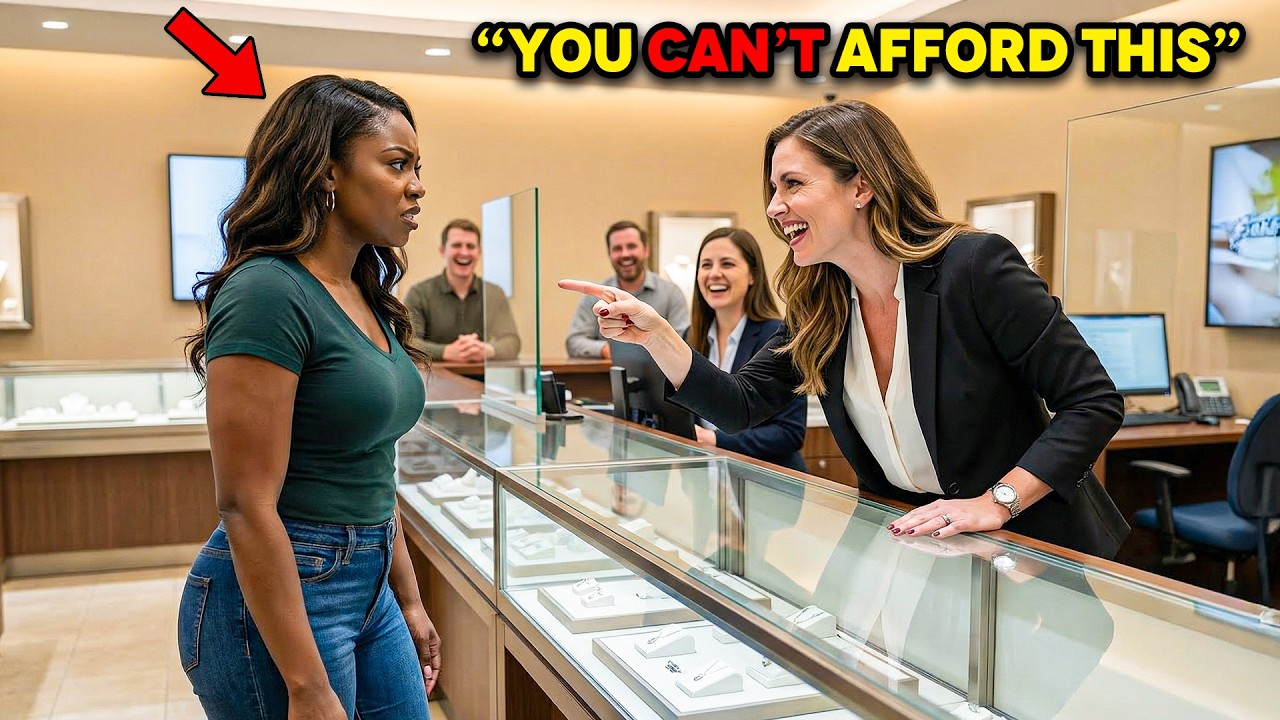
“If You Can Afford This, I’ll Quit” Manager Mocked Black Woman—Unaware She Was A Billionaire
close
arrow_forward_ios
Read more
00:00
00:00
01:31
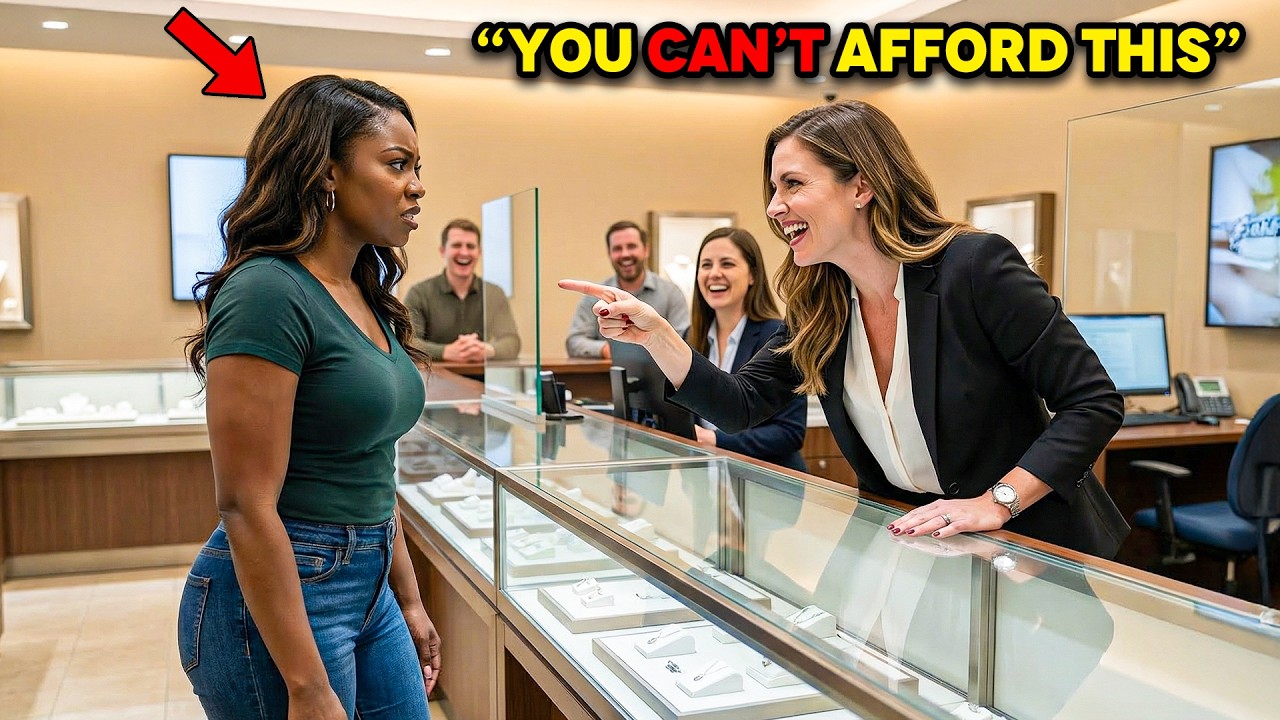
Honey, if you can actually afford this necklace, I’ll quit. Irene Hubert leaned her elbow on the display case like she owned the world, which in her mind she did. Her voice carried, deliberate, meant to reach every corner of the showroom. The laughter followed instantly. Quick, decisive, people choosing sides.
Felicity didn’t move or flush. She didn’t look away. She stood there in dark jeans and a plain t-shirt, a worn canvas tote slung over her shoulder, ordinary enough to be dismissed at a glance, except it wasn’t. Inside that tote rested a black card. Behind that card was a billion-dollar holding company.
And behind that holding company was the building Irene was standing in. Before continuing, comment where in the world you are watching from and make sure to subscribe, because tomorrow’s story is one you can’t miss. The morning light hit the display cases at Hargrove and Lane like it had been hired to do so. Everything in that store was deliberate.
The white orchids on the reception pedestal, the soft jazz threading through the air, the way the overhead lights were angled to make the diamonds look like they were breathing. It was a beautiful place. It knew it was beautiful. And so did the woman who ran it. Irene Hubert stood at the center of the showroom floor with her arms loosely crossed and her eyes moving, always moving.
She was 32 years old, sharp-jawed, and put together in the way that took real effort to make look effortless. Her black blazer was pressed. Her highlights were fresh. She had managed this store for 3 years, and in 3 years she had never once let it forget who was in charge. Kylie. Her voice was low, crisp. The Maurice cases in the back left corner.
I want it front and center by 9:15, and stand up straight. You look like you’re apologizing for being here. Kylie, 23 and already trained to flinch, straightened immediately. Irene turned back to the floor. She saw everything. That was her gift, or so she believed. She could read a person in the time it took them to cross the threshold.
Shoes first, then bag, then the way they moved, confident or cautious, purposeful or just wandering. She’d built her whole philosophy on it. Appearance signals belonging. She’d said it so many times it had stopped feeling like an opinion and started feeling like a law. The door opened at 8:52. A couple stepped in, young, Latino, dressed nicely but not extravagantly.
The man had his hand at the woman’s back. They were looking at the Legacy Collection display with wide, hopeful eyes. Irene drifted toward them, smooth and unhurried. Good morning, she said warmly. Are you looking for something in particular? We were hoping to see the Oh, you’ll love our Celebration Collection.
She was already steering them, hand gesturing gracefully toward a case near the far wall. Beautiful pieces, very accessible price points, really lovely for anniversaries. She smiled the whole time. She never raised her voice. She never said anything cruel. She didn’t have to. The couple followed her because people usually did when they were being redirected by someone confident enough.
Irene was back at her post by 8:58. At 9:03, a man walked in. Mid-50s, white, wearing a rumpled jacket and carrying a coffee cup. Unremarkable, except that Irene had seen his photograph 3 weeks ago in the program for the Metropolitan Arts Gala. She was across the floor in under 10 seconds. Mr. Herman, welcome back.
She extended her hand. We have the Langley piece reserved for you. Can I offer you anything while you wait? He looked mildly surprised she remembered him. She always remembered. At 9:17, the door opened again. Irene didn’t look up right away. She was reviewing a receipt at the front desk, but she felt the shift in the room, the small, instinctive thing that happened when her staff clocked something and didn’t know how to handle it. She looked up.
The woman who had just walked in was black, 31 years old, and dressed in the plainest way imaginable. Dark jeans, a simple t-shirt, leather sneakers, not designer, just clean. No jewelry, no statement bag, just a worn canvas tote hanging from one shoulder. Her hair was natural, pulled back without fuss. She looked young, unbothered, like someone who had somewhere better to be and had stopped in anyway.
She did not look around the store the way most people did. She didn’t crane her neck at the displays or slow down near the entrance to take it all in. She walked directly to the Legacy Collection. Irene watched her. She nudged Kylie once with her elbow, a small, practiced gesture, and the two of them shared a look that didn’t need any words.
The woman leaned over the glass case and studied the centerpiece necklace. Platinum, diamonds, $1.4 million. She studied it the way you study something you are genuinely considering, not dazzled, not intimidated, just looking. Then she straightened and glanced toward Kylie. Excuse me, could I see that necklace up close? Kylie hesitated a half second too long. She looked at Irene.
Irene set down the receipt, smoothed the front of her blazer with one hand, and began walking across the floor. Her heels silent on the marble, her smile already forming. The particular smile she reserved for certain kinds of conversations, the kind she’d had a hundred times before, the kind she had always won.
Irene arrived at the display case the way she always did, like she owned it. She positioned herself between Felicity and the velvet tray without making it look intentional. It was a move she had perfected, a half step, a slight angle of the shoulder, enough to create a barrier without technically being one. She clasped her hands in front of her and let her smile settle into place like a mask she’d worn so long it had started to feel like skin.
Hi there. Her voice was warm, friendly even, but it was the kind of friendly that had a locked door behind it. Can I help you find something? Felicity looked up from the case. Yes, I’d like to see that necklace. She pointed to the centerpiece, platinum setting, graduated diamonds, the kind of craftsmanship that took a master jeweler 6 months to complete.
Could you take it out for me? Irene’s smile didn’t move, but something behind her eyes did. Of course. She paused, just long enough. I do want to make sure you have all the information first because this particular collection She gestured at the case with one manicured hand.
It’s our Legacy line. It’s quite specialized. The piece you’re looking at starts at $380,000, and the centerpiece necklace specifically is priced at $1.4 million. She said the numbers slowly, carefully, the way you speak to someone you’ve decided needs things explained simply. That’s fine, Felicity said. I’d still like to see it.
Something shifted in the room. Kylie, standing 6 feet away, went very still. The two customers browsing near the Celebration Collection, a woman in her 40s and a younger man who appeared to be her son, had stopped pretending to look at the display cases. Everyone was watching now. Irene tilted her head. I just want to be transparent with you because I’d hate for there to be any confusion.
She lowered her voice just enough to seem considerate while staying perfectly audible to everyone around them. These pieces aren’t like our other collections. There’s no financing, no payment plans. It’s the kind of purchase that She smiled again. Well, it’s a very particular kind of buyer. I understand that, Felicity said.
Her voice was even, quiet, steady in a way that should have been a warning. I’d like to see the necklace. Irene straightened. She glanced at Kylie, then at the two customers watching from across the room. She could feel the audience. She had always performed better with an audience. Okay, I’ll tell you what.
She leaned one elbow lightly on the top of the case, casual as anything. We also have a really gorgeous gift section right near the entrance. Beautiful pieces. Sterling silver, some lovely gold-plated items, really elegant options in the $200 to $500 range. She gestured toward the front of the store. I think you’d find something really special over there.
Felicity didn’t look toward the entrance. She didn’t move at all. “I didn’t ask about the gift section.” she said. The smile on Irene’s face curdled into something else. Not anger. Not yet. Something more dangerous. Amusement. The kind that needed witnesses. She looked over her shoulder at Kylie. A slow, deliberate look.
The kind that came with an expectation attached to it. Kylie’s eyes darted between Irene and Felicity. She understood what was being asked of her. She had learned in two years of working under Irene Hubert that there were two options when Irene looked at you like that. Perform or pay for it later. A small, uncomfortable smile crawled onto Kylie’s face.
Not confident. Not cruel. Just the desperate compliance of someone who had already calculated the cost of staying neutral and decided she couldn’t afford it. Irene turned back to Felicity, satisfied. And the words came out light as air. Easy as breathing. Delivered with the confidence of someone who had never once been wrong about anything.
“Tell you what, honey. If you can actually afford this, I’ll quit.” It landed like a slap. The younger male customer across the room snorted. Quick and unguarded. The woman beside him said nothing. Just looked sharply at the floor. Kylie’s smile faltered the instant the words were out. Like some part of her recognized, too late, that a line had just been crossed that she was now standing on the wrong side of.
But she didn’t correct it. She just stood there. Still and pale. Caught. Irene stood straight. Arms crossed now. Chin lifted. Satisfied. Certain. The silence that followed lasted four full seconds. Felicity held Irene’s gaze. She didn’t flinch. She didn’t flush. She didn’t look away or down or anywhere else.
She just looked at Irene with an expression that was impossible to read. Calm and deep. And somehow much older than her years. Like still water with no visible bottom. Then, very quietly, she said, “I’ll hold you to that.” She reached into the canvas tote and pulled out her phone. She dialed a number. And she waited. Felicity dialed like she was checking the weather.
No hesitation. No dramatics. She just pulled out her phone, found the number, and pressed call. Standing right there at the display case with the canvas tote on her shoulder and the centerpiece necklace still locked behind glass in front of her. Irene watched from two feet away. She kept her arms crossed and her expression loose.
The way you look when you’re trying to appear unbothered. And mostly succeeding. She had seen this before. The slow reach for the phone. The performance of having someone important to call. She had called the bluff on women like this a dozen times. It always landed the same way. Felicity held the phone to her ear.
When the line connected, she spoke three sentences. Short ones. She gave her name. She gave the store’s name. She said she needed a moment of someone’s time. Then she hung up. That was it. She slid the phone back into her tote and returned her attention to the display case. Studying the necklace again with the same calm, unhurried focus she’d had when she first walked in.
Like the call was already handled. Like whatever needed to happen was already in motion. And she could afford to be patient. Irene waited for something more. Nothing came. She exhaled through her nose. Barely audible. And drifted back toward the front desk. She had a store to run. Kylie was hovering near the Celebration Collection.
Straightening things that didn’t need straightening. The two customers who had been watching had gone back to their browsing. Or pretending to. The showroom resettled into its usual quiet rhythm. 11 minutes passed. The store’s landline rang. Irene picked it up at the front desk. Half distracted. Reaching for a pen out of habit. “Hargrove and Lane, Fifth Avenue.
This is Irene.” Irene. The voice on the other end stopped her cold. It was Martin Maurice. Not his assistant. Not a forwarded call. Martin himself. CEO of Hargrove and Lane. Calling from his office on the 43rd floor of a building 20 blocks north. His voice was the kind of calm that meant the opposite of calm. Measured.
Tight. Like a man holding something fragile with both hands and walking very carefully. “I need you to listen to me.” Irene straightened. “Of course.” “Is everything the woman on your floor? He didn’t wait for her to finish. The one you’ve been speaking with at the Legacy Collection.” The pen in Irene’s hand went still.
“Her name is Felicity Blanche.” A pause. Short and deliberate. “Her holding company is Blanche Global. Does that name mean anything to you?” It didn’t. Not immediately. And then, slowly, like a light coming on in a dark room, it did. Blanche Global. She had seen that name somewhere. A financial brief. A board memo that had been passed around the management team six months ago.
The kind of document that most store managers skimmed and filed without reading fully. Meridian Luxury Group. Hargrove and Lane’s parent corporation had brought on a major institutional investor. A significant one. “She’s” Irene started. “She is the primary institutional investor in Meridian Luxury Group.” Martin said.
“Her holding company owns a controlling position. Which means she holds an indirect ownership stake in every Hargrove and Lane location.” Another pause. Longer this time. “Including the one you are standing in right now.” The pen dropped onto the desk. Irene didn’t reach for it. “I need you to hear me very clearly.” Martin’s voice had not risen.
It didn’t need to. “Whatever Ms. Blanche requires, you provide it. Immediately. Without question. Do you understand me?” “Yes.” The word came out smaller than she intended. “Good.” The line went dead. Irene stood at the front desk for a moment that felt much longer than it was. The store continued around her.
The soft jazz. The cool air. The light bouncing off the cases. Completely indifferent to the fact that the floor had just dropped out from under her. She set the phone down carefully. Then she looked up. Felicity Blanche was still at the Legacy Collection display. Still standing in her dark jeans and her plain t-shirt and her canvas tote.
She hadn’t moved. Hadn’t checked her phone again. Or shifted her weight. Or done any of the small, restless things people do when they’re waiting to be proven right. She was just standing there. Patient as stone. Waiting to see what happened next. Irene Hubert had never moved so carefully in her life.
She retrieved the velvet tray from the back with both hands. Walking the length of the showroom like someone carrying something that could shatter. Except it wasn’t the tray she was afraid of dropping. It was herself. Her composure. The three years of authority she had built in rooms exactly like this one. Now balanced on the edge of a single phone call she hadn’t seen coming.
She set the tray on the counter in front of Felicity. And stepped back. “Ms. Blanche.” The name felt foreign in her mouth. 20 minutes ago she hadn’t known it. Now it was the only word in the room that mattered. “I I want to start by saying that I apologize if our earlier conversation came across in a way that was” “The necklace.” Felicity said.
Not unkindly. Not sharply. Just directly. Like a door closing on a conversation that didn’t need to happen. Irene stopped talking. Felicity leaned forward over the tray. She looked at the necklace the way a person looks at something they have already decided about. Not with longing. Not with hesitation. But with the quiet attention of someone confirming what they already know.
Her eyes moved over the setting slowly. The platinum band. The graduated diamonds stepping down from the center stone in a clean, deliberate arc. “The platinum grade on this” she said. “Is it 950 or 900?” Irene blinked. “950.” “And the center stone. The certification. GIA?” “Yes. Internally flawless. D color.
” Felicity nodded once. Like the answer had confirmed something she’d suspected. She tilted her head slightly. Studying the setting from a different angle. “The prongs are hand set.” “They are.” Irene’s voice was steadier now. Pulled back into familiar territory by the questions. Our master jeweler in Antwerp. The setting alone is approximately 6 months of work.
I can see that. Felicity straightened. She looked at the necklace one more moment. Then she looked at Irene. I’ll take it. The room went absolutely silent. Not the polite curated silence of a luxury showroom. Something different. Something electric. Kylie, standing near the service counter, stopped breathing for a visible second.
The woman in her 40s, who had been watching from across the room, lowered her phone without realizing she’d done it. Even the jazz seemed to quiet, as though the store itself was paying attention. Irene’s mouth opened, then closed. “Of course,” she said. “Of course. Let me Yes.” She reached beneath the counter for the transaction materials.
Her hands were not steady. She kept them below the counter’s edge as much as possible, willing them to cooperate, furious at herself for the trembling she couldn’t entirely control. She placed the transaction form on the counter and slid it across. Felicity set the canvas tote down at her feet, opened it, and produced a single card. Black.
Matte. No visible account number on the face of it. Just her name in small silver letters. She placed it on the counter without ceremony. $1.4 million dollars. Irene processed the transaction herself. She didn’t call Kylie over. She didn’t hand it off. Some part of her understood, without anyone telling her, that she needed to do this herself.
That this was something she had to stand inside of and feel completely. The confirmation printed. The receipt was long and formal and said everything a receipt needed to say. Irene placed the necklace back in its velvet box with hands that had finally steadied, mostly out of necessity. She folded the receipt, slid it into the branded envelope, set the box inside the signature carry bag.
Ivory, with the Hargrove and Lane crest embossed in gold on the side. She placed it on the counter. Felicity picked it up, opened her canvas tote, put it inside, then she turned and walked toward the door. The whole room watched her go. Nobody said anything. Kylie had found something on the service counter to stare at.
The two customers who had witnessed everything, the woman in her 40s and the young man beside her, were completely still, watching with the wide, unblinking attention of people who understood they had just seen something they would be describing for a long time. Felicity reached the door. She stopped. She turned. Just her head. Looking back across the length of the showroom to where Irene stood behind the counter, receipt still in her hand.
The look on Felicity’s face was not anger. It was not satisfaction. It was something far quieter and far more devastating than either of those things. It was pity. “You still have a job,” she said, her voice carrying easily across the still room. “Because I didn’t ask for you to lose it.
” She let that sit for exactly 1 second. “Think carefully about why.” She pushed the door open and walked out into the afternoon light. The door swung shut behind her. And Irene Hubert stood exactly where she was, holding a receipt for $1.4 million dollars, alone in the silence she had made. Felicity’s penthouse was quiet in the way that expensive places are quiet, completely, deliberately, like the noise of the world had been designed out of it.
She had changed out of the jeans and T-shirt and was sitting on the couch in a loose sweater, the television on low, a glass of water on the table in front of her. The ivory Hargrove and Lane bag sat beside it. The velvet box inside undisturbed. She hadn’t opened it again. She didn’t need to. The necklace wasn’t the point.
It had never been the point. She watched the news without really watching it. The day had settled into her bones the way difficult days do, not loudly, but with a dull, persistent weight. She was tired. Not broken. Just tired. She thought about Irene’s face when Martin’s call came through. The way the color had left it.
She thought about the receipt and the trembling hands and the pity she had felt. Real pity, not a performance. Standing at that door, she turned off the television at 10:00 and went to bed. She thought it was over. She found out it wasn’t at 6:15 the next morning. Her phone was on the nightstand. She reached for it out of habit before she was fully awake.
And the first thing she saw was a text from a college friend she hadn’t spoken to in 4 months. “Did this happen to you yesterday?” There was a link below it. Felicity sat up. The clip was 47 seconds long. Shaky. Shot from across the showroom on someone’s phone. Captured at an angle that caught the tail end of the confrontation. You could see Felicity at the counter, her back straight, her expression unreadable.
You could see Irene leaning on the case with that loose, theatrical confidence. You could see Kylie’s uncomfortable smile. You could see the younger male customer’s snort of laughter, brief and damning. The audio was partially muffled by distance, but Irene’s final line came through clearly enough. “If you can actually afford this, I’ll quit.
” The account that posted it belonged to someone named Petra Leroy. Her bio described her as a lifestyle and culture writer. She had 400,000 followers. Her caption read, “Watched a store manager publicly humiliate a black woman at a luxury jewelry store today. Smiled the whole time she did it. This is what discrimination looks like when it wears a blazer.
” The post had been live for 9 hours. It had been shared 4 million times. By 8:00, Felicity’s phone had filled up with messages from people who recognized the store, the display case, the interaction, everything except her name. Petra hadn’t known who she was. Nobody in that store had thought to find out. The woman in the clip was simply a black woman, unnamed, unidentified, which meant the story was being written entirely without her.
By 9:00, it had 12 million views. By 10:00, Hargrove and Lane responded. The statement came through their communications firm and landed on every major news platform within the same hour. It was four paragraphs of carefully constructed nothing, and Felicity read every word of it twice at her kitchen counter with her coffee going cold beside her.
The first paragraph expressed deep commitment to an inclusive and welcoming environment for all guests. The second acknowledged an unfortunate interaction that did not reflect the values of Hargrove and Lane. The third announced that Irene Hubert had been placed on paid administrative leave pending a full internal investigation.
A move dressed up to look like consequence and designed to function as protection. Then the fourth paragraph. “Security footage and additional context not captured in the circulating video indicate the interaction has been misrepresented in certain material respects. The customer in question was at all times treated with professionalism.
She completed a purchase and departed the store satisfied. We consider this matter resolved.” Felicity read that last sentence three times. She completed a purchase and departed the store satisfied. “We consider this matter resolved.” They had taken the $1.4 million dollar transaction, the moment that was supposed to mean something, the moment that was supposed to land, and turned it into a closing argument.
Proof that nothing happened. Evidence that she had walked out happy. They had used her own money to build the wall. Irene was on paid leave. Not fired. Not facing anything real. Sitting at home, collecting a paycheck, waiting for a news cycle to end. Felicity set her coffee cup down on the counter. Not hard. Not dramatically.
Just down. With the quiet, deliberate precision of a woman who has just made a decision she will not be talked out of. She stared at the statement on her phone screen. They had protected Irene. They had buried the story. They had done it efficiently, professionally, and completely. And they had done it using her own purchase as the weapon.
Margaret Rickson’s office was on the 31st floor, and it looked like her. Dark wood. Clean lines. A wall of windows overlooking Midtown that let in enough light to work by without making anything feel soft. There were no decorative items on the desk, just files, a legal pad, and a pen that had been used enough to show it.
The diplomas on the wall were hung straight and never talked about. Margaret herself was 63 years old with close-cropped natural hair and the kind of stillness that came from spending three decades in rooms where losing your composure cost you everything. She listened to Felicity without interrupting. That was the first thing Felicity had always appreciated about her.
Margaret let you finish. She let you lay the whole thing out, every piece, every sequence, before she touched any of it. When Felicity was done, Margaret picked up her pen. She didn’t write anything yet. She just held it. A discrimination lawsuit is winnable, she said. I want to be clear about that. What happened to you in that store is documented, partially on video, and witnessed by multiple parties.
She paused. But winnable and fast are two different things. Hargrove and Lane’s legal team is large, and they are experienced at exactly this kind of defense. We are talking about years of litigation, discovery motions, depositions, delays. She set the pen down. And during all of that, Irene Hubert sits at home on paid leave.
Martin Maurice runs his company, and the statement they published stays on the internet defining what happened before we get a single word in front of a judge. Felicity nodded slowly. I know. So, tell me what you’re actually thinking. Felicity was quiet for a moment. Outside, 31 floors down, the city moved at its usual relentless pace, completely indifferent.
“I want the pattern,” Felicity said. Not just what happened to me. If they’ve done this before, if there are other women who walked into that store and were treated the same way, then this isn’t an isolated incident. It’s a practice. She looked at Margaret evenly. That’s a different story. Margaret studied her. You have someone in mind for that.
I do. Roger Perry answered on the second ring, which meant he had been expecting her call, or he had been awake anyway. With Roger, it was usually both. He was 55 years old, broad-shouldered, with reading glasses he was always misplacing, and a reputation that preceded him into every room he entered. He had broken three major corporate cover-up stories in the past decade.
Two of them had resulted in federal investigations. The third had ended a political career that everyone assumed was untouchable. He was not a man who frightened easily, and he was not a man who let a story go once he had decided it was worth telling. Felicity told him what she needed. Not the full story. Not yet.
She asked him to look into Hargrove and Lane’s complaint history and Irene Hubert’s record quietly, without any publication commitment, without his name attached to anything. Just information. “How quiet?” he asked. “Completely.” A short pause. “Give me a few hours.” She trusted him because she had known him for 30 years, since they were both young and broke, and certain they were going to change something.
He had changed things his way. She had changed them hers. The friendship had survived the distance between those two paths, which was the best kind of friendship. She hung up and went back to work. The rest of Wednesday passed without incident, which was its own kind of discipline. Felicity answered no press inquiries.
Her assistant had fielded 11 by noon. Two television producers, four digital outlets, two newspaper reporters, two radio programs, and a podcast that described itself as covering stories the mainstream media ignores. She declined all of them through a single reply. “Ms. Blanche has no comment at this time.” She sat in meetings.
She reviewed contracts. She signed off on a logistics expansion her team had been preparing for 6 weeks. She did every ordinary thing the day required of her, and she did it without letting the weight of the morning show on her face. But it was there. It sat behind everything. Behind the meetings and the contracts and the phone calls, like a low sound you can’t unhear once you’ve noticed it.
The fourth paragraph of that statement. She completed a purchase and departed the store satisfied. By evening, Roger called. His voice carried the specific quality it got when he had found something worth finding. Not excited, not dramatic, just focused. “Stripped down. Seven formal discrimination complaints,” he said.
Four years. All settled quietly. Every single one buried under a non-disclosure agreement. A beat. Three of the complainants were black women. Felicity sat very still at her desk. “Find them,” she said. Thursday morning came in gray and cold. Felicity was at her desk by 7:15, working through a contract review that had been waiting since Monday.
Before all of this, before the store, before the statement and the video and the fourth paragraph that she couldn’t stop hearing. She had learned a long time ago that work was the most honest thing available to her. It asked straightforward questions and accepted straightforward answers. It did not profile her at the door.
Her assistant, Marcus, knocked at 8:45. “Martin Maurice is on line, too,” he said. He called personally. No assistant. Felicity looked up from the contract. When the CEO of a company calls without going through his own assistant first, it means one of two things. Either something has gone very wrong, or he wants you to believe that it hasn’t.
“Put him through,” she said. She picked up the line. “Mr. Maurice.” “Ms. Blanche.” His voice was warm, practiced. The kind of warm that cost money to develop. “Thank you so much for taking my call. I know you’re an extraordinarily busy woman, and I genuinely appreciate the time.” She said nothing. She let him have the silence.
“I wanted to reach out personally,” he continued, “because I think it’s important that you hear directly from me how deeply, deeply sorry I am about what occurred at our Fifth Avenue location on Tuesday. What you experienced was completely unacceptable, and I want you to know that we are taking this situation with the full seriousness it deserves.
” It was a good opening. Smooth. Genuinely difficult to argue with on the surface. “The investigation is ongoing,” he said. “And I can assure you that appropriate action will be taken. Irene Hubert does not represent our values, and her behavior does not reflect the standard we hold for every guest who walks through our doors.
I appreciate you saying so,” Felicity said. Neutral. Even. A brief pause. Then Martin shifted, barely perceptibly, like a man adjusting his footing on uncertain ground. “I also want to be candid with you because I respect you too much to be anything less.” He let that land for a half second. “There’s been a great deal of public attention on this situation over the past 48 hours, and I think we both understand that when something like this escalates, when it moves from an internal matter into a very public campaign,
the effects can be broad. They can touch things that neither of us necessarily intends.” Here it was. “Meridian’s share value has already moved two points since the video circulated,” Martin said. “Two points in 2 days. And given your position with the group, Ms. Blanche, I think you understand that any further escalation would have implications that extend well beyond Hargrove and Lane.
” He paused again. “I would hate for a situation that is already being addressed internally to cause collateral damage to investments that matter to both of us.” He was asking her to protect her own money by staying quiet. The audacity of it was almost beautiful. “I hear you, Martin,” Felicity said. Her voice was perfectly pleasant.
“Thank you for calling.” A beat of surprise on his end. He had expected more resistance or more capitulation. Either would have told him something useful. She gave him neither. “Of course,” he said. “I hope we can I’ll be in touch.” She hung up. She sat for a moment with her hands still resting on the phone. Then she picked it back up and dialed her financial advisor.
“Begin liquidating my full position in Meridian Luxury Group,” she said. “All of it. Start this afternoon.” By Thursday evening, Hargrove and Lane’s PR firm had made their next move. Felicity found out through Marcus, who had been monitoring the news coverage as she had asked. A morning show, one of the large national ones, the kind with a cheerful set and a live studio audience, had announced a segment for the following morning.
A special interview with Irene Hubert. The preview clip was 40 seconds long and had already been viewed 2 million times. Felicity watched it on her desktop. Irene sat across from the host in a cream-colored blouse, her hair down, her expression calibrated to something between wounded and resolute. The chyron beneath her read Facing the mob. A manager speaks out.
In the clip, Irene’s voice was soft and controlled. She talked about being devastated by the way the interaction had been taken completely out of context. She did not name Felicity. She didn’t have to. The framing did the work for her. Felicity watched it once. She did not watch it again. She picked up her phone and called Roger.
“How much do you have?” she asked. Friday morning arrived with the particular tension of a day that already knows what it carries. Roger was waiting in Margaret’s conference room when Felicity arrived at 9:00. He had a manila folder on the table in front of him and the expression of someone who had been up since 4:00.
Not because he couldn’t sleep, but because he hadn’t tried. Margaret sat across from him, legal pad open, pen in hand. The coffee in the center of the table was fresh. Nobody had touched it. Felicity sat down. Roger opened the folder. “I found one of them,” he said. “One of the three black women who filed complaints against Hargrove and Lane.
” He slid a single page across the table. “Her name is Julie Osbert. 61 years old. Queens. Spent 20 years in retail management before she filed her complaint 3 years ago.” He paused. “She signed the NDA 6 weeks after filing. Settlement amount is sealed, but based on the legal firm involved and the speed of resolution, I’m estimating somewhere in the low to mid six figures.
” Margaret picked up the page, read it without expression. “She signed willingly?” Felicity asked. Roger took off his reading glasses and set them on the table. “She signed because she had no real choice. Single mother. Couldn’t fund a prolonged legal battle. Hargrove and Lane’s attorneys made clear, very politely, that they were prepared to drag the process out as long as necessary.
” He folded his hands. “She needed the money. So she took it and she signed and she went home. And she has been carrying this story alone for 3 years.” The room was quiet for a moment. “Does she want to talk?” Margaret asked. “Not on record. Not yet. But through a mutual source, I was able to make contact and she’s willing to speak informally.
Enough to corroborate the pattern. Enough to confirm that what happened to Felicity wasn’t an accident or an aberration.” He looked at Felicity directly. “It’s how they operate.” Felicity nodded once, slowly. The second call that morning came from a number Felicity didn’t recognize. She almost let it go to voicemail.
She answered on the last ring. “Ms. Blanche.” The voice was young, careful. “My name is Petra Leroy. I think you know who I am. I got your number through It’s a long chain. I’m sorry. I wasn’t sure if you’d pick up.” Felicity leaned back in her chair. “I picked up.” A breath on the other end. “I wanted to call because I need you to know that what’s happening with that video, with the way Hargrove and Lane is spinning it, it makes me sick.
I posted that clip because what I saw was wrong and I wanted people to know it happened.” A pause. “I didn’t think they’d come after me for it.” “They sent you a legal letter,” Felicity said. “3 days ago. Cease and desist. They’re claiming the clip misrepresents the interaction and damages their brand.” She exhaled.
“I have 400,000 followers and I write about culture and lifestyle and I’ve never had a lawyer contact me in my life. I’m She stopped, steadied herself. “I’m scared, but I’m not taking it down.” Felicity was quiet for a moment. “Don’t take it down,” she said. By early afternoon, the four of them were in the same room.
Felicity, Margaret, Roger and Petra, who turned out to be smaller in person than her online presence suggested, with paint-stained fingers and the alert, watchful eyes of someone who notices everything. She sat at the end of Margaret’s conference table with her phone in front of her and her back very straight.
They laid it out together, piece by piece. Felicity’s account. Julie’s corroboration. Petra’s video. The seven settled complaints. The NDA pattern. Martin’s phone call. The morning show segment. The plan that formed over the next 2 hours was straightforward. Roger would write a fully documented investigative piece.
Not a reaction to the viral video. Not a celebrity story. But a serious, sourced examination of Hargrove and Lane’s documented history of discriminatory conduct. Felicity would go on the record. Julie’s account would be included, anonymized but unmistakable to anyone paying attention. The piece would name Irene. It would name Martin. It would establish the pattern with documentation behind every claim.
Target publication, the following Friday. Margaret submitted the completed article to the publication’s fact-checking team at 4:15 that afternoon. Roger drove straight from her office to his own to begin the sourcing review. Felicity took the elevator down to the lobby alone. She pushed through the revolving door into the cold afternoon air and stood on the sidewalk for a moment, the city loud and indifferent around her.
For the first time since Tuesday morning, she felt like the ground beneath her was solid. The week moved the way weeks do when you are waiting for something, slowly and then not at all. Monday through Wednesday, the work continued. Roger was deep in sourcing, running down every document, every filing, every paper trail that touched Hargrove and Lane’s complaint history.
Margaret was coordinating with the publication’s legal team, walking them through the corroborating materials line by line. Petra had taken down nothing. Felicity ran her company and answered no interviews and watched the news coverage with the detached attention of someone studying a map of terrain they are about to cross.
The viral video had settled into the internet the way these things do. Still circulating. Still generating commentary. But no longer exploding. The morning show segment with Irene had aired Friday and generated its own wave of reaction, split roughly in half between people who believed her and people who didn’t.
Hargrove and Lane’s paid leave announcement had bought them just enough goodwill with the portion of the public that wanted to believe institutions self-corrected when pressed. By Thursday, the article was 48 hours from publication. Felicity was at her desk at 7:15 that evening, working through a logistics brief her team had sent over, when her phone rang. She looked at the screen.
Julie Osbert. She picked up immediately. Julie was crying before the first word came out. Not quietly. The kind of crying that has been held back for hours and finally given up trying to stay contained. Felicity set down her pen and waited, giving her the space to find the beginning of what she needed to say.
It took a moment. “They called me,” Julie finally managed. “Their lawyers. This morning. I don’t I don’t know how they knew, Felicity. I don’t know how they found out.” Felicity’s hand tightened slightly around the phone. “Tell me exactly what they said.” Julie walked her through it in pieces, her voice breaking and steadying and breaking again.
The call had come at 9:14 Thursday morning from a senior attorney at the firm that had handled Hargrove and Lane’s original settlement with her 3 years ago. He had been professional, courteous, even, which somehow made it worse. He reminded her, with precise and carefully documented legal language, that her non-disclosure agreement was ironclad, reviewed and upheld in two prior instances, and that any cooperation with a journalist in any form, including anonymized accounts, constituted a material breach of that
agreement. Then he told her what a material breach would cost her. The full original settlement amount to be returned in its entirety. Plus damages. The figure he quoted was $340,000. “I don’t have that,” Julie said. Her voice had gone very flat. The crying had stopped, replaced by something quieter and more frightening.
“I used that money to pay off my house, my daughter’s tuition. I don’t have it, Felicity. I cannot” She stopped, started again. “I have a daughter.” Felicity closed her eyes for 1 second. “I know,” she said. “I’m sorry.” Julie’s voice fractured again on the word. “I wanted to do this. I wanted You have no idea how long I have wanted someone to finally” She couldn’t finish it.
“Julie.” Felicity kept her voice steady, calm, not because she felt calm, but because Julie needed someone in the room who did. “You don’t have to apologize to me. Do you hear me? Not for a single second.” They stayed on the line together for a few more minutes. Felicity said what could be said. She meant all of it.
Then Julie said good night and the call ended and the office went very quiet. Felicity sat without moving. Four minutes later, Roger called. She knew from the first syllable of his voice. “The publication pulled it,” he said. “Their legal team received a preemptive letter this afternoon, addressed directly to the editor-in-chief.
Hargrove and Lane’s attorneys put them on notice about the sourcing, the NDA implications, potential litigation exposure.” A pause. “Without Julie’s corroboration, the pattern can’t be verified in print. Everything else we have is strong, but the spine of the piece is gone.” Another pause, shorter. “The editor made the call an hour ago.
The piece is dead.” Felicity said nothing for a long moment. “Okay,” she said finally. “Felicity, I’ll call you tomorrow, Roger.” She hung up, sat back in her chair. The logistics brief was still open on her desk, completely irrelevant now. Outside, Manhattan hummed its indifferent hum 30 floors below. Margaret arrived 22 minutes later.
She had clearly come straight from her own office, coat still on, bag over one shoulder, reading glasses pushed up on her head. She sat down across from Felicity without preamble and the two of them held the silence together for a long moment, the way people do when words haven’t caught up to what just happened.
Then Margaret set her bag down, folded her hands on the desk and spoke. “They’ve done this before,” she said, flat, certain. “They know exactly how to do this.” Felicity opened her news alerts at 6:50 Friday morning and found her own name. It was the first time in her public life that had happened and it landed with a specific kind of wrongness, like hearing your voice played back on a recording, familiar and foreign at the same time.
She stood in her kitchen in the gray early light, phone in hand, reading the headline that Martin Maurice had handed to the financial press sometime Thursday night. “Billionaire’s personal vendetta rattles Meridian Luxury Group.” Two outlets had run with it. A third had picked it up by 7:00. The framing was consistent across all of them, clearly fed from the same source, shaped by the same hands.
Felicity Blanche, described in each piece as a major institutional investor, had initiated a significant divestiture of her Meridian Luxury Group position following a personal dispute at one of the group’s retail locations. Analysts quoted in the pieces used words like erratic and emotionally driven. One of them, a man whose photograph showed him smiling in a conference room, used the phrase “troubling lack of fiduciary judgment.
” Martin had not quoted himself directly. He never would, but his fingerprints were on every sentence. He had found a way to take the story of what happened to her in that store and replace it with a different story entirely, one where she was the problem, unstable, vindictive, a woman letting her feelings override her responsibilities.
He had taken her silence and filled it with his own version of her and because she had no public presence, no record of statements, no history of speaking for herself in any forum, there was nothing to contradict it. She put the phone face down on the counter. Roger called at 8:00. “I saw it,” Felicity said before he could speak.
“I’m sorry.” He meant it. He moved fast. “I should have anticipated.” “You couldn’t have.” She picked up her coffee, set it down again. “What do we have left?” A pause. “The two women whose complaints were dismissed without settlement. No NDAs. They’re reachable. But without Julie’s corroboration and without the article, their accounts alone aren’t enough to establish the pattern in print.
Any publication that runs something now, after the legal letter Hargrove and Lane sent, is going to be extremely cautious.” He exhaled. “We’d need something that changes the entire shape of the story.” Felicity said nothing. “Felicity.” His voice shifted. “Careful now,” feeling for the edge of something. “There is one thing that changes everything.
” “But it requires you to” “I know what it requires,” she said. She hung up and called Petra. Petra answered sounding like she hadn’t slept. She probably hadn’t. “I saw the articles,” Petra said immediately. “What they’re doing to you, framing you as irrational, like you’re the one who caused a problem.” Her voice cracked with genuine outrage.
“It’s the same thing they did with the video. They just keep rewriting it.” “I know,” Felicity said. “What do we do?” Felicity looked out the window at the city below, dense and gray and completely certain of its own importance. She thought about a question she had been carrying since Wednesday morning, since she’d sat in Margaret’s office and heard about seven complaints and three black women and a pattern that had been running for years behind clean glass and soft jazz and a smile that locked the door.
She thought about every woman who had walked into that store before her and been turned away before they even reached the display case. Every woman who had gone home and said nothing because what was the point? Every woman who had signed a document that cost her something she couldn’t get back in exchange for money she shouldn’t have needed and silence she shouldn’t have had to keep. She was 31 years old.
She had more money than she would ever spend. She had lawyers and journalists and a councilwoman’s direct line and she had been on the verge of letting this get buried. That evening, Felicity sat alone in her office. The logistics brief from earlier in the week was still on her desk, still waiting. The velvet box sat beside it.
She had brought it from the penthouse that morning without fully deciding why. She opened it now and looked at the necklace in the lamplight, $1.4 million of platinum and diamonds bought to prove a point to a woman who had already moved on to her next performance. She looked at it for a long time. Then she closed the box, picked up her phone and called Roger.
“Come to my office tomorrow morning,” she said. “Bring your recorder.” A beat of silence. “I’m going to give you the whole story.” Roger arrived at 9:00 with his recorder and no coffee. That told Felicity something. Roger always had coffee. The fact that he hadn’t stopped for it meant he had come straight from wherever he’d been, moving fast, not wanting to be late for something he understood mattered.
He set the recorder on the desk between them, small, black, unremarkable, and sat down without unpacking anything else. Felicity had a glass of water. No notes. “Before we start,” Roger said, “I need to ask you directly. Once this is out, it doesn’t go back. Your name, your history, your company, all of it becomes part of a public story that you have no control over once it’s printed.
Are you certain?” Felicity looked at him evenly. “Press record, Roger.” He pressed record. She started at the beginning. Not Tuesday. The real beginning. Southeast Washington, D.C. A neighborhood that the rest of the city looked through rather than at. A two-bedroom apartment above a dry cleaner where the smell of chemical solvent lived permanently in the carpet and the walls.
Her mother, Susan, a woman with hands that were always moving, always working, who cleaned houses 6 days a week for families who never learned her last name, who came home on Sunday evenings and sat at the kitchen table and counted what she had earned, stacking the bills in careful columns with a precision that Felicity had watched so many times she could still see it perfectly.
She talked about watching her mother move through those houses, efficient and invisible. She talked about understanding, very young, what it meant to be seen as a function rather than a person. She talked about deciding, somewhere around the age of nine, that she was going to build something that nobody could take away from her.
She talked about the first business, 28 years old, a $4,000 loan from a credit union that had made her prove herself three times before approving it. A logistics operation out of a rented garage in Maryland, running contracts that larger companies didn’t want to bother with. She talked about the years of 70-hour weeks and the accounts that went wrong and the partners who underestimated her and eventually regretted it.
She talked about the money coming, not all at once, but steadily, the way a tide comes in. First enough to live differently, then enough to operate differently, then enough that it stopped being the primary thing she was tracking. Then she talked about the stores. The first time, 31 years old, she had just closed a contract that would double her company’s revenue.
She walked into a luxury watch boutique in Georgetown wearing work clothes. She had come straight from a site visit and a sales associate followed her for 11 minutes before asking her to leave. She had not yet been a millionaire for a full year. She went home and said nothing to anyone. The second time, she was 30, building the business, not yet wealthy in any visible way, a clothing store on Michigan Avenue in Chicago, a security guard who kept drifting into whatever aisle she was in, close enough to make the point without making a scene. She
left without buying anything. She told herself it wasn’t worth the energy. And then, Tuesday. 31 years old, a billion-dollar holding company, a building she partially owned, and a woman in a blazer pointing her toward the gift section. She laid out every financial document, the Meridian stake, the terms of her institutional position, the divestiture she had initiated Thursday.
Then she reached into her desk drawer and produced her phone and played Roger the recording of Martin Maresca’s call. New York State allowed one-party recording. She had known that. She had pressed record 11 seconds into the conversation, the moment she understood what kind of call it was.
Martin’s voice came through the small speaker, warm and careful and completely unmistakably corrupt. Roger listened without moving. When it finished, he sat quietly for a moment. Then he made a note on the legal pad he had eventually pulled from his bag. The first note he had written in 3 hours of talking. She gave him the names of the two women whose Hargrove and Lane complaints had been dismissed without settlement, without NDA protection, and who had agreed through Margaret’s outreach to speak with him directly.
She gave him everything. By 9:00 that evening, the recorder had been running for 12 hours, broken only by two coffee breaks and one walk around the block in the late afternoon cold, when the weight of certain memories required movement to carry. Roger stopped the recording. He sat back, looked at her across the desk.
Felicity. His voice was quiet. This isn’t just an article. He paused. This is the story. She held his gaze for a moment. The velvet box was still on the corner of her desk, exactly where it had been all week. Then write it that way, she said. Sunday morning came in quietly. Felicity was up before 6:00, which was not unusual.
She made coffee, stood at the kitchen window, and watched the city come back to itself after the night. Delivery trucks, early joggers, the first yellow cabs cutting through streets that would be impossible by midday. She had slept better than she expected. Not well, but better. There was something about having spoken the whole truth out loud, all of it, for 12 hours straight, that had loosened something in her chest she hadn’t fully realized was clenched.
She had one call to make before Roger submitted the piece. She made it at 7:15. Pamela Madison answered on the second ring, which meant she had been awake already. At 66, she kept hours that alarmed her staff and impressed her opponents, of which there were many. She had chaired the New York City Commission on Human Rights for 6 years, had served two terms on the city council before that, and had spent her entire professional life doing the specific and exhausting work of making institutions answer for themselves. She and Felicity
had known each other for 8 years, not intimately, but with the particular respect of two women who had observed each other across enough rooms to understand what the other was made of. Felicity. Her voice was warm, but alert. Ready. I’ve been wondering when you’d call. I should have called sooner. You called when you were ready.
That’s what matters. A brief pause. Tell me where you are. Felicity told her. All of it, concisely, precisely, the way she had learned to communicate with people whose time was both valuable and genuinely limited. She covered the incident, the statement, the NDA pattern, Julie, the killed article, Martin’s phone call, and the recording she had of it.
She told Pamela about the two women whose complaints had been dismissed without settlement, without NDA, and who were prepared to file formally. Pamela listened without interrupting. When Felicity finished, there was a short silence, not hesitation, just the sound of a sharp mind organizing what it had just received.
You understand that once you file formally, under your full name, this becomes a matter of public record, Pamela said. The commission’s investigations are not confidential at the intake stage. I know. And you’re prepared for that. I’ve been prepared since Wednesday morning, Felicity said. I just needed the rest of it to be ready first.
Another pause, shorter this time. I’ll personally ensure the complaints receive full commission review, Pamela said. All three of them. Yours and the two additional filings. If the pattern is as documented as you’re describing, this will not be a quiet process. Her voice carried something underneath the professionalism, not quite anger, but its more useful cousin, resolve. It shouldn’t be.
No, Felicity agreed. It shouldn’t. They spoke for another 10 minutes, logistics, timing, the coordination between the formal filing and the article’s publication. Pamela’s team would be prepared to receive the complaints Monday morning. She would say nothing publicly until the article was live.
When the call ended, Felicity finished her coffee standing at the window, watching a man walk a large, unhurried dog along the empty sidewalk below. The dog stopped every few feet to investigate something invisible. The man waited each time without impatience. She rinsed her cup and went to her desk. Margaret had been working through the weekend.
She called at 10:00 Sunday morning with an update delivered in the clipped, forward-moving cadence she used when she was deep in the middle of something and didn’t want to lose momentum. She had filed a formal legal challenge to Julie’s NDA on Friday evening, a motion arguing the agreement had been signed under conditions of financial duress, with inadequate time for independent legal review, and that the enforcement threat leveled against Julie constituted an improper use of a civil settlement mechanism to suppress witness cooperation.
It would take weeks to resolve, possibly longer, but the filing created a legal record that the challenge existed, that someone was pushing back formally, in writing, in a court that would have to respond. It plants the flag, Margaret said. Even if it doesn’t move quickly, they know we’re coming. Good, Felicity said.
By 2:00 Sunday afternoon, Roger had submitted the completed article. 6,000 [snorts] words, every claim sourced, every document attached. The two women who had filed dismissed complaints had spoken to him directly and on record. Martin’s recorded phone call was transcribed in full and verified by the publication’s audio team.
The headline, chosen by the editor after 20 minutes of deliberation, was simple and exact. She bought the necklace. Then they tried to bury her. The article went live at 6:00 in the morning Monday. By noon, it was the most read piece in the publication’s online history. Felicity was in a logistics meeting when Marcus slipped a note across the table to her with the number written on it, the read count, updated every hour.
She She at it once, folded it, slid it into her jacket pocket, and returned her attention to the meeting. Felicity’s phone did not stop. She let it go. She was back at her desk by 1:00 Monday afternoon, 6 hours after the article had gone live, working through a supplier contract that had been sitting in her inbox since Thursday.
Marcus had forwarded her the read count update, the numbers climbing in a column, updated hourly. And she had not looked at it again. She had done what she could do. The rest of it was no longer in her hands, and she had made her peace with that somewhere between submitting the piece and waking up this morning.
The world outside her window was doing what it does. She let it. By 3:00 Monday, Irene Hubert’s name was everywhere. The careful positioning she had built over the past week, the sympathetic morning show appearance, the background interviews with friendly outlets, the tearful framing of herself as a woman facing a social media mob, had been constructed on the assumption that Felicity would stay nameless.
That the woman in the video would remain an anonymous figure, a symbol rather than a person with a documented history and a legal recording of the CEO’s phone call. The article had removed that assumption entirely. Irene was named in full. Her conduct was corroborated from three independent directions: Felicity’s first-hand account, Petra’s video with its clear audio, and the testimony of the two women whose discrimination complaints had been dismissed without settlement.
The article described the interaction in precise, sequential detail. The redirection to the gift section, the audience she played to, the line she delivered with her elbow on the display case like she was telling a joke she’d already heard the punchline to, “If you can actually afford this, I’ll quit.” Printed in a sentence, sourced, verified, permanent.
By Tuesday morning, two former Hargrove & Lane sales associates had come forward publicly. Not to Roger, but to two separate outlets that had been following the story since the article broke. Both had left the company within the past 18 months. Both described, in their own words and with their own specifics, a floor culture under Irene’s management that operated on a single unspoken rule.
Assess the customer at the door and adjust your approach accordingly. One of them used a phrase that circulated widely by Tuesday afternoon. She said Irene had a word for customers she had already decided weren’t worth the time. She called them browsers. The word landed like a stone in still water. Martin Maurice’s strategy collapsed from a different direction.
His attempt to frame Felicity’s Meridian divestiture as erratic and emotionally driven had seemed, on Thursday, like a clean move. Get ahead of the story, control the financial narrative, make her look unstable before she could make him look culpable. It had worked for approximately 72 hours.
Then the article published, and financial journalists who had run his version of events on Thursday morning began reading the sourced documentation that Roger had spent 2 weeks assembling. The NDAs, the seven settled complaints, the complaint suppression pattern. The timeline of Martin’s phone call, placed the morning after the incident, before any investigation had occurred, asking a woman who had just been publicly humiliated in one of his stores to consider the impact on shared investments before deciding how loudly to respond. And then, the recording.
Martin’s own voice, warm and careful and completely exposed, asking Felicity to be quiet in exchange for the protection of her own money. By Tuesday evening, the story was no longer about a store manager in a blazer. It was about a corporation that had spent 4 years building a system designed to absorb discrimination complaints and continue unchanged, settling quietly, sealing with NDAs, and counting on the people it had wronged to eventually run out of resources or resolve.
Three members of Meridian Luxury Group’s board issued a joint statement Tuesday night calling for an independent operational review. The statement did not mention Martin by name. It didn’t need to. Everyone reading it understood what an independent operational review meant and who had made it necessary. Wednesday morning, 9 days after Irene Hubert had leaned on the Legacy Collection display case with her elbow and made her offer, Hargrove & Lane published a three-sentence statement announcing the temporary closure of
their Fifth Avenue flagship location for internal review. Felicity read it at her desk with her morning coffee. Marcus had printed it and left it on top of her files without comment. She read it once, set it down, picked up her coffee. Outside, the city moved the way it always did, loud and indifferent and relentless.
But something had shifted inside it. Something small and real and permanent. A door had closed. And this time, it wasn’t the one they had tried to close on her. Three weeks passed. They passed the way the aftermath of difficult things always passes. Not cleanly, not all at once, but in pieces. A development here, a statement there.
A door closing somewhere that you didn’t even know had been open. Felicity tracked it the way she tracked everything, quietly, from a distance, through Marcus’s daily briefings and Margaret’s updates and the occasional call from Roger, who was still pulling threads even after the article had been published. Because Roger was constitutionally incapable of leaving a story alone until it had told him everything it knew.
Hargrove & Lane’s Fifth Avenue flagship reopened on a Thursday morning, 3 weeks and 2 days after it had closed for internal review. The window displays had been refreshed. The orchids on the reception pedestal were new. The jazz was the same. It was always the same. And the light still hit the display cases at that particular angle that made the diamonds look like they were breathing.
The operational management team was entirely different. Irene Hubert’s name appeared on no roster, no internal directory, no staff communication. She was simply absent, the way things are absent when they have been removed rather than lost. Felicity learned this through Margaret, who had a contact inside the new management structure.
There had been no dramatic termination scene, no public announcement, no moment of visible reckoning in the store she had treated as her personal kingdom for 3 years. There didn’t need to be. The luxury retail industry was a specific and interconnected world. Everyone knew everyone. References traveled fast and reputations traveled faster.
Irene had spent the weeks since the article making calls to former contacts, to competing boutiques, to the regional managers of two other luxury groups she had cultivated relationships with over the course of her career. The calls were not returned. The doors that had always been open to her were not exactly closed.
They were simply, quietly, unavailable. No explanation offered. None needed. The career she had built entirely around deciding who belonged in beautiful rooms had locked her out of every beautiful room she knew. Felicity did not feel triumphant when she heard this. She felt the specific, tired satisfaction of a thing being true that should have always been true finally becoming true.
It was not joy. It was closer to relief. Martin Maurice resigned from Meridian Luxury Group on a Tuesday, 11 days after the article published. His statement was released through the company’s communications firm at 4:30 in the afternoon. Late enough to miss the morning news cycle, early enough to make the evening one.
It was four sentences. It cited a desire to pursue new opportunities and expressed gratitude for the privilege of leading the organization. It contained no acknowledgement of anything that had happened. It was the statement of a man who had decided that the most dignified exit available to him was the one that said the least.
The board’s independent review was ongoing. Felicity’s recording of Martin’s phone call had been submitted as part of the commission’s formal investigation. What would come of that and when was a question for lawyers and time. But Martin Maurice was no longer the CEO of Meridian Luxury Group, and the position he had used to pressure a discrimination victim into silence had been taken from him.
That was enough. For now. The call that mattered most came on a Wednesday afternoon. Margaret’s voice, when Felicity picked up, had the particular quality it got when something had gone right after a long time of things going sideways. Controlled but warm underneath. Julie. She said simply. Felicity sat forward.
Meridian Luxury Group’s new legal team operating under the board’s directive to conduct a full review of outstanding legal exposure had contacted Margaret 3 days earlier to open renegotiation on Julie’s NDA. The original enforcement threat had been quietly withdrawn. In its place, a new offer. A full release from the non-disclosure agreement allowing Julie to speak freely and publicly if she chose.
And a renegotiated settlement figure. Four times the original amount. Margaret had countered at four times. They had accepted without negotiation. “She can say whatever she wants to whoever she wants for the rest of her life.” Margaret said. “And she is financially whole.” “Better than whole.” Felicity sat with that for a moment.
“Can I call her?” she asked. “She’s been waiting for you, too.” Julie cried for the first 4 minutes of the call. Not the fractured, frightened crying of 3 weeks ago when the lawyers had called and the $340,000 figure had landed on her like something physical. This was different. This was the sound of something that had been held too tight for too long finally being put down.
Felicity let her cry. She didn’t rush it or redirect it or fill it with reassurances. She just stayed on the line and waited. Because sometimes the most useful thing you can offer another person is the space to feel the full weight of what has just been lifted. When Julie finally spoke, she said, “I just want people to know it happened.
” “They will.” Felicity said. “You can tell them yourself now.” Another silence. Quieter this time. “Thank you.” Julie said. Felicity shook her head though Julie couldn’t see it. “You held on for 3 years.” “That was you.” They stayed on the line for 20 minutes more. When the call ended, Felicity sat at her desk for a long moment in the early evening quiet of her office.
Then she opened her email and pulled up Margaret’s summary. A single document laying out every outcome, every resolution, every door that had closed, and everyone that had opened over the past 3 weeks. She read it through once. All of it. Then she typed two words in reply. “Thank you, Margaret.” She hit send and went back to work.
5 weeks after the article published, the mornings had gone back to being ordinary. That was the thing nobody told you about the aftermath of something significant. The way life eventually reclaimed its shape around it. The meetings came back. The contracts came back. The coffee went cold on the desk because she had gotten absorbed in a call and forgotten it was there.
The city outside did what the city always did. Which was everything all at once without pausing to acknowledge that anything had changed. Felicity had changed. She knew that. But it lived quietly in her now. The way important things do once they have finished being urgent. The envelope arrived on a Thursday morning.
Marcus brought it in with the rest of the day’s mail. A small stack, mostly formal correspondence and set it on the corner of her desk. He pointed to it briefly. “That one’s handwritten.” “No return address.” “Postmarked Baltimore.” She looked at it when she had a moment, which turned out to be 11:15 between a supplier call and a review session with her operations team.
She picked it up, turned it over once, and opened it. Inside was a single sheet of lined notebook paper folded in thirds covered front and back in careful, close handwriting. The kind of handwriting that had been taught, practiced, taken seriously. The letter was from a young woman named Destiny. 22 years old, a college junior studying business at a university in Baltimore.
She wrote that she had read the article 5 weeks ago. The full 6,000 words of it. Which she mentioned specifically like she wanted Felicity to know she hadn’t skimmed. And that she had read it again 2 days later. And once more the week after that. She wrote about her mother. About how her mother had always told her to dress up before going anywhere nice.
To do her hair. To wear something that communicated effort. To make herself acceptable before walking through any door that felt uncertain. She wrote that she had grown up understanding this as love. Which it was. And also as armor. Which it also was. And also as a kind of shrinking that she had never had a word for until she read about a woman who walked into a store in dark jeans and a plain t-shirt with a canvas tote on her shoulder and did not shrink for anyone.
“I never thought I was allowed to just walk in as myself.” Destiny wrote. “Like myself wasn’t enough to justify the space I was taking up.” “You made me think maybe it is.” “Maybe I’ve always been enough and I just kept being told I wasn’t in ways too quiet to argue with.” The letter ended simply. No ask, no request. Just a thank you.
Written in the same careful hand as the rest of it. Felicity read it twice. She sat for a long time after that. Long enough that the review session with her operations team started without her. Which had not happened in recent memory. She was not reading. She was not working. She was just sitting with the letter on the desk in front of her.
And the velvet box beside it. And the particular weight of being seen clearly by someone she had never met. She took out a sheet of her personal stationery. It was cream-colored. Heavyweight. With her initials embossed at the top in a dark gray that was almost black. She used it rarely. For things that deserved the formality of paper and a pen.
And the time it took to mean every word. She wrote for 40 minutes without stopping. She told Destiny about her mother Susan. About the dry cleaner smell in the carpet. And the careful columns of bills on the kitchen table on Sunday evenings. She told her about the first store that turned her away at 31.
And about going home and saying nothing. And about the long arithmetic of deciding over many years and many silences that staying quiet was a strategy she had run out of patience for. She told her that fear dressed up as caution is still fear. That the instructions to make yourself smaller. Dress up. Be acceptable. Don’t give them a reason. Came from love.
And she honored that love. And she also refused to obey it anymore. She ended the letter the way she had ended nothing else she had ever written. Because she had never before said it to someone who needed it in quite this way. “They taught us that making ourselves small was protection.” “But smallness is not safety.
” “It is just a slower way of disappearing.” “Take up your full space, child.” “Every inch of it belongs to you.” She folded the letter. Sealed the envelope. Set it aside for Marcus to send. Then she opened the velvet box. The necklace lay against the dark fabric exactly as it always had. Platinum and diamonds. $1.4 million.
The craftsmanship of 6 patient months in Antwerp. It caught the morning light the way it had caught the light in the store. The way it had caught the lamplight on the nights she had opened the box and sat with it and tried to decide what it meant. She had bought it because she could. Because a woman in a blazer had decided she couldn’t.
And she had needed the world to know that woman was wrong. But it was not hers to keep. She picked up her phone and called Margaret. “I need to set something said. “A full 4-year scholarship.” “The recipient is a 22-year-old junior in Baltimore named Destiny.” She paused. “And I need you to draft a letter of intent.
” “On the day she graduates, I want this necklace waiting for her.” A brief silence on Margaret’s end. Not surprise. Margaret was not easily surprised. Just the small pause of a woman absorbing something and deciding it was right. “I’ll have the paperwork to you by end of week.” Margaret said. “Thank you.” She closed the velvet box gently. Set it back on the corner of her desk.
Outside, Manhattan moved at its relentless, indifferent pace. Cabs and crowds and the low, constant roar of a city that did not pause for anyone. Inside, Felicity Blanched picked up her pen. And got back to work. If you enjoyed the story, leave a like to support my channel. And subscribe so that you do not miss out on the next one.
On the screen, I have picked two special stories just for you. Have a wonderful day.