

Off-Duty Cop Poured Drink On Fat Black Man’s Head—10 Seconds Later He Hit The Ground Hard
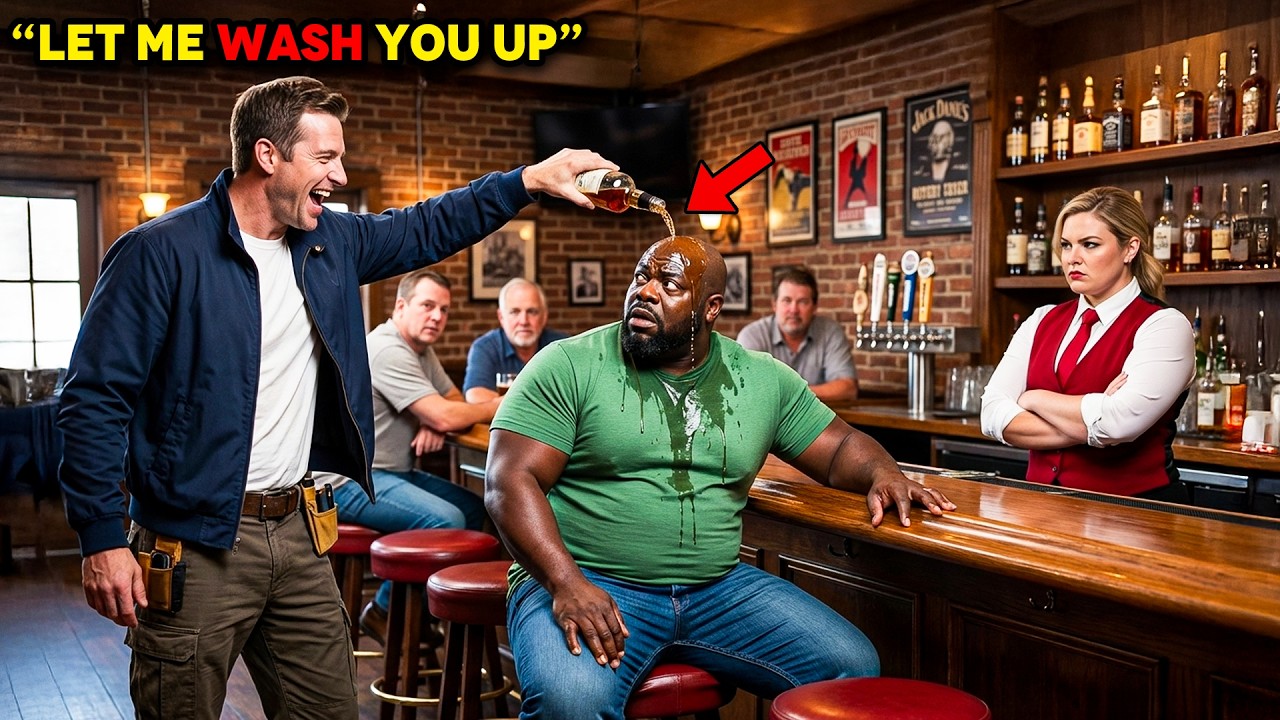
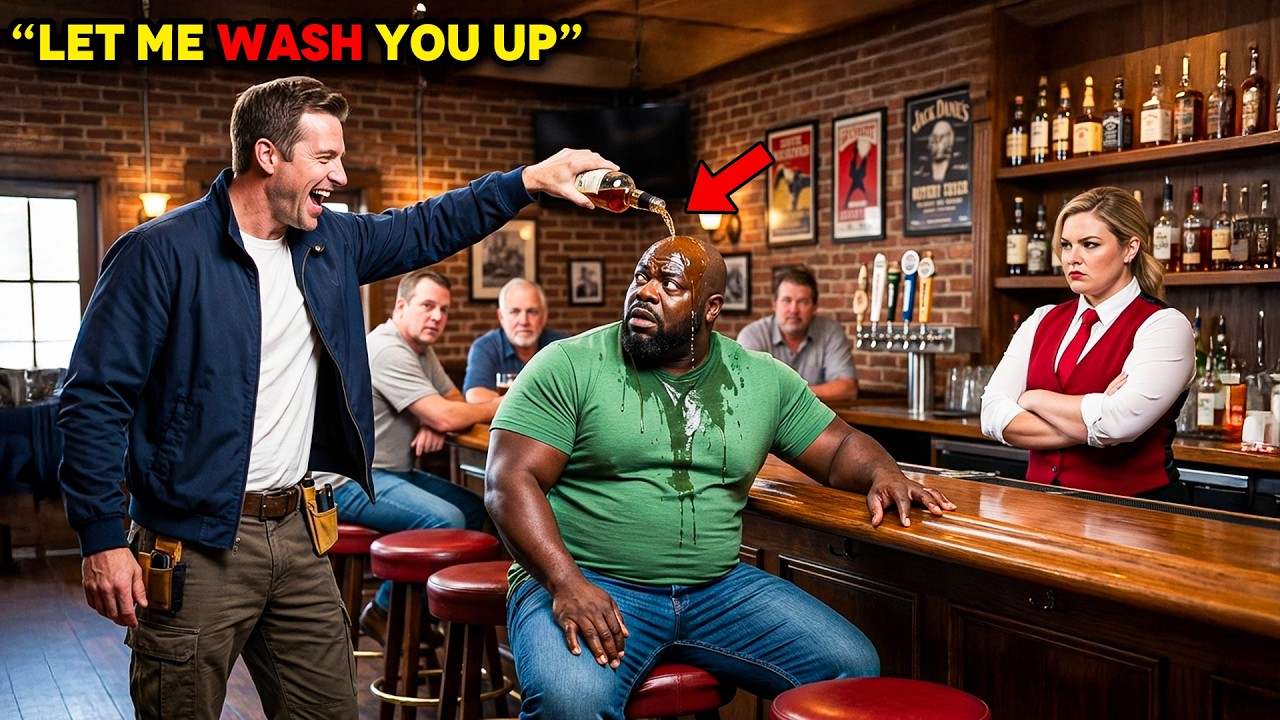
“Damn, man. Did you come here for a drink or to test the weight limit of the stool? You look so heavy.” Officer Henry Callahan’s voice cut through Teresa’s Place as he lifted his glass, then slowly tipped it over Marcus Dillard’s head. Every drop of the drink poured over Marcus’s head with deliberate contempt.
The bar watched in stunned silence as it streamed down his face and soaked his collar. Yet, despite the humiliation, Marcus Dillard didn’t move. Both his hands stayed flat on the bar, jaws set tight. Callahan set the empty glass down and laughed with his companions. What he didn’t know was that this single act of arrogance would cost him everything.
Before continuing, comment where in the world you are watching from and make sure to subscribe because tomorrow’s story is one you can’t miss. The bourbon was smooth. That was Marcus Dillard’s first thought as he settled onto the bar stool at Teresa’s Place on that Friday evening in late October. He turned the glass slowly in his big hand, watching the amber liquid catch the warm light above the bar, and he smiled to himself.
A quiet smile. The kind of man allows himself when something finally goes right. It had been a long time since something finally went right. Teresa’s Place sat on the corner of Broad and Ninth in Augusta, Georgia. And it had been there longer than most people could remember. The bar itself was dark polished mahogany, worn smooth by 30 years of elbows and conversation.
Old photographs lined the walls, civil rights marches, neighborhood celebrations, faces that had since grown old or passed on. The place smelled like oak and fried catfish and something that wasn’t quite perfume and wasn’t quite memory, but was somewhere between the two. It was the kind of bar that made you feel like you belonged the moment you walked through the door.
Marcus belonged here more than most. At 54, Marcus, Big Mark Dillard, was a hard man to miss. He stood 6 ft 4 in and carried 280 lb the way a mountain carries snow, naturally, without apology. His hands were the size of dinner plates. His shoulders were wide enough to block a door frame. He had spent 11 years in the NFL as an offensive lineman, protecting quarterbacks for a living, and his body still remembered all of it. But his eyes were warm.
That was what people noticed first once they got past the size. His eyes were the eyes of a man who genuinely liked people. He had earned that warmth the hard way. After football, after the knee surgery, and the slow fade from the sports pages, Marcus had come home to Augusta. He had taken a beat-up building on Walton Way and turned it into the Dillard Community Center.
15 years of his own money, his own sweat, and more grant applications than he cared to count. The center ran after-school programs, job training workshops, and a summer basketball league that kept kids off the street from June through August. It was not glamorous work. Nobody gave him a trophy for it.
But every Friday evening, Marcus Dillard sat at Teresa’s bar and felt like a man who had done something worth doing with his life. Tonight, that feeling was better than usual. “Two hundred thousand dollars,” Teresa Watkins said from behind the bar, shaking her head with a grin that creased her whole face. She was 61, small and sharp with silver-streaked locks and the kind of eyes that had seen everything twice.
“Boy, I remember when you were begging the city for 20.” “Don’t remind me,” Marcus said. “You did it, though.” She pointed at him. “Don’t forget that part.” Walt Greer raised his glass from the next stool over. “To Big Mark,” he said, “who apparently still has some moves left in him.” Marcus laughed and shook his head.
Walt was 68, white-haired with a soft Carolina accent and a laugh that belonged on a front porch. He had been a school teacher for 35 years and Marcus’s best friend for 20 of them. They had met at a neighborhood zoning meeting, both there for the same reason, both too stubborn to leave when the meeting ran 4 hours long, and had been friends ever since.
“The grant comes through and suddenly you’re a comedian,” Marcus told him. “I was always a comedian. You just couldn’t afford to laugh before.” The bar hummed around them. A couple at a corner table shared a plate of wings. Two older men played dominoes near the window. A birthday party of young women laughed loudly in the back booth, someone holding up a phone to capture the moment.
The television above the bar was showing a college football game with the sound low. It was, by every measure, a good night. Marcus was midway through a sentence about the new youth mentorship program he was planning when the front door opened. The noise that came in with the cold air was different from the noise already inside, louder, looser, the kind of noise that announces itself before it has a reason to.
Three men walked in. The two in back were younger, maybe early 30s, still in the kind of shape the police department required. But it was the man in front who owned the room the moment he entered it, or believed he did, which amounted to the same thing. Detective Henry Callahan. He was broad-shouldered and square-jawed with the kind of face that had probably been handsome once and now just looked hard.
He was laughing at something one of the other men had said, and the laugh was too big for the room, too comfortable with itself. His eyes swept the bar the way a man sweeps a room when he expects to own it. Then those eyes found Marcus, and they stopped. Callahan did not move right away. He just stood there at the edge of the bar’s warm light, that too-big laugh dying on his face, and looked at Marcus the way a man looks at something he has decided he does not like.
It was not a quick glance. It was the long deliberate kind, the kind designed to be noticed. Marcus noticed it. He turned back to his drink. Callahan and his two companions settled at the far end of the bar. Teresa moved toward them with the practiced neutrality of a woman who had managed difficult people for 30 years. She took their order without warmth and without hostility, just business.
But Marcus caught the small tension in her shoulders as she turned away from them, and he filed it quietly. For a few minutes, nothing happened. The birthday party laughed in the back booth. Walt told a story about a former student that went nowhere and was funny anyway. Marcus finished his bourbon and thought about ordering another.
Then Callahan’s voice cut across the bar. “They make these stools extra wide down here, or is that a special request?” The laughter from his companions was immediate, practiced, the kind that exists only to encourage. The bar went quiet in pieces, the domino players first, then the couple at the corner table, then Teresa, who stopped moving behind the bar entirely.
Walt set his glass down. Marcus kept his eyes forward and said nothing. “I’m serious,” Callahan said, louder now. “I’m trying to figure out the engineering in that situation.” Marcus breathed slowly through his nose. He had heard this his whole life. He had learned that silence was not weakness. Sometimes silence was the strongest thing in the room. He stayed silent.
Callahan pushed off the bar and walked closer. His companions followed at a lazy distance, drinks in hand, already smiling. “You’re Dillard, right?” Callahan said. “Big Mark. You’re the one who got up in front of the city council and told them to cut our overtime budget. Said the money should go to some little rec center instead.
” He tilted his head. “My guys worked doubles for 6 months, missed their kids’ birthdays, and you decided you knew better.” “I said what I believed,” Marcus said quietly. He did not turn around. “Yeah,” Callahan stepped closer. “that’s what bothers me.” Walt leaned forward. “Friend, I think you’ve had enough for one night.
” Callahan looked at him like something small that had made an unexpected noise. “Nobody asked you, old man.” Then he picked up his glass and poured every last drop of whiskey directly over Marcus Dillard’s head. The bar stopped breathing. Whiskey ran down Marcus’s forehead, over his eyes, along his jaw. It soaked into his collar and darkened his shirt.
A single drop hit the bar with a small, sharp sound that seemed enormous in the silence. Marcus did not move. He sat perfectly still, both hands flat on the bar, his jaw tight. He was choosing, consciously, deliberately, not to rise to it. He reached for a cocktail napkin and pressed it slowly to his face. “I’m going to ask you to step back.
” Marcus said. His voice was low and even. “Just step back.” Callahan’s smile curdled. Something in Marcus’s composure, the refusal to explode, the quiet dignity of it, seemed to enrage him more than any outburst would have. “Ask me?” Callahan said. “You don’t ask me anything.” And then he grabbed Marcus by the collar. Both hands, hard.
Yanking him half off the bar stool with the full force of a man who had never once been told no by anyone who mattered. Marcus caught the edge of the bar with one hand to keep from falling. Teresa shouted something. Walt was on his feet. One of Callahan’s companions took a half step forward. “Henry.
” The younger officer said. Callahan shoved Marcus backward. The bar stool screeched against the floor. Marcus caught himself, both feet planted, and held up one open hand, a clear, visible signal. “Stop.” He was still trying to end it without contact. Still trying to give this man a way out. Callahan did not want a way out. He shoved him again, harder.
His forearm driving into Marcus’s chest, backing him up against the bar. 10 seconds. That was how long Marcus Dillard held himself back. Then something shifted behind his eyes. Not rage, exactly. Something quieter and more certain than rage. The decision of a man who had been patient long enough. He planted his feet.
And with one short, controlled, open-palmed shove, straight from the shoulder, every pound of him behind it, he sent Henry Callahan stumbling backward off his footing and crashing hard to the floor. Glass shattered. The bar erupted. Callahan hit the floor hard. For a moment, he just lay there, blinking up at the ceiling of Teresa’s place, with the stunned expression of a man whose body had received information his ego had not yet processed.
His glass had shattered somewhere behind him. A bar stool was on its side. One of his companions had spilled his drink, catching himself mid-step. Then the bar erupted. Not in chaos. In applause. It started at the domino table and spread fast. The couple in the corner. The birthday party in the back booth.
A man at the far end of the bar who Marcus had never met in his life stood up and clapped like he was at a football game. Teresa pressed both hands flat on the bar and exhaled so hard her shoulders dropped 2 in. Walt Greer was on his feet with his glass raised. “That’s enough of that.” he said to nobody and everybody at once.
Callahan’s two companions rushed forward. The younger one crouched to help him up. The other one, the bigger of the two, thick through the neck, stepped toward Marcus with something ugly moving across his face. “You just put your hands on a law enforcement officer.” he said. “Your friend poured a drink on my head.
” Marcus said. “Then he grabbed me by the collar. Then he shoved me. Twice.” He said it calmly, the way you state facts that don’t require argument. “I defended myself.” “You’re going to want to think very carefully about what happens next.” the thick-necked one said. Teresa moved. She came around the bar with her tablet already in her hand.
And the look on her face was not fear. It was the look of a woman who had been waiting 30 years for exactly this kind of moment and had the receipts to handle it. “Let me help you think.” she said. She held the tablet up so Callahan’s companions could see the screen clearly. On it was the live playback feed from the bar’s security system.
Two cameras, high definition, time-stamped down to the second. The footage was already rewound to the beginning of the incident. She pressed play. The bar went quiet again. This time it was a different kind of quiet. Everyone watched. The screen showed Callahan walking over. It showed his mouth moving. It showed him pick up the glass.
It showed every single drop of whiskey falling over Marcus Dillard’s head while Marcus sat completely still, hands flat on the bar, not moving, not retaliating. It showed Marcus pressing the napkin to his face. It showed him hold up his open hand. It showed Callahan grab him by the collar and shove him. Twice.
It showed everything. “I’ve had these cameras running for 2 years.” Teresa said. She was speaking to Callahan’s companions, but her voice was loud enough for the whole bar to hear. “Two cameras, high definition, every angle covered.” She looked at the thick-necked officer directly. “Go ahead and call it in.
I will be standing right there with my attorney and this recording.” The thick-necked officer looked at the tablet, then at Teresa, then at Callahan, who had made it to his feet and was straightening his jacket with the careful movements of a man trying very hard to look like he had not just been knocked to the floor of a bar in front of 30 witnesses.
Callahan’s face was dark. His jaw was set. He looked at Marcus with something in his eyes that was colder and more deliberate than anger. Anger burns hot and quick. This was something that intended to last. But he said nothing. He picked up his jacket from the floor. He smoothed the front of his shirt. He looked once more at the tablet in Teresa’s hand.
And for just a moment, something moved across his face. Not embarrassment. Not remorse. Calculation. Then he turned and walked out of Teresa’s place without a word. His companions followed. The door swung shut behind them and the cold October air came in briefly and then was gone. For a half second, the bar held its breath.
Then it exhaled all at once. Laughter, conversation, the resumption of the domino game, someone in the birthday party letting out a whoop that made three people jump. Teresa set down her tablet, reached for the good bourbon, and poured Marcus a fresh glass without being asked. “On the house.” she said. Marcus accepted it. He was still damp.
His collar was still dark with whiskey. But he was smiling. Slowly. Then fully. The deep, rolling laugh of a man who had faced something ugly and watched it walk out the door on its own two feet. Walt sat back down and raised his glass. “Engineering problem solved.” he said. Marcus laughed and shook his head.
It felt finished. Clean. Like a storm that had threatened all evening and then simply passed. Marcus believed it was over. He had no way of knowing that Henry Callahan was already on his phone before he reached the parking lot. Marcus slept well that night. That was the thing that would stay with him later. How well he had slept.
He had come home from Teresa’s place just after 10:00, changed out of his whiskey-soaked shirt, eaten a bowl of leftover red beans and rice standing over the kitchen sink, and gone to bed feeling lighter than he had in months. The grant was real. The community center was safe. Even the ugliness at the bar had resolved itself cleanly, the way ugliness sometimes does when the truth is sitting right there on a tablet screen for everyone to see.
He slept like a man with nothing chasing him. His phone started at 7:14 in the morning. The first buzz he ignored. The second he rolled toward. By the third he was sitting up in bed squinting at the screen. And when he saw Tyler’s name, he felt something shift in his chest. The particular alarm a parent carries for their child, regardless of the child’s age. He answered on the fourth ring.
“Dad.” Tyler’s voice was tight in a way Marcus recognized. His son was 24 years old and studying law at the University of Georgia. And he had inherited his father’s composure along with his father’s broad shoulders. When Tyler’s voice got tight, it meant something was genuinely wrong. “You need to look at your phone.” “Right now.
” “I’m looking at my phone. I’m talking to you on my phone.” “Pull up Facebook. Pull up Twitter.” “Pull up anything.” A pause. “They beat us to it, Dad.” Marcus put Tyler on speaker and opened Facebook. The Augusta Police Union statement was already everywhere. Posted at 6:00 a.m. Which meant someone had been working on it since last night.
The language was careful and deliberate and made Marcus’s stomach turn. It described an unprovoked attack on a decorated law enforcement officer by a large, aggressive individual at a local establishment. It mentioned that the officer had been off duty, attending a private celebration. It used the word aggressive three times in four sentences.
It did not mention a drink. It did not mention a collar. It did not mention two shoves. Then Marcus saw the image. Someone had taken a still frame from Teresa’s security footage. He could tell by the angle, the timestamp stripped from the corner, and cropped it down to a single moment. Just one. Marcus’s open palm connecting with Callahan’s chest.
Nothing before it. Nothing after. Just a large black man with his hand on a white police officer. Isolated from every single second of context that explained why. The image was already attached to the union statement. It was already spreading. “Dad.” Tyler again. “It’s not just local.” Marcus looked.
Three national conservative media websites had picked it up within the hour. The headlines were variations of the same thing. “X NFL player attacks decorated cop at Augusta bar.” One of them had already generated 400 comments. He scrolled three comments deep and stopped scrolling. He set the phone face down on the nightstand and sat on the edge of his bed in the gray morning light.
His hands were resting on his knees. He looked at them. Those big, familiar hands, and thought about how a single image could take something true and turn it into something that looked true in the opposite direction. That was the craft of it. That was what made it so effective. They had not lied, exactly. The image was real.
The moment had happened. They had just removed everything that gave it meaning. His phone began buzzing against the nightstand. Not calls. Messages. Notifications. The particular swarm that builds when something has found its audience. “You need to call your attorney.” Tyler said. He had stayed on the line. “Today, Dad.” “This morning.
” “Not Monday morning.” “I know.” “And I’m coming up.” “You don’t need to.” “I’m already in the car.” Marcus picked the phone back up. He looked at the image one more time. Callahan’s people had moved fast, and they had moved smart. And somewhere under the anger that was building in his chest, Marcus recognized, with the cool assessment of a man who had spent a decade reading defensive formations, that this had been the plan all along.
The complaint at the bar had not been about humiliation. It had been about setup. The drink, the shove, the cropped image, the 6:00 a.m. statement. Henry Callahan had walked out of Teresa’s place last night calculating every step of this. Marcus stood up. He dressed slowly and deliberately, the way he always had before a game. Not rushing.
Not panicking. Thinking about what came next. Then he sat down at his kitchen table and dialed his attorney. Tyler was already on his way. The attorney’s name was Bernard Cole. He was 60 years old, thin, with reading glasses he was always either putting on or taking off, and the kind of measured calm that came not from being unworried, but from having learned long ago that panic was expensive.
He had been practicing law in Augusta for 32 years. Marcus had known him for 15 of them. Bernard Cole did not waste words, and he did not soften things he believed you needed to hear clearly. He did not soften this. “Henry Callahan filed a formal criminal complaint this morning.” Bernard said. He set a single printed document on the desk between them.
“Assault on a law enforcement officer. It’s a felony charge in Georgia, Marcus. That applies whether the officer is on duty or off duty at the time of the incident.” Marcus looked at the paper. He did not pick it up. Tyler, sitting beside his father, leaned forward with his elbows on his knees. “He grabbed my father first.
He shoved him twice. There’s security footage that shows the entire “I know what the footage shows.” Bernard said. He took his glasses off. “The problem is who is going to be standing between that footage and a courtroom?” He folded his hands on the desk. “The officer assigned to lead the investigation into your father’s case is a man named Detective Phil Burrows.
Phil Burrows and Henry Callahan came up through the department together. They’ve been friends for 20 years.” He paused to let that settle. “And the assistant district attorney who will decide whether to formally pursue these charges is a man named Gavin Fallon.” Marcus looked up. “I don’t know that name.” “You wouldn’t.
” “But you know his brother-in-law.” Bernard put his glasses back on. “Henry Callahan.” The room was very quiet. Tyler sat back slowly in his chair. Marcus looked at the document on the desk again. Really looked at it this time. And felt the full weight of what was happening arrange itself in front of him with ugly clarity.
This was not a complaint filed in anger. This was a structure. Callahan at the center. A friendly investigator on one side. A family member at the DA’s office on the other. It had been constructed piece by piece by someone who had done this kind of thing before. “What about the footage?” Marcus asked. “Teresa has everything on camera.
The whole incident from the beginning.” “Teresa’s footage is currently our strongest asset.” Bernard said carefully. “But Callahan’s attorney has already contacted me this morning, informally. He suggested, and I want you to hear this word, he suggested there may be grounds to challenge the admissibility of that recording.
” He held up a hand before either of them could speak. “I am not saying they will succeed. I am saying they intend to try. And with the judge likely to be assigned to any related hearings, I cannot promise you the outcome.” Marcus said nothing. Outside Bernard’s window, Augusta was going about its Saturday morning the way it always did.
Traffic moving. People walking. The ordinary, indifferent business of a city that did not know and did not care what was happening in this particular office on this particular morning. “There’s something else.” Bernard said. He looked at Marcus directly, the way he always did when the news required it. “Your community center’s grant documentation contains a standard morality clause.
A felony charge, not a conviction, Marcus, a charge, triggers an automatic funding review. Depending on how the board interprets their obligation, they may be required to suspend the grant until the matter is resolved.” The words landed like something physical. $200,000. 15 years of work. The youth mentorship program he had just started planning.
The summer basketball league. The job training workshops that had put 43 people back to work in the last 2 years alone. All of it sitting on the edge of a complaint filed by a man who had poured whiskey over his head and then planned the whole next morning before he hit the floor. Marcus stood up from the meeting 2 hours later and shook Bernard’s hand and walked to his car and sat in it for a long moment without starting the engine.
That afternoon, the community center board held an emergency meeting. Marcus sat at the head of a table and watched three of his seven board members exchange looks that told him everything about which way the wind was blowing. They were not bad people. They were scared people, which was sometimes more dangerous.
No decision was made that afternoon. But the question had been asked out loud. And questions like that, once spoken in a room, have a way of not leaving. Marcus drove home alone as the sun went down over Augusta. And the silence in the car was the heaviest thing he had carried in years. The weekend had not been kind.
By Sunday evening, Marcus had changed his personal cell number twice. The first number he gave only to Tyler, Bernard Cole, and Teresa. The second he gave to nobody at all, because by then it didn’t matter. The community center’s main phone line had received 11 voicemails since Saturday morning. And three of them were ugly enough that Tyler had quietly saved the recordings without telling his father how bad they were.
Marcus knew anyway. Monday morning came gray and cold. The kind of October morning that felt like a warning. Marcus and Tyler sat across from Bernard Cole in the same chairs they had occupied 2 days before. But the room felt different now. Smaller. The documents on Bernard’s desk had multiplied. Bernard did not waste time.
“I want you to understand the full picture.” he said. He laid three separate sheets across the desk like he was dealing cards. “Because what we are dealing with is not one man with a grudge. It is a network. And you need to see how it connects.” He walked them through it methodically. Detective Phil Burrows, assigned to lead the investigation, had been Callahan’s partner for 6 years before moving to a different unit.
They still golfed together on alternate Sundays. ADA Gavin Fallon, Callahan’s brother-in-law, would have direct influence over whether formal charges were pursued and how aggressively. And the judge most likely to be assigned to any suppression hearings or preliminary motions was a man named Samuel Hogan, who had been photographed twice at departmental charity events standing next to Callahan with the comfortable proximity of old friends.
Tyler stared at the sheets. So, the man investigating it, the man deciding whether to prosecute it, and the man who would rule on the evidence, they all have a relationship with Callahan. That is an accurate summary, Bernard said. That’s not a justice system, Tyler said. That’s a circle. Bernard looked at him over his glasses.
Welcome to Augusta, son. Marcus had been quiet through all of it. He was looking at the papers on the desk, but his eyes had the distant focus of a man running calculations in his head. He had spent 11 years in professional football studying systems, how they were built, where they were strong, where the gaps were.
What Bernard was describing was a system, tight, layered, and designed specifically to protect one of its own. How many times has he done this? Marcus asked. Bernard paused. Done what, specifically? Filed complaints after he started something. Used the system to flip the story. Marcus looked up.
How many times? Bernard removed his glasses slowly. That is a question worth pursuing, he said, but I don’t have that answer yet. Tyler did. Or rather, he knew who did. He had been thinking about it since Saturday morning, turning the name over in his mind the way you turn over a key when you’re trying to remember which lock it fits.
Violet Gilbert. Atlanta Journal-Constitution. He had come across her work eight months ago in a research paper he was writing for his criminal procedure class, a three-part investigative series she had written on misconduct patterns in mid-sized Georgia police departments. She was meticulous. She was fearless.
And she had been, according to the paper’s archives, actively covering Augusta PD for the better part of 3 years. If anyone had already been pulling on Callahan’s thread, it was her. After the meeting, Marcus and Tyler sat in the car in Bernard’s parking lot. Marcus was looking straight ahead through the windshield at nothing in particular.
A woman walked past on the sidewalk pushing a stroller. A delivery truck rumbled by. The ordinary world doing its ordinary things, completely indifferent. I want to reach out to a journalist, Tyler said. Marcus turned to look at him. Her name is Violet Gilbert. She writes for the AJC. She’s been covering misconduct in this department for years, Dad.
If Callahan has done this before, she may already have the documentation. And if she doesn’t, she’ll know how to find it. Tyler held his father’s gaze. We can’t fight this thing in a closed room. They own the closed room. We need to bring it outside. Marcus was quiet for a long moment. He thought about the cropped image, the 6:00 a.m.
union statement, the three connected men sitting between him and anything resembling a fair process. He thought about his community center and the kids who showed up every afternoon expecting the lights to be on. Then, he nodded slowly. Do what you need to do, he said, but do it right. Tyler pulled out his phone before they reached the end of the block.
Teresa called on Wednesday morning at 8:45. Marcus was at the community center sitting at his desk going through the grant suspension paperwork Bernard had forwarded the night before when his phone lit up with her name. He answered expecting her voice to be the steady, grounded thing it always was.
Instead, she sounded like a woman standing on uncertain ground, testing each word before she put her weight on it. They filed something, she said. My attorney just called me. Callahan’s people filed a legal motion. They want my security footage thrown out. Marcus set the paperwork down. On what grounds? he asked. Signage. Teresa said the word like it tasted bad.
They’re saying I didn’t have proper notification signs posted, the kind that tell customers they’re being recorded. Apparently, there’s a specific requirement under Georgia law about how visible those signs have to be, what size, where they have to be mounted. She paused. My attorney says the sign I have is real and it’s posted, but it might be in the wrong position.
Too high up. Too close to the door. Something about the exact wording. Another pause, longer this time. Marcus, if they get that footage thrown out, I know, he said. That footage is the whole truth. Everything that happened in order, the way it happened. Without it, it’s your word against his.
And his word comes with a badge and a brother-in-law at the DA’s office. He already knew that, too. What made it worse, what made Marcus’s jaw tighten as he sat in his office surrounded by photographs of children he had coached and mentored for 15 years, was the precision of it. Callahan’s attorney had not gone looking for a big, dramatic reason to suppress the footage.
He had gone looking for a small, technical, bureaucratic one. A sign in the wrong position. A font that was two points too small. The kind of paperwork violation that had nothing to do with truth or justice or what actually happened in that bar, but that a sympathetic judge could use as a perfectly legal tool to erase the one piece of evidence that told the whole story.
It was elegant in its way. And it was infuriating. When is the hearing? Marcus asked. Friday. Teresa’s voice tightened. They got it fast-tracked, Marcus. My attorney says the judge assigned is Samuel Hogan. Marcus closed his eyes for exactly 2 seconds. Samuel Hogan. Bernard had mentioned that name on Monday. Charity events. Old friends.
The comfortable proximity of men who took care of each other. I’m going to fight it, Teresa said. My attorney is already pulling photographs of the sign from every angle. We’re going to argue the placement was compliant. But Marcus, she stopped. I’ve been running this bar for 30 years. I have never once had a legal challenge filed against me this fast, by this many people, with this much organization behind it.
This is not a coincidence. No, Marcus said, it isn’t. After he hung up, he sat very still for a moment. Then, he called Tyler. Tyler listened without interrupting, which was how Marcus knew his son understood the severity. When Marcus finished, Tyler was quiet for 3 seconds. They’re trying to erase the tape before arraignment, Tyler said.
If they get it excluded before charges are formally filed, it poisons the well. Even if we try to introduce it later, Hogan has already ruled on it. It’s gone. That’s what it looks like. Then we need something else, Tyler said. We can’t put everything on Teresa’s footage anymore. We need to move faster. His voice shifted.
That particular register Marcus recognized as his son thinking out loud, sorting through options with the quick, deliberate mind that had earned him a place in one of the state’s best law programs. I’m reaching out to Violet Gilbert today. Not tomorrow. Today. If Callahan has a pattern of this, she may already have documentation we can use publicly, even if we can’t use it in court yet.
The hearing is Friday, Marcus said. I know. But a courtroom isn’t the only room that matters here, Dad. If this goes public the right way before Friday, it changes the pressure on everyone involved, even Hogan. Marcus looked up at the wall of his office. A photograph of last summer’s basketball league, 32 kids in matching jerseys squinting into the sun.
He had hung that photo himself with a level and a pencil mark, the way his own father had taught him to hang things, straight, careful, built to last. Make the call, Marcus said. Tyler was already dialing. Thursday morning arrived cold and still. Marcus was at home at the kitchen table working through a second cup of coffee and the notes Bernard had sent over about Friday’s suppression hearing when his phone rang at 8:20.
He saw Walt’s name and picked up immediately. Walt? There was a pause before Walt spoke. A pause that was half a second too long. When Walt Greer’s voice came through, it had a careful, controlled quality that did not belong to it. Like a man reading from a script he had rehearsed twice, and still wasn’t sure he had memorized.
“Mark,” he said. “I need to tell you something about last night.” Marcus set his coffee down. Walt told it slowly. Two detectives had come to his house Wednesday evening, just after 7:00. He had not been expecting anyone. They knocked with the easy authority of people who were accustomed to doors opening for them, and when Walt let them in, they settled into his living room chairs like they had been there before.
They introduced themselves as detectives from the Augusta PD. They said they were conducting a routine witness canvas related to the incident at Teresa’s place. Standard procedure. Nothing to be concerned about. For the first 20 minutes, it was exactly what they said it was. They asked Walt what he had seen.
He told them. They took notes. They were polite. Then one of them mentioned the house, casually, the way you mention the weather. He noted it was a nice place, well-maintained. Said he remembered a property tax dispute that the city had opened against the estate a few years back. Walt’s wife, Mara, had passed 3 years ago.
The estate matter had been complicated, and at one point, there had been a minor outstanding dispute with the city over an assessed value discrepancy. It had been resolved, or Walt had believed it was resolved. He had a letter somewhere confirming it. The detective said he wasn’t sure it had been fully closed out.
Said sometimes these things stayed open in the system longer than people realized. Said it might be worth checking into. Then they thanked Walt for his time, shook his hand, and left. They were in his house for an hour and 10 minutes. “They never raised their voices,” Walt said.
“They never made a single direct threat. They were perfectly polite the entire time.” He stopped. “But Mark, I know what that was. I am 68 years old, and I taught high school civics for 35 years, and I know exactly what that was.” Marcus’s hand had tightened around the phone somewhere in the middle of Walt’s story. He had not noticed until now.
“Did they give you their names?” he asked. “They gave me cards.” Walt read them out. Marcus wrote both names on the corner of Bernard’s notes. “Walt, I need you to listen to me. What they did, going to a witness’s home and referencing unresolved financial liability with the city, that is not a routine canvas. That is pressure.
And pressure applied to a witness in an active case is a federal matter.” Marcus kept his voice level. “You didn’t do anything wrong. You let them in. You told the truth. And you are going to be fine. But I need you to tell Tyler everything you just told me. Every detail. In order. Okay?” Walt was quiet for a moment.
“I still want to testify, Mark. I want you to know that. I’m not I’m not saying I’m walking away. Another pause. I’m just scared. I didn’t expect to be scared, and I am.” “That’s an honest thing to say,” Marcus told him. “And it matters that you said it.” After he hung up, Marcus called Tyler before he had set the phone down.
Tyler listened to the full account without a word. When Marcus finished, the silence on the line lasted exactly 4 seconds. Marcus counted them. And then Tyler said, with the flat precision of someone filing information into a specific mental folder, “That’s witness intimidation. Federal statute.
I need Walt to write down everything while it’s still fresh. Times, names, the exact language they used about the estate. All of it.” He called Walt immediately after. Walt talked for 40 minutes. Tyler typed while he listened. That afternoon, Tyler assembled everything into a single document. The two detectives’ names, the timeline, Walt’s verbatim account of the estate comments, and the case context that made the visit’s purpose unmistakable.
He attached it to an email addressed to Violet Gilbert, marked it urgent, and hit send. Her reply came in 11 minutes. Three words. “I’m coming down.” Violet Gilbert was not what Marcus had pictured. He had imagined someone loud, maybe. Someone who carried their ambition visibly, the way some journalists did, like a press badge worn on the outside of their personality.
Instead, the woman who walked into the coffee shop on Broad Street Friday morning was compact and quiet, with quick, observant eyes and the unhurried manner of someone who had learned that the most important information rarely announces itself. She shook Marcus’s hand first, then Tyler’s. She set a worn leather notebook on the table beside her coffee, and did not open it immediately.
“Tell me about Henry Callahan,” she said. So they did. Two blocks away, in the Augusta courthouse, Teresa Watkins sat beside her attorney while Samuel Hogan presided over the suppression hearing with the practiced efficiency of a man who had already decided his conclusion, and was moving through the procedural requirements to get there.
Teresa had described the hearing to Marcus in a text. “Hogan barely looked at our photographs. Kept checking his watch. The ruling would come later. For now, the footage existed in legal suspension, neither safe nor gone.” While the world outside the courthouse moved at its own speed, Tyler laid everything out for Violet in sequence.
He had brought the full document package he had assembled over the past week, printed, organized, tabbed. The three prior complaints against Callahan, sourced from public records requests Tyler had filed the previous year during a law school research project that had, by pure chance, crossed Callahan’s name.
Each complaint described a pattern. An altercation initiated by Callahan, a counter complaint filed against the other party, and a quiet internal resolution that left Callahan’s record clean and the other party with nothing. Two of the three complainants were black men. One was a Latino teenager who had been 17 at the time.
Violet read without interrupting. She turned pages slowly, and her pen moved in small, precise marks in the margin of her notebook. Then Tyler placed Walt’s written account on top of the stack. The Wednesday evening visit. The two detectives, the estate, the careful, threatening politeness of men who understood that a threat does not require a raised voice to land.
Violet looked up from that one. “He wrote this himself?” she asked. “The same night,” Tyler said. “While it was fresh.” She looked at it again. Then she closed her notebook, folded her hands on top of it, and looked at Marcus directly. “I have enough for a preliminary piece,” she said. “I want to be clear about what that means.
It will document the prior complaints, the connections between Callahan and the investigating officer and the ADA, and the witness contact. I will not print anything I cannot source.” She paused. “But what I can source is significant. And I want to run it today.” “Today?” Tyler said. “The suppression hearing is happening right now.
Your arraignment is scheduled for next Thursday. If this story runs before that ruling comes down, it changes the environment. It changes what it costs people to keep moving in the direction they’ve been moving.” She looked at Marcus. “I’ve been watching this department for 3 years.
Callahan’s name has come up before. I just never had a case public enough to build around.” She was quiet for a moment. “I’m sorry it had to be yours.” Marcus nodded once. “Run it,” he said. The piece went live on the Atlanta Journal-Constitution’s website at 4:17 that afternoon. By 5:00, it had been shared 1,400 times. By 6:00, it had been picked up by two national news networks.
By 7:00, a crowd of roughly 60 people had gathered outside Augusta PD headquarters with handmade signs, and by 8:00 that number had more than doubled. The DA’s office released a statement at 8:45. They were reviewing all elements of the Marcus Dillard case in light of newly surfaced information. At 9:15, Marcus’s phone rang.
It was a member of the grant board. Not a cold, official voice this time, but the personal cell of a board member he had known for a decade. The man said they were standing by. That they were not pulling funding while the facts remained publicly contested. That they believed in Marcus and in the work the center did.
Marcus thanked him and hung up. He was sitting at his kitchen table. Tyler was across from him, laptop open, watching the story spread across the internet in real time. The house was quiet except for the sound of the television in the other room where the Augusta PD headquarters was visible on the local news. The crowd outside it growing.
Marcus exhaled slowly. A long, full breath. The kind he had not allowed himself in a week. He looked at his son. “Maybe,” he said carefully, “it turns out okay.” Tyler looked up from the screen and almost smiled. Almost. The weekend had felt like a held breath. After the article, after the protests outside the precinct, after the DA’s statement and the board member’s call and Tyler’s quiet, almost smile across the kitchen table.
Marcus had spent Saturday and Sunday in a state of cautious stillness. Not hope, exactly. Something more careful than hope. The feeling of a man watching a dangerous thing from a safe distance. Not yet certain it couldn’t reach him. Monday morning answered that question. Bernard Cole called at 8:00. Marcus was already up, already dressed, already at the kitchen table with his coffee.
He answered on the first ring. “Judge Hogan ruled Friday afternoon,” Bernard said. “I wanted to wait until I had the full written order before I called you.” A pause that carried its full weight. “The footage is inadmissible. The signage violation held.” Marcus set his coffee mug down carefully. “Teresa’s sign was 11 in too high on the wall,” Bernard continued.
“That was the finding. 11 in.” His voice carried something underneath the professional calm. A quiet, contained outrage that a man of his experience and discipline would never let fully surface. “The motion was granted. The footage cannot be introduced as evidence in any criminal proceeding.” Marcus said nothing.
Outside his kitchen window, Augusta was a gray Monday morning. Clouds low, air cold, a garbage truck moving slowly down his street with the patient indifference of machinery. “There’s more,” Bernard said. There always was. The DA’s office had made its decision. With Callahan’s brother-in-law Gavin Fallon still in place, still operating without recusal, the office was moving forward with the felony assault charge.
Marcus was to present himself for formal processing that afternoon. Arraignment was scheduled for Thursday morning. Marcus processed himself at 2:00. It took 45 minutes. He sat in a plastic chair and answered questions in a flat, level voice and did not allow his face to show what was happening behind it. They took his photograph standing, facing forward, the small height marker on the wall behind him. The flash was brief and impersonal.
By 5:00, that photograph was on every local television news broadcast in Augusta. Ex-NFL player arraigned on felony assault charge following altercation with law enforcement officer. Tyler watched it from the community center where he had been working with Marcus all afternoon. He turned the television off before Marcus could see it.
Marcus had already seen it on his phone. At 6:15, the grant board called. It was not the same voice as Friday night. The warm, personal call from a decade-long colleague. This was the board’s official chairwoman and her voice had the formal, reluctant quality of someone reading from language that had been reviewed by an attorney before it was spoken aloud.
The morality clause had been triggered by the formal charge. Effective immediately, the $200,000 grant was suspended pending resolution of the criminal case. The community center was required to cease two of its three active youth programs within 30 days. Marcus thanked her. He used those exact words. “Thank you.” and hung up.
He sat at his desk in his office and did not move for a while. At 7:30, Walt called. Marcus could hear it in the first syllable. The guilt and the grief and the exhaustion of a man who had been carrying a weight he could no longer hold. “I can’t do it, Mark.” Walt’s voice was barely above a whisper. “I want to. God knows I want to.
But I’m 68 years old and I’m alone in this house and I don’t I don’t have the fight in me that you have. I never did.” A long pause filled with the sound of an old man trying to hold himself together. “I’m sorry. I am so sorry.” Marcus told him it was okay. He told him he understood.
He meant both things and he also felt something crack quietly in his chest as he said them. At 8:00, Henry Callahan appeared on the Channel 6 evening news. He was standing outside Augusta PD headquarters in a pressed shirt accepting his departmental commendation from the deputy chief. He shook hands. He smiled for the camera. That same confident, unbothered smile of a man for whom the system had never once failed to perform exactly as expected.
He said he was grateful for the support of his department and his community. Marcus turned the television off. He walked back to his office. He sat down in his chair. The photographs on the wall looked back at him. Children in basketball jerseys, teenagers holding certificates, a community built year by year from nothing.
He looked at them for a long time. Then he put his head in his hands. The room was very dark and very quiet. Tyler was on his father’s porch before sunrise. Marcus heard the car first. The familiar engine, the specific sound of his son’s door closing with the firm, purposeful click of someone who had somewhere to be. He was already awake.
He had not slept much. He had lain in the dark for most of the night staring at the ceiling with the particular wakefulness of a man whose mind refuses to stop working even when his body has nothing left. He had the front door open before Tyler reached the steps. His son looked like he hadn’t slept either. He was still in yesterday’s clothes, a legal pad tucked under one arm, and his phone in his hand.
And there was something in his eyes that Marcus recognized. Not desperation, not panic, but the focused intensity of a person who has spent all night turning a problem over and over until they found the angle that hadn’t been tried yet. “I need to go back to the bar,” Tyler said. “And I need you to stay here.
” Marcus looked at him. “What are you looking for?” “Something Callahan forgot about,” Tyler said. “Something nobody thought to ask about.” He held the doorframe with one hand. “Dad, Teresa’s footage got thrown out because it belonged to the establishment. The suppression ruling covers recordings made by the bar’s own security system.
But it does not cover footage recorded by private citizens on their personal phones.” He paused. “That night, there were other people in that bar and some of them had their phones out.” Marcus was quiet for a moment. He thought back to that Friday evening. The birthday party in the back corner booth. He had registered them peripherally.
The way you register background noise in a familiar space. A group of young women laughing, someone holding a phone up to capture the celebration. He had noticed them the way you notice a song playing in another room. They had been there. They had been recording. And they had been gone before the police arrived or the gravity of the situation announced itself.
“Go,” Marcus said. Teresa’s place didn’t open until 10:00 on Tuesdays. But Teresa was always there by 8:00. She opened the door for Tyler in her apron with a dish towel over one shoulder and when he explained what he was looking for, she sat down at the bar and thought about it with the careful seriousness of someone who understood exactly what was at stake.
“The birthday party,” she said slowly. “Yes. Corner booth. Eight women, maybe nine. Young. Late 20s, I’d say.” Teresa folded the dish towel in her hands thinking. “They had a reservation. I remember because they called ahead for the booth specifically. They wanted the big corner one.” She was quiet for a moment.
“Several of them had their phones out all evening. I remember thinking they were filming the whole night. Birthday content.” She looked at Tyler. “They left before everything happened with the police coming. Before I even realized I should be getting people’s information.” “Do you have any record of the reservation?” Tyler asked.
“A name? A phone number? A credit card on the tab?” Teresa moved behind the bar and opened reservations book. A physical ledger, handwritten, which she had kept by personal preference for as long as the bar had been open. She ran her finger down the page for that Friday. “Chandler.” She said. She turned the book toward Tyler. “Party of eight.
” “Reservation under Chandler.” Tyler wrote it on his legal pad and underlined it twice. He drove home and sat at the kitchen table with his laptop open and his legal pad beside him and began to search with everything he had. The date. The last Friday of October. The location. Teresa’s Place, Augusta. The name. Chandler.
He worked through Facebook first, searching event check-ins and tagged posts, then Twitter, then Instagram, which had become the natural home of birthday documentation. The stories, the group shots, the small captured moments of celebration that people posted without any awareness of what else their cameras might have caught.
He searched for 2 hours. He almost missed it. It was a post from 3 days before the incident. A countdown. “Birthday week starts now.” Tagged in Augusta, Georgia. The account belonged to a woman named Jasmine Chandler. “29 years old.” Her bio said. “Augusta, GA.” Tyler scrolled her profile with the focused care of a man diffusing something.
And there. The last post before the night of the incident. A photograph. Six women crowded into a corner booth laughing, glasses raised. The location tag clear and specific. Teresa’s Place. Tyler sat back in his chair and looked at the screen for a long moment. Then he picked up his phone. The message Tyler sent was careful.
He had written it three times before he sent it, sitting at his kitchen table with the early morning light coming through the window, choosing each word the way you choose footing on uncertain ground. He introduced himself by name. He explained who his father was. He described, plainly and without drama, what had happened at Teresa’s Place that Friday evening and what had happened in the days since.
He told Jasmine Chandler that he believed she might have been there that night. And that if she had recorded anything, anything at all, it might be the only thing standing between his father and a felony conviction for defending himself. He read it one final time. Then he sent it and set the phone face down on the table and made himself eat breakfast.
The phone buzzed 22 minutes later. “I remember that night. I had no idea any of that happened. Call me.” Tyler called. Jasmine Chandler’s voice was clear and direct with the particular alertness of someone who had just read something that rearranged their understanding of an evening they thought they already knew.
She told him she and seven friends had been celebrating her friend Carla’s birthday. They had reserved the corner booth specifically because it fit the whole group. She remembered the bar being warm and loud and good. She remembered the commotion near the front, a crash, raised voices, applause, and assuming it was just bar energy, the kind of random noise that happens on Friday nights.
She and her group had gathered their things shortly after and moved on to another spot. She had not connected it to anything significant. She had not known there was anything to connect. “That night,” Tyler said carefully, “were you recording on your phone?” A pause. “I record everything.” She said. “Carla’s birthday. I was getting it all.
The toasts, the group moments. I had my phone out pretty much the whole time we were there.” Another pause, shorter. “The story expired off my Instagram the next morning. I didn’t post most of it publicly, but I save everything to my camera roll before it disappears.” Tyler’s grip on the phone tightened. “Jasmine.” He said.
“I need to ask you to look at something. Before we say anything else, I need you to go to your camera roll and look at the videos you saved from that night.” The silence that followed was 40 seconds long. Tyler counted them. “Oh.” Jasmine said quietly. Just that one word, but the weight of it told him everything.
They met that afternoon at a coffee shop on Washington Road. Tyler, Marcus, Bernard Cole, and Violet Gilbert, who Tyler had called from the car on the way over. Jasmine arrived 5 minutes early. A young woman in a gray jacket with natural hair and careful eyes, holding her phone in both hands like she already understood she was carrying something important.
She sat down across from Marcus and looked at him for a moment. “I’m sorry this happened to you.” She said. Marcus nodded. “Thank you for being here.” She placed her phone on the table and opened her camera roll and found the video without hesitation. She had already watched it twice that morning, she told them.
She turned the phone so they could all see the screen and pressed play. The video began as what it was meant to be. A birthday. Jasmine’s friends crowded into the corner booth laughing, someone raising a glass, the warm amber light of Teresa’s Place surrounding everything. In the background, clearly visible over the shoulder of the woman nearest the camera, was the bar.
Marcus was on his bar stool. You could see him clearly. Then Callahan walked into the frame. Everything followed in sequence. The approach. The words, not audible but visible in posture and proximity, and the shifting of the bar’s attention. The glass rising, the pour, 10 full uninterrupted seconds of Marcus sitting completely still, hands flat on the bar, not moving.
The napkin. The open hand held up in plain view. Then the grab. The shove. The second shove. Then Marcus rising and what came after. The timestamp in the corner of the screen was intact, unbroken, and precise. Bernard Cole leaned forward. He watched the final seconds twice. Then he sat back in his chair and removed his glasses and pressed two fingers to the bridge of his nose.
“This footage was recorded on a private citizen’s personal device.” He said. “It was never part of Teresa’s establishment system. Hogan’s suppression order does not touch it.” He looked up. “This is completely and fully admissible.” Jasmine Chandler looked at Marcus across the table. “Tell me what you need me to do.” She said. For the first time in days, Marcus Dillard looked like himself again.
Tyler drove to Walt’s house alone. It was Wednesday evening, the sky going dark early the way it did in late October, the streetlights on Whitfield Avenue clicking on one by one as he turned onto Walt’s block. He had not called ahead. He had thought about it and decided against it because a phone call gave a man the option of saying no before he had seen what Tyler needed him to see.
Walt answered the door in his cardigan and reading glasses, a paperback in one hand, and the expression on his face when he saw Tyler was complicated. Relief and guilt in equal measure. The look of a man who had been alone with something heavy and was not sure whether a visitor made it better or worse. “Come in.” Walt said quietly.
The house was warm and neat and full of the particular stillness of someone who lived alone and had made their peace with it. Photographs of Mara on the mantel. A stack of library books on the coffee table. The television off. Tyler sat on the couch and Walt took the armchair across from him, setting his paperback face down on the side table.
And for a moment, neither of them spoke. Tyler did not argue. He did not plead. He did not say a single word about courage or friendship or what was right. He opened his laptop and pressed play. Walt watched the video in complete silence. His hands were folded in his lap. His reading glasses caught the screen’s light. He watched Callahan pour the drink.
He watched Marcus sit still for 10 full seconds with his hands flat on the bar. He watched the grab, the shove, the second shove. He watched Marcus rise and respond. When it ended, Walt asked him to play it again. Tyler played it again. Walt watched it the second time with the focused, deliberate attention of a former teacher reviewing something he intended to be certain about.
When it finished, he sat back in his armchair and looked at the middle distance for a long moment. The house ticked quietly around them. Somewhere outside, a car passed. Then Walt Greer looked at Tyler and said, “I was there. I sat on that bar stool and I watched every second of what that video just showed me.
” His voice was steady now in a way it had not been on the phone. “I am not going to let them rewrite what I saw with my own eyes. Tyler exhaled slowly. “I need you to do one more thing,” he said carefully. “The detectives who came to your house last week, the estate comments, the timing, the way it was framed, I need you to include all of that in a formal written statement.
Because what they did to you that evening was not a witness canvas.” He held Walt’s gaze. “That was witness intimidation under federal statute. And if we document it properly, it becomes a weapon, not just for your testimony, but for everything.” Walt nodded once. He reached for the notepad on his side table, the same one he had used for 35 years of lesson planning, and clicked his pen open.
“Tell me what you need,” he said. Walt wrote for an hour. Tyler sat across from him and asked clarifying questions and wrote his own notes alongside Walt’s account. Every detail. The time the detectives arrived, their names from the cards they had left, the specific language used about Mara’s estate, the length of the visit, the careful politeness that made the threat more effective by never stating it directly.
When Walt finished, he signed the bottom of the statement in the same deliberate cursive he had used to grade papers for three decades. Tyler drove home and called Lieutenant Rachel Connor. He had spoken to her twice before. Brief, careful conversations conducted at her instigation, always on her personal cell.
She was Internal Affairs, 2 years into a file on Callahan that the department’s administrative structure had blocked at every turn. She had been waiting for a case that was too public to bury. Tonight, Tyler gave her everything. Jasmine’s footage, Walt’s formal statement, the documented timeline of the suppression motion, and the names of the two detectives who had sat in Walt’s living room and mentioned a dead woman’s estate.
Connor listened without interrupting. When Tyler finished, she said, “I’m filing tonight. Augusta PD and the FBI Civil Rights Division simultaneously. The federal filing takes the case out of local hands immediately.” She filed at 11:47 that night. By morning, Gavin Fallon, Callahan’s brother-in-law, the ADA who had been steering the prosecution, had recused himself from Marcus’s case without a public statement.
His name quietly removed from the court filing before most of Augusta had finished their first cup of coffee. In Washington, Congressman Reginald Booth watched the developments scroll across his phone’s newsfeed and reached for his desk phone. His press secretary answered on the second ring. Marcus dressed carefully that Thursday morning.
He stood at his closet in the gray pre-dawn quiet and chose a navy suit he had bought for his son’s law school orientation, the one Tyler had told him made him look like someone who had already won. He knotted his tie twice until it sat exactly right. He polished his shoes at the kitchen table with the methodical patience of a man who understood that how you carried yourself into a room was its own kind of statement. Tyler arrived at 7:00.
He looked at his father in the doorway and said nothing for a moment. Then he said, “Let’s go.” They drove to the courthouse mostly in silence. The radio stayed off. Augusta moved past the windows in the early morning light. Gas stations opening, school buses pulling out, the ordinary machinery of a Thursday running its course without any awareness of what it contained.
Then Tyler turned onto Green Street and Marcus saw them. 300 people. They lined both sides of the courthouse steps and spilled onto the sidewalk and into the street. Some held signs. Some held nothing but themselves, standing shoulder to shoulder in the cold morning air. Neighbors, parents, former players Marcus had coached in youth leagues 15 years ago, teachers from the schools his center partnered with, strangers who had read Violet Gilbert’s article and driven in from Atlanta and Columbia and Savannah because something in them required being
present for this. Walt Greer was near the front steps, his coat collar turned up, his chin raised. Marcus looked at the crowd through the windshield for a long moment. “Dad.” Tyler’s voice was quiet. “I see it,” Marcus said. He got out of the car. The crowd saw him before he had taken three steps. A sound moved through them.
Not a cheer. Not yet. Something more like a collective exhale. The sound of 300 people releasing something they had been holding. Someone started clapping. It spread fast. Marcus walked through it with his head up, acknowledging faces as passed, touching a shoulder here, moving toward the courthouse doors with the measured dignity of a man who had dressed for exactly this moment.
Inside, the courtroom was already full. Marcus sat beside Bernard Cole at the defense table. The prosecution table, usually occupied by Gavin Fallon, held a woman Marcus did not recognize, the newly assigned DA brought in after Fallon’s recusal. Her name was Angela Marsh and she had been handed this case 48 hours ago with a full evidence package, a federal inquiry active in parallel, and Jasmine Chandler’s footage already submitted to the court record by Bernard Cole the previous afternoon.
She had reviewed it the same night she received it. Judge Samuel Hogan was not presiding. Hogan had been quietly reassigned the evening before. The federal civil rights filing had cast sufficient shadow over his prior rulings in related motions to make his continued involvement untenable. The judge who entered the courtroom that morning was a woman Marcus had never seen before.
She moved efficiently, without ceremony, and called the proceeding to order with the brisk authority of someone with a full docket and no interest in theater. Angela Marsh stood before the opening statements could begin. “Your Honor,” she said, “the state moves to dismiss all charges against Marcus Dillard with prejudice.
” The courtroom went very still. “The state has reviewed newly submitted video evidence from an independent corroborated by a signed eyewitness statement that establishes clearly and unambiguously that Mr. Dillard acted in self-defense following physical aggression initiated by the complaining party.” She set the document on the bench.
“The state finds no basis on which to proceed.” The judge reviewed the motion for 90 seconds. “Motion granted,” she said. “All charges against Marcus Dillard are hereby dismissed with prejudice. Mr. Dillard, you are free to go.” Four words. “You are free to go.” Marcus sat completely still for exactly one breath.
Bernard put a hand on his arm. Then Marcus stood, buttoned his jacket, and walked out of that courtroom with his head exactly as high as it had been when he walked in. Tyler was waiting at the bottom of the courthouse steps. He had come outside to be there for this specific moment. And when Marcus pushed through the doors into the October sunlight, the crowd erupted, fully, completely.
The sound of 300 people releasing everything they had been carrying all week. Marcus walked down the steps and his son met him at the bottom and they held each other the way fathers and sons hold each other when something almost took one of them and didn’t. The cameras caught all of it. Then, at the edge of the crowd, Lieutenant Rachel Connor appeared.
Beside her stood two federal officers in dark jackets. Between them, having arrived at the courthouse expecting to watch Marcus arraigned, stood Henry Callahan. Connor met Marcus’s eyes across the crowd. She gave him one small nod. Then she turned to Callahan and the cuffs went on. The crowd saw it happen. >> [clears throat] >> The silence lasted exactly 1 second.
Then they roared. The charges came down that afternoon like a hammer. Racially motivated assault with a federal hate crime enhancement, misconduct in the office, conspiracy to obstruct justice. Three counts, each one a brick in a wall that Henry Callahan had spent 20 years building around himself, now stacked against him instead.
His attorney released a statement by noon that said very little and convinced nobody. The police union, which had published its passionate defense of Callahan 9 days ago with the confidence of an organization that had never once been held accountable for being wrong, posted a four-line retraction on its website at 2:00 in the afternoon and hoped nobody would notice the difference in the font. Everybody noticed.
At 3:00, Augusta’s police chief stood in front of cameras in the department’s main briefing room. He was a careful man by nature, someone who chose his public words the way a surgeon chose instruments, and today he chose them with the particular precision of a person who understood that the FBI was watching.
He announced that Detective Henry Callahan’s departmental commendation, presented on camera just 3 days prior, was formally and permanently revoked. He announced that two officers who had accompanied Callahan to Teresa’s place that Friday evening were suspended with pay pending their own conduct investigations.
He said the department was committed to accountability. He did not say Callahan’s name more than once. At 4:15, the Grant Board convened an emergency conference call. Several of its members had watched the dismissal hearing live on their phones from their offices. The chairwoman, who had delivered the suspension notice in her careful attorney-reviewed language just days before, now spoke in her own voice without a script.
The $200,000 was reinstated effective immediately. The suspended youth programs would resume. The community center’s funding was restored in full. Tyler, sitting at his father’s kitchen table with his laptop open, was still reading the board’s confirmation email when his phone rang. An Atlanta area code he didn’t recognize. He answered.
It was the director of a philanthropic foundation that had been following Violet Gilbert’s coverage since the first article ran. They had been watching the case develop and had held an emergency board vote of their own that morning. They wanted to make a matching donation to the Dillard Community Center. $100,000. Tyler sat very still for a moment.
Then he said, professionally and calmly, “Yes, we accept. Thank you.” He hung up and called Violet Gilbert immediately. Her full investigative piece, 4,000 words, fully sourced, documenting the complete pattern of Callahan’s misconduct across 7 years, the buried complaints, the intimidation of witnesses, the family connection to the ADA’s office, and the deliberate campaign to reframe a black man’s act of self-defense as a criminal assault, went live in the Atlanta Journal-Constitution at 5:00.
By 6:00, it had been shared 40,000 times. By 7:00, it was on the front page of the paper’s national edition. By 8:00, three television networks had requested Violet for morning show appearances. A second foundation called Tyler at 8:30. Another hundred thousand. Teresa’s place filled up that evening the way it only filled up for things that mattered.
People came without being invited because they knew, the way communities know things, that this was the place to be. Walt Greer arrived early and claimed the same barstool he always claimed and sat in it with the straight back of a man who had found something he had briefly lost. Lieutenant Rachel Connor came in at 7:00, off duty, in her own clothes, and sat at the far end of the bar and accepted one drink from Teresa without ceremony.
Jasmine Chandler came with three of the women from Carla’s birthday party. Violet Gilbert arrived with her notebook in her bag and left it there all evening. Congressman Booth sent word that he would be in Augusta the following week. Bernard Cole stayed for 2 hours, which was 2 hours longer than he usually stayed anywhere that wasn’t a courtroom.
The community center now had $340,000. At 9:00, Teresa reached beneath the bar and brought out the good bourbon. The bottle she kept for moments she decided were worth the bottle. She poured a glass and set it in front of Marcus without a word. The bar went quiet. Not the nervous quiet of that Friday night 10 days ago when a man had poured a drink over another man’s head and the room had held its breath waiting to see what the world would do about it.
This was a different quiet, the warm, full quiet of people who had gathered around something that had come out right. Marcus looked at the glass. He picked it up slowly and turned to face the room. Every face in it, Walt and Tyler and Teresa and Connor and Jasmine and Violet and people whose names he didn’t know, but whose presence he felt like something solid at his back.
He thought about the Friday night that started all of this. About whiskey running down his face while a bar full of people watched. About a cropped image and a 6:00 a.m. press statement and a judge who ruled on 11 inches of wall space. About his son driving through the night and an old teacher finding his spine and a young woman who saved everything to her camera roll.
He raised the glass. The bar leaned in. “They thought they could drown me,” Marcus said. His voice was quiet enough that the whole room had to be still to hear it. “Turns out they handed me the thing that floated me.” He drank. Teresa’s place shook with what came next. If you enjoyed the story, leave a like to support my channel and subscribe so that you do not miss out on the next one.
On the screen, I have picked two special stories just for you. Have a wonderful day.