

Cops Stole Money From an Elderly Black Woman — Unaware Her Son Was the FBI’s Most Feared Operative
00:00
00:00
01:31
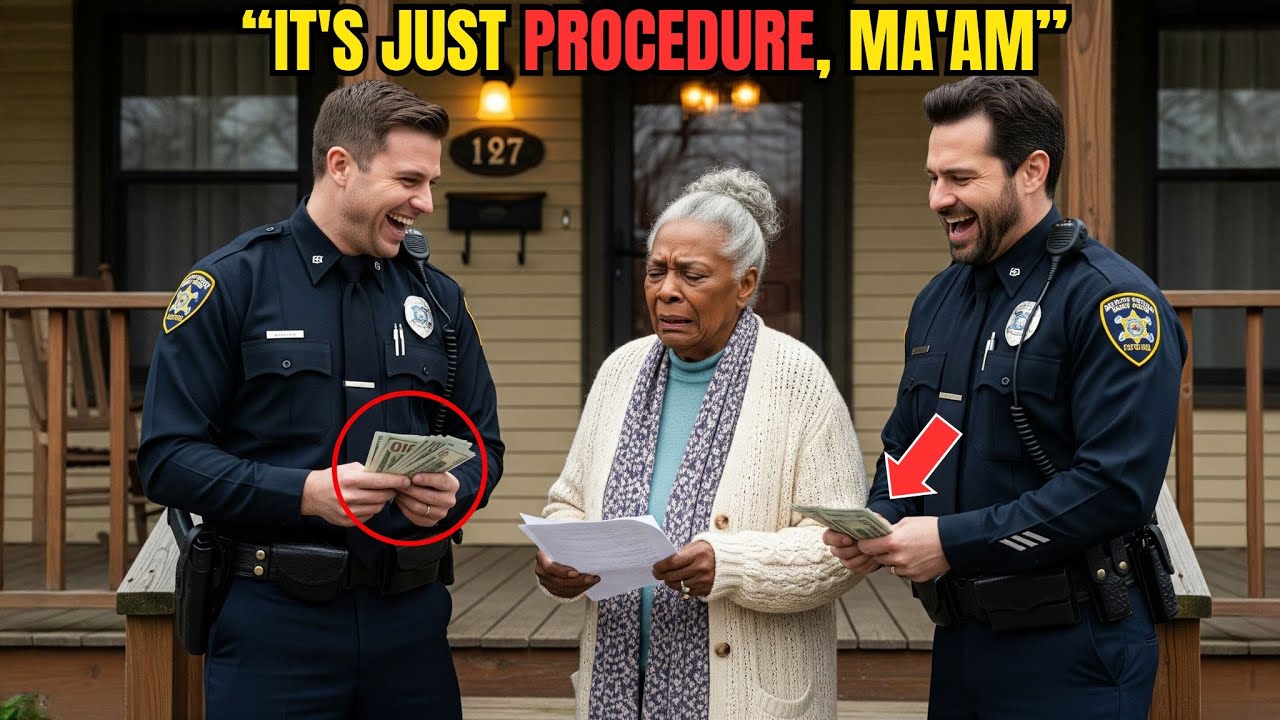
What’s an old black woman like you doing with all this drug money? Officer Brad Mitchell’s voice boomed across the Metro City Bank parking lot. Every passerby stopped and stared at 72-year-old Vivien Miller. Mitchell snatched the white envelope from her trembling hands, tearing it open with violent force. $3,200 in crisp bills spilled onto the asphalt. Officer, please.
That’s my husband’s pension. I have the withdrawal slip. Viven’s voice broke as she reached for her scattered life savings. Mitchell’s boots slammed down on her arthritic hand as she bent toward the money. “Don’t you dare touch evidence, Grandma.” He scooped up every bill while she cradled her throbbing fingers. The crowd watched in stunned silence as he stuffed her entire life savings into his jacket pocket.
“Dirty money belongs with the law,” he sneered, towering over the crying elderly woman. Maybe next time you’ll think twice about dealing drugs. Have you ever watched a predator destroy an innocent life in broad daylight? Vivien Miller had lived in this neighborhood for 47 years. She and her husband Robert bought their modest two-story house in 1978, back when the streets were lined with working families who looked out for each other.
Family
The house held decades of memories. Robert’s workshop in the basement where he repaired neighbors bicycles for free. the kitchen where Vivien baked cookies for every child on the block. The front porch where they watched sunsets and planned their retirement dreams. Now at 72, she was one of the last original residents.
The gentrification wave had swept through like a tide, bringing young professionals who complained about suspicious activity whenever they saw longtime black residents going about their daily lives. New residents called the police if children played too loudly. If elderly people sat on their porches too long, if anyone who didn’t look like them walked down their streets.
Discover more
Gadgets & Portable Electronics
Law Enforcement
Camcorders
The community that once felt like family had become hostile territory. The money Mitchell had stolen represented everything to Viven. Robert’s pension from 40 years driving city buses through rain, snow, and scorching heat. Every dollar saved over 3 years since his death. Money earned through dignity, hard work, and sacrifice.
Her only hope of fixing the roof before winter storms turned her home into a ruin, was now crumpled in a corrupt cop’s pocket. She had been Metro Elementary’s principal for 35 years. Hundreds of children had passed through her office, some for awards, others needing guidance. Parents trusted her with their most precious gifts. The community respected her wisdom and dedication.
Teachers sought her advice on difficult students. Parents confided their family struggles. Children ran to hug her in grocery stores years after graduation. She had shaped young minds and built futures with patience and love. But respect meant nothing to officer Brad Mitchell. Mitchell was an 8-year veteran of the Metro Police Department.
His personnel file, hidden from public view, contained 17 complaints. excessive force against teenagers, racial profiling during traffic stops, theft of personal property during searches, all dismissed by his superiors. His protection came from Sergeant Tom Rodriguez, a 20-year veteran who shared Mitchell’s views about keeping certain people in line.
Together, they had perfected a system of legal theft disguised as law enforcement. Rodriguez had taught Mitchell the tricks. Target elderly victims who couldn’t fight back. Choose immigrants afraid of deportation. Pick people whose complaints would be ignored by the system. Always file paperwork showing smaller amounts than actually seized.
Civil asset forfeite was their weapon of choice. The law allowed police to seize money and property suspected of being connected to crimes. No arrest required. No charges filed, no conviction needed, just suspicion and a badge. The process to reclaim seized assets was deliberately complex. expensive lawyers, multiple court appearances, months of bureaucratic delays.
Most victims simply gave up, which was exactly what the system intended. Mitchell’s recent divorce had drained his bank account. His ex-wife took the house, the savings, and most of his dignity. His gambling debts to local bookies were mounting daily. Lone sharks didn’t care about police badges when payment was overdue.
Targeting elderly residents in gentrifying neighborhoods had become his personal ATM. Old people carried cash. They were isolated. They rarely fought back effectively. Perfect victims for a predator with legal authority. The $3,000 burning in his pocket would solve his immediate problems. He had logged only $200 in evidence, splitting the rest with Rodriguez as usual.
It was a perfect crime protected by qualified immunity and departmental brotherhood. But Mitchell had made a fatal mistake. He had chosen the wrong victim. Vivien stumbled home, her hands still throbbing from Mitchell’s boot. Blood seeped through the skin where his heel had ground into her arthritic knuckles. Every step sent pain shooting up her arm. Her neighbor, Mrs.
Johnson, rushed over from her garden where she had been watching the whole time. Viven, honey, what happened? You look like you’ve seen a ghost. Worse than a ghost, Vivien whispered. A devil with a badge. Mrs. Johnson helped her inside, bringing ice for the swelling. Other neighbors began gathering, their faces grim with shared outrage.
This was their community matriarch. Their children’s former principal, the woman who organized food drives and holiday celebrations. Inside her kitchen, Vivien’s hands shook as she dialed her son’s number. She rarely called Samuel at work, knowing how busy his government job kept him. But she needed to hear a familiar voice after such trauma.
Hey, Mom. Everything okay? Baby, I hate to bother you, but something terrible happened today. Samuel’s voice immediately shifted. 20 years of training had taught him to recognize genuine distress in a victim’s voice. Mom, what’s wrong? Are you hurt? A police officer. He took Robert’s pension money. All of it. $3,200.
He called me terrible names. He stepped on my hand when I tried to get the money back. The silence stretched long enough for Viven to worry the call had dropped. Mom, don’t say another word over the phone. I’m handling this. But Samuel, I don’t think there’s anything anyone can do. He’s a police officer.
Who’s going to believe an old black woman over? Trust me, I’ll call you back tonight. Stay inside. Don’t talk to any more police until I get there. Viven hung up, confused by her son’s intensity and strange instructions. Samuel worked in government security, but she had never quite understood what that meant. He traveled frequently, spoke carefully about his job, and always seemed to carry invisible weight on his shoulders.
What she didn’t know was that Samuel Miller held the title of assistant director for criminal investigation at the Federal Bureau of Investigation. His division specialized in civil rights violations and police corruption across the entire United States. For 6 months, his team had been building a case against the Metro Police Department.
Anonymous tips had flooded in from elderly residents and immigrants. Stories of stolen money, planted evidence, and systematic harassment targeting the most vulnerable community members. They had surveillance footage, financial records, victim testimonies, but they needed one case with ironclad evidence and a sympathetic victim willing to testify.
Mitchell had just handed them both. Mitchell sat in his patrol car outside Vivian’s house filling out paperwork with practice deception. Under amount seized, he wrote $200. Under suspected crime, he scrolled drug trafficking cash transaction consistent with narcotic sales. The remaining $3,000 sat in a manila envelope on his passenger seat waiting to be divided with Rodriguez.
They had done this dance 17 times in the past year. Each theft is documented as a smaller amount. Each victim left with no recourse and no hope. He walked to Viven’s front door and rang the bell, enjoying the power he held over her life. When she answered, her eyes were red from crying.
“Here’s your receipt, ma’am.” Mitchell held out a carbon copy form. “$200 seized pending investigation.” Vivian’s voice cracked. “But you took over 3,000. Are you calling me a liar?” Mitchell’s hand moved to his weapon because filing a false police report is a serious crime. She stared at the receipt. $200. Her entire life savings reduced to pocket change on an official document that would protect him and destroy her.
When will I get my money back? Mitchell laughed. Well, that depends on our investigation. Could take months, could take years, might never happen if we find evidence of criminal activity. What evidence? I’m a retired school principal. Drug dealers come in all shapes and sizes, Grandma. You’d be surprised how many teachers supplement their income with illegal activities.
The accusation hit like a physical blow. 40 years of dedicated service to children, a spotless record, community respect built over decades, all reduced to cruel insinuation by a corrupt cop. I need that money for my roof, Vivian pleaded. It’s leaking badly. Winter is coming.
I should have thought about that before getting involved with drugs. Mitchell tucked the receipt into her mailbox. Have a blessed day. Word spread through the neighborhood like wildfire. Mrs. Johnson called her sister. Her sister called the church. The church called community leaders. By evening, half the block knew that officer Mitchell had robbed their beloved former principal.
Three neighbors came forward with similar stories. Maria Santos, 78, had lost her grocery money to Mitchell last month. He claimed her food stamps were suspicious. David Carter, 81, lost $800 during a routine traffic stop. Mitchell said his cash smelled like marijuana. All had received receipts for much smaller amounts. All had been threatened when they questioned the discrepancies.
All had been told their cases were under investigation with no timeline for resolution. The pattern was clear, but the system protected Mitchell at every turn. Viven tried calling the police department’s internal affairs division. The death sergeant told her complaints had to be filed in person. When she arrived the next morning, they said the complaint officer was unavailable.
When she returned that afternoon, they claimed the computers were down. On her third visit, Sergeant Rodriguez himself handled her complaint. He listened with fake sympathy, typing slowly on his keyboard. So, you’re claiming Officer Mitchell took more money than what’s documented? Yes, sir. $3,200, not 200. Rodriguez shook his head sadly.
Ma’am, that’s a very serious accusation. Are you sure you’re remembering correctly? Sometimes trauma can affect memory. I counted that money three times at the bank. I have the withdrawal slip. Bank records show you withdrew $3,000, but that doesn’t prove you still had it when Officer Mitchell encountered you. Rodriguez leaned back in his chair.
Could you have spent some of it, given it to someone? Drug dealers often use elderly people as couriers. There it was again. The drug dealer accusation designed to discredit her before she could even file a proper complaint. I want to file an official complaint anyway. Rodriguez sighed and handed her a thick packet of forms. Fill these out completely.
Any missing information will invalidate your complaint. We’ll need documentation for every dollar you claim was taken. Bank statements, receipts, witness testimony from people who saw the money. The forms were deliberately complex. Pages of legal language designed to confuse and intimidate elderly complaintants. questions about her mental health history, her criminal background, her family’s finances.
Family
By the time Vivien finished the paperwork, Rodriguez’s shift had ended. The night desk sergeant said complaints could only be processed during business hours. She would have to return tomorrow. That night, her ceiling leaked worse than ever. Rain poured through multiple holes, soaking her living room carpet and damaging family photos.
The temperature dropped 10°, turning her house into an ice box. She called her insurance company. They said roof damage from neglected maintenance wasn’t covered. She called contractors for estimates. The cheapest quote was $4,000. Money she no longer had thanks to Mitchell’s theft. Viven sat in her cold, wet house surrounded by buckets catching drips and made the hardest phone call of her life.
Samuel, baby, I don’t think I can fight this anymore. Samuel’s voice turned ice cold. Mom, pack a bag. Stay at Mrs. Johnson’s tonight. Don’t answer your door for anyone. But Samuel, this is my home. Just trust me. And mom, don’t throw away any documents. Keep everything. Within hours, federal surveillance teams were positioned around Vivian’s neighborhood.
Unmarked vans monitored Mitchell’s radio communications. Financial investigators tracked every dollar flowing through his bank accounts. Digital forensic specialists began pulling phone records and text messages. But Vivien knew none of this. She only knew that the next morning brought fresh horror. Mitchell’s patrol car was parked outside her house when she returned from Mrs.
Johnson’s. He stood on her front porch, writing parking tickets and placing them under her car’s windshield wipers. Morning, ma’am. Just documenting some violations I noticed. He had written her tickets for parking too close to a fire hydrant, expired registration, and blocking a driveway. All false.
Her car sat legally in her own driveway, registered and inspected properly. These tickets are wrong. I’m parked in my own driveway. Mitchell’s smile was predatory. City ordinance requires vehicles to be parked at least 3 ft from property lines. Looks like you’re in violation. He measured with his hands, making an obvious show of counting imaginary feet.
That’s not a real law. Are you questioning my knowledge of city ordinances? His hand moved to his handcuffs. Because obstruction of justice is a serious charge, each ticket carried a $50 fine, $200 in fabricated violations, money she didn’t have because he had stolen her savings. This was just the beginning.
Over the next week, Mitchell escalated his campaign of harassment with methodical cruelty. every morning brought new tickets, noise violations for her television being too loud, littering charges for leaves that blew from her yard. Property maintenance citations for peeling paint that had been there for years.
The city code enforcement officer Harold Barnes arrived Thursday morning with a clipboard full of violations. He had worked for the city for 15 years and had never bothered Viven before. Ma’am, we’ve received complaints about your property. broken front step, damaged gutters, overgrown vegetation. Viven stared at her neat, well-maintained yard.
What overgrown vegetation? Barnes pointed to a rose bush Robert had planted 20 years ago. City ordinance requires vegetation to be maintained below 4 ft in height. That rose bush has been there for decades. Nobody ever complained before. Well, someone’s complaining now. Barnes handed her a citation. You have 7 days to correct these violations or face daily fines of $100.
The violations were expensive to fix. Professional landscaping, roof repairs, concrete work, thousands of dollars she no longer had because of Mitchell’s theft. It was a perfect trap. Create violations that require money to fix. Steal the victim’s money so they couldn’t afford repairs. Then pile on daily fines until they lost their home entirely.
That evening, Vivien’s water was shut off without warning. The utility company claimed she had unpaid bills dating back three months, but Viven had always paid her bills on time. Her checkbook showed every payment properly recorded and deposited. When she called to dispute the shut off, she was transferred between departments for 2 hours.
Each representative asked her to verify account information she had already provided. Each promised to investigate and call back. None did. She spent the night without running water, washing dishes with bottled water and rain water collected in buckets from her leaking roof. Mrs. Johnson brought her gallons of drinking water and helped her contact a lawyer. The consultation fee was $300.
The lawyer listened sympathetically, but delivered devastating news. Civil asset forfeite cases are extremely difficult to win. Police departments have legal immunity for good faith seizures. The burden of proof is on you to demonstrate the money wasn’t connected to criminal activity, but I have bank records showing where the money came from.
That proves you had legitimate income. It doesn’t prove you still had that specific money when it was seized. Officer Mitchell’s report says he only took $200 in suspected drug proceeds. The lawyer’s fees for fighting the case would start at $10,000 with no guarantee of success. Even if she won, it could take years.
Meanwhile, the harassment would continue and her house would deteriorate beyond repair. Friday brought the crulest blow yet. Mitchell arrived with a television news crew from Channel 7. The reporter, Jessica Walsh, had been told police were conducting a major drug investigation in a residential neighborhood. This is Jessica Walsh reporting live from Metro City, where police are investigating alleged drug trafficking in what residents thought was a quiet family neighborhood.
Family
Mitchell positioned himself prominently in the camera frame, speaking with practiced authority. We’ve had multiple reports of suspicious cash transactions at this address. Large amounts of money changing hands, vehicles coming and going at unusual hours. The camera panned to Viven’s house while Mitchell continued his fabricated narrative.
Every detail was a lie, but it sounded convincing on television. Drug traffickers often use elderly residents as fronts for their operations. They seem harmless, but appearances can be deceiving. Neighbors gathered to watch the spectacle. Some defended Viven loudly, but others whispered among themselves. Television news made everything seem official and credible. Viven watched from Mrs.
Johnson’s window as her reputation was destroyed on live television. 40 years of community service erased by one corrupt cop’s lies. The news story aired that evening during prime time. Channel 7’s Facebook page filled with angry comments about drug dealers hiding in residential neighborhoods. Most commenters didn’t know Viven personally, but they demanded action against anyone threatening their community safety.
By Sunday, someone had spray painted drug dealer on her garage door in red letters 3 ft tall. Her mailbox was knocked over. Trash was scattered across her yard. Parents who once trusted her with their children now crossed the street to avoid her. Grocery store clerks watched her suspiciously.
The pharmacist asked extra questions about her prescription medications. The isolation was devastating. She had lived in this community for nearly 5 decades. These were her neighbors, her friends, her extended family. Now they looked at her with suspicion and fear. But unknown to everyone, federal agents were documenting every illegal act.
They recorded Mitchell’s false testimony to the news crew. They photographed the fabricated parking tickets. They traced the city water department’s shut off order back to a phone call from the police station. They had surveillance footage of Mitchell and Rodriguez celebrating at Murphy’s bar, spending Vivian’s money on expensive whiskey, and laughing about their latest victim.
Stupid old lady thought she could fight back. Mitchell had bragged to the bartender. I could take her house next if I wanted. Who’s going to stop me? The bartender unknowingly was an offduty federal agent working part-time to monitor police corruption. Every word was recorded. Every crime was documented.
Every violation of Vivian civil rights was carefully cataloged by investigators who specialized in bringing down corrupt officials. Samuel checked in with his mother daily, his heart breaking at the pain in her voice. But he couldn’t reveal the investigation without compromising the case. He could only offer comfort and promise that justice would come.
“Baby, I don’t know how much more I can take,” Vivian whispered during their Thursday call. “My neighbors think I’m a criminal. My house is falling apart. I’m afraid to leave my own home.” “Mom, I know this is hard, but I need you to hold on just a little longer. Can you do that for me?” “I’ll try, sweetheart.
I’ll try.” What Viven didn’t know was that federal prosecutors were already preparing arrest warrants. What Mitchell didn’t know was that every move he made was being recorded by the most sophisticated law enforcement agency in the world. The trap was set. The evidence was overwhelming and the reckoning was about to begin.
Monday morning arrived with devastating news. Mitchell stood on Vivian’s front porch holding official court documents and wearing his most triumphant smile. Good morning, Mrs. Miller. I have some paperwork for you. Viven opened the door with trembling hands, her arthritis worse from stress and the cold dampness of her leaking house.
What is it now? Asset forfeite proceedings. The city is seizing your house under the comprehensive crime control act. Property used in furtherance of drug trafficking becomes government property. The legal papers were thick and intimidating, filled with whereas clauses and legal terminology designed to confuse elderly victims, but the message was clear.
She had 48 hours to vacate the premises. This is insane. I’ve never sold drugs in my life. Mitchell shrugged with mock sympathy. Pattern of cash transactions, multiple complaints from neighbors, evidence of ongoing criminal enterprise. The law is the law, Grandma. What complaints? What neighbors? Anonymous tips.
Very credible sources concerned about criminal activity in their neighborhood. It was all fabricated. Mitchell had filed the complaints himself using fake names and addresses. The system rarely verified anonymous tips, especially when they came from police officers. You have until Wednesday morning to remove your personal belongings.
Anything left behind become city property. Vivien stared at the papers, seeing her 47-year home disappearing into legal quicksand. The house where she had raised Samuel, where she and Robert had built their life together, where decades of memories lived in every room. I’m calling my son. Call whoever you want.
Federal courts don’t interfere with local asset forfeite cases, and your son can’t help you now, can he? What’s he going to do? File a complaint? Mitchell laughed cruy. By the time any lawyer gets involved, you’ll be living under a bridge. Homeless old drug dealers don’t get much sympathy from judges. The words cut deep, but Vivien maintained her dignity.
She walked to her phone with steady steps, refusing to let him see her break. Mitchell walked away whistling, already planning how to profit from selling her house to developers. The gentrification boom made older homes valuable. This theft would net him more money than all his previous crimes combined.
He called Rodriguez from his patrol car. It’s done. The old lady will be out by Wednesday. The house should sell for at least 200,000. Beautiful. Split at 50/50 as usual. Absolutely. Easiest money we’ve ever made. They had no idea that every word was being recorded by federal surveillance equipment. Viven called Samuel with shaking fingers, barely able to speak through her tears.
Baby, they’re taking the house. I have two days to get out. 47 years and they’re just taking it all away. Samuel’s voice was steady, controlled, but she could hear steel underneath. Mom, pack one bag with essentials. Stay at Mrs. Johnson’s tonight. Tomorrow morning, I want you to sit on your front porch at exactly 900 a.m.
Samuel, there’s nothing anyone can do. He said federal courts don’t get involved in local cases. Trust me, Mom. Just be on your porch at 9:00 a.m. Don’t go inside. Don’t talk to any police officers. Just sit there and wait. Wait for what? Justice. That evening, Samuel made his final preparations. He called FBI Director Sarah Carter personally.
Ma’am, we’re ready to execute the arrest tomorrow morning. We have 47 victims willing to testify. financial evidence of over $200,000 in stolen assets, video and audio recordings of the crimes and the civil rights violations. Crystal clear color of law violations, conspiracy under federal RICO statutes. These officers have been running a criminal enterprise under police protection. Do it.
And Samuel, I’m sorry about your mother. Thank you, ma’am. She taught me what justice really means. Tuesday night, Vivien barely slept. She packed her most precious belongings into two suitcases. photos of Robert, her teaching awards, Samuel’s childhood drawings, a lifetime reduced to what she could carry. Mrs.
Johnson helped her prepare. Both women crying as they folded clothes and wrapped fragile memories in the newspaper. 47 years, Viven whispered. Everything Robert and I worked for, gone. Maybe your son can help. He works for the government, right? He does something with security, but what can one person do against the whole police department? Mrs.
Johnson hugged her tightly. Sometimes one person is all it takes. Honey, you raised that boy right. I have faith he’ll find a way. Wednesday morning came gray and cold. At exactly 9:00 a.m. Viven sat on her front porch wearing her best dress and holding her purse in her lap. She looked dignified despite everything that had been taken from her.
Mitchell arrived early bringing a city towing truck and several police officers to oversee the eviction. He had also called Channel 7 News, wanting to document his victory over the drug dealer who had terrorized the neighborhood. Jessica Walsh set up her camera across the street, preparing to film the eviction of an elderly drug suspect.
It would make compelling television for the evening news. “Good morning, Mrs. Miller,” Mitchell called out cheerfully. “Ready to vacate the premises?” Viven sat quietly, her hands folded, looking down the street as if waiting for something. I said, “Are you ready to leave?” Mitchell’s voice turned sharper. “Because I have a court order, and I will have you arrested for trespassing on city property.
” Still, Viven remained silent, her eyes fixed on the horizon. Mitchell walked closer, his voice turning menacing. “Hey, I’m talking to you, drug dealer. You think ignoring me will save your house?” He leaned down until his face was inches from hers. You’re nothing. A worthless old woman who thought she could outsmart the system.
Well, guess what? The system always wins. Then a distant engine sounds, growing louder. A black Suburban turned onto their street, followed by another, then another. A convoy of federal vehicles moving with precision and purpose. Mitchell frowned, watching the approaching motorcade. What the hell? The vehicle stopped directly in front of Vivian’s house.
Men in dark suits emerged, their movements coordinated and professional. FBI badges glinted in the morning sunlight. From the lead vehicle stepped a tall, imposing black man in an expensive suit. His presence commanded immediate attention and respect. Mitchell stepped forward aggressively. Excuse me. This is a local police matter. You need to move your vehicles.
The man walked directly to Mitchell, stopping inches from his face. Officer Mitchell, I’m Assistant Director Samuel Miller, Federal Bureau of Investigation, Criminal Investigative Division. Mitchell’s confidence flickered. Your Your name is Miller. You’ve been stealing from my mother. The words hit like lightning.
Mitchell’s eyes darted to Viven, then back to Samuel, his mind struggling to process the connection. Your mother? This is some kind of mistake. Viven stood up slowly, her voice clear and strong for the first time in weeks. Samuel, baby. This is the officer I told you about. Samuel’s voice carried the weight of federal authority. Officer Bradley Mitchell, you are under arrest for violations of Title 18, section 242 of the United States Code, deprivation of rights under color of law.
Federal agents moved like a choreographed dance. Mitchell’s hands were cuffed behind his back before he could react. His weapon was secured. His radio was confiscated. This is crazy. I was just doing my job. Samuel stepped closer, his voice deadly calm. Your job was to protect and serve. Instead, you terrorized a 72-year-old retired school principal. You stole her life savings.
You falsified police reports. You violated her constitutional rights under color of law. The television crew captured everything. But now they were filming Mitchell’s arrest instead of Viven’s eviction. Rodriguez emerged from his patrol car, rushing to defend his partner. Agent Miller, there’s been a misunderstanding.
Officer Mitchell was conducting a legitimate investigation. Sergeant Rodriguez. Samuel didn’t turn around. You’re also under arrest. Same charges plus conspiracy and obstruction of justice. Two more agents moved to arrest Rodriguez while he sputtered protests about departmental procedures and proper jurisdiction.
Captain Lisa Barnes arrived just as Rodriguez was being handcuffed. What’s the meaning of this? I demand to speak with your supervisor. Samuel turned his full attention to her. Captain Barnes, you’re under arrest for operating a criminal enterprise under color of law. You’ve systematically covered up civil rights violations and shared in the proceeds of theft.
You can’t arrest me. I’m a police captain. Ma’am, I’ve arrested governors, federal judges, and police commissioners. Your rank means nothing when you violate federal law. The crowd of neighbors had grown larger, drawn by the federal convoy and television cameras. Many looked shocked and ashamed at how quickly they had believed Mitchell’s lies about their beloved former principal.
Samuel walked to his mother, helping her stand with gentle hands. I’m sorry this took so long, Mom. How did you I don’t understand. I’ve been investigating police corruption for 15 years. When you called that first day, you gave me the case I needed to bring them all down. He gestured to the federal agents now searching Mitchell’s patrol car.
We’ve been watching them for 6 months, recording their conversations, tracking their bank accounts, documenting every crime. From the patrol car, agents retrieved the manila envelope containing the remainder of Vivian’s money, $3,000, exactly as she had described. Samuel held up the envelope for the television cameras.
Officer Mitchell stole $3,200 from my mother. He logged $200 in evidence and kept the rest. This is the money he claimed didn’t exist. Mrs. Johnson rushed over to hug Vivian. Oh, honey, I knew you were telling the truth. I just knew it. Other neighbors began approaching, offering apologies and support. The community that had abandoned her was rallying back to her side.
Samuel continued addressing the cameras, his voice carrying the authority of the federal government. For 6 months, the FBI has been investigating systematic civil rights violations by members of the Metro Police Department. We have documented 47 cases of theft, harassment, and abuse targeting elderly residents and minorities.
He handed his mother the envelope containing her money. Today’s arrests are just the beginning. We will prosecute every officer who participated in this criminal enterprise. Mitchell, now sitting in the back of a federal vehicle, stared at Viven with pure hatred. You have no idea what you’ve done, old woman. Samuel leaned down to Mitchell’s window.
Actually, she knows exactly what she’s done. She helped expose a corrupt police department and protected 46 other victims. The asset forfeite papers were immediately voided by federal order. The fabricated tickets were dismissed. The fake violations were expuned from city records.
As Mitchell and Rodriguez were driven away in federal custody, Viven finally understood why her son had been so secretive about his work. You’re really an FBI director. Samuel smiled, the first genuine smile she had seen from him in years. Assistant director and mom. I got into law enforcement because I watched you stand up for what’s right every single day.
Within hours of the arrests, the transformation began. FBI forensic accountants traced every stolen dollar through Mitchell’s and Rodriguez’s bank accounts. The evidence was overwhelming and undeniable. Mitchell had deposited irregular cash amounts totaling $43,000 over 8 months. Rodriguez had similar deposits.
Captain Barnes had received monthly payments disguised as overtime compensation. Samuel personally returned to his mother’s house that afternoon, bringing a team of federal agents who had become impromptu moving helpers. They carried Vivian’s belongings back inside while she watched in amazement. Baby, I still can’t believe this is real.
It’s real, Mom, and it’s just beginning. Samuel handed her an official document. Federal court order invalidating all seizure proceedings against your property. Your house is legally protected from any future harassment or false claims. The roof repair crew arrived 2 hours later. Samuel had called in favors with contractors who worked on federal buildings.
Within 3 days, Viven’s house had a completely new roof, gutters, and weatherproofing. I can’t afford all this work, Samuel. The city is paying for it. Part of the federal settlement agreement. The Metro City Council had called an emergency session the moment news of the FBI arrests hit television. Federal prosecutors had presented them with a choice.
Cooperate fully with reforms or face federal takeover of the entire police department. They chose cooperation. Mayor Patricia Thompson arrived at Vivian’s house Thursday morning with a formal apology and a large check. Mrs. Miller, on behalf of Metro City, I want to apologize for the horrific treatment you received. This should never have happened to anyone, especially not to someone who dedicated her life to serving our community.
The settlement was substantial. $500,000 for civil rights violations, full reimbursement for property damage and legal fees, a formal letter of apology to be published in the city newspaper. But Vivien wanted more than money. What about the other victims? What about making sure this never happens again? Mayor Thompson nodded respectfully.
We’re establishing a civilian oversight board with real authority to investigate police misconduct. Every officer will undergo civil rights training and we’re implementing body cameras for all interactions. Samuel added, “The entire department is under federal consent decree for the next 5 years. Any violation will result in federal takeover.
Camcorders
” The neighborhood transformation was equally dramatic. Mrs. Johnson organized a welcome home celebration that drew over 200 people. Former students, now adults with children of their own, came to honor their beloved principal. David Carter, the elderly man who had lost money to Mitchell, approached Viven with tears in his eyes. Mrs.
Miller, I’m so sorry I didn’t speak up when you needed support. I was scared, but that’s no excuse. Mr. Carter, we were all scared. That’s how bullies control people. But we’re not scared anymore. Maria Santos, the grandmother who had lost her grocery money, hugged Viven tightly. You saved us all by being brave. My granddaughter wants to be just like you when she grows up.
The local newspaper ran a front page story about Viven’s courage and Samuel’s investigation. The headline read, “Former principal’s courage exposes police corruption ring. But the most meaningful recognition came from the school board. Superintendent Dr. Michael Roberts visited Viven personally. Mrs. Miller, we want to name the new community center after you.
The Viven Miller Center for Community Justice. That’s very kind, but I’m not sure I deserve. You absolutely deserve it. You taught our children that standing up for what’s right matters more than staying safe. That’s the most important lesson anyone can learn. Samuel took a week of leave to spend time with his mother, something he hadn’t done in years.
They sat on the front porch in the evenings watching neighbors wave and children play in the streets. I’m sorry I couldn’t tell you what I really did for work, Mom. Baby, I always knew you were protecting people. I just never imagined you’d end up protecting me. You taught me everything I know about justice. Remember when I was eight and those boys were picking on Sarah Martinez? Viven smiled at the memory.
You came home with a black eye because you stood up for her. And you told me that sometimes doing the right thing costs us something, but it’s always worth it. I never thought those words would come back to save my own life. The federal investigation expanded rapidly. Samuel’s team had uncovered similar corruption in 12 other police departments across the state.
Vivian’s case had provided the legal precedent and evidence patterns needed to launch a statewide civil rights investigation. Mitchell and Rodriguez were held without bail pending trial. Their legal fees quickly drained their stolen savings. The properties they had purchased with crime proceeds were seized under federal asset forfeite laws.
Captain Barnes faced the most serious charges. As the commanding officer, she had not only participated in the theft, but had systematically covered up complaints and protected criminal officers. All three would ultimately plead guilty to avoid longer sentences. Mitchell received 8 years in federal prison. Rodriguez got seven years.
Barnes was sentenced to 10 years and loss of her pension. The 47 victims identified by the FBI investigation received full restitution plus damages. The total recovery exceeded $800,000 in stolen assets and fraudulent seizures. But for Viven, the personal victories mattered most. Her water service was restored with a formal apology from the utility company.
The fabricated parking tickets were expuned from city records. The false property violations were removed and the responsible code enforcement officer was terminated. Most importantly, her reputation was fully restored. The community that had briefly doubted her now rallied around her as a hero who had exposed systematic injustice.
The spray-painted drug dealer graffiti on her garage was painted over by volunteer teenagers from her former school. In its place, they painted a beautiful mural showing hands of different colors joined together with the words, “Justice for all.” Samuel arranged for enhanced security around his mother’s house, but it proved unnecessary.
The neighborhood had become protective of their local hero. Parents used Vivian’s story to teach their children about courage and integrity. Local churches invited her to speak about standing up against injustice. Community colleges asked her to address criminal justice classes. Her quiet dignity and powerful story inspired audiences across the region.
“I never wanted to be famous,” she told Samuel. “I just wanted my money back so I could fix my roof.” Sometimes the smallest act of resistance becomes the biggest catalyst for change. 3 months after the arrests, Viven received a letter from the FBI director personally thanking her for her courage in exposing corruption.
The letter was accompanied by a civilian service award recognizing her contribution to civil rights enforcement. But the recognition that meant the most came from an unexpected source. A package arrived with no return address. Inside was a handdrawn card from a child who had seen the news story. The crayon drawing showed a small figure standing up to a much larger figure wearing a police uniform.
The message written in careful block letters read, “Thank you for being brave. You showed me that even kids can stand up to bullies. 6 months later, Vivian Miller stood before a packed auditorium at Metro Community College. Students, community leaders, and law enforcement officials had gathered to hear her speak about justice, courage, and the power of standing up for what’s right.
I taught children for 35 years, she began, her voice clear and strong. I always told them that America is built on the promise of justice for everyone. When that promise was broken for me, I almost lost faith. She paused, looking out at the diverse crowd hanging on her every word. But my son reminded me that good people never give up.
And sometimes help comes from places we never expect. The audience included Maria Santos, David Carter, and 43 other victims who had received justice because of Viven’s courage. Their presence validated every difficult moment of her fight. I’m not a hero. I’m just a retired teacher who refused to accept injustice. But I learned something important.
Corruption thrives when good people stay silent. Evil wins when we convince ourselves that we’re powerless. Samuel sat in the front row, beaming with pride as his mother addressed the crowd with the same authority she had once used to inspire students. The system works, but only when people make it work. Local officials failed me, but federal law enforcement stepped in because that’s what they’re supposed to do.
No one is above the law, especially those sworn to uphold it. She gestured to the reformed police officers in attendance, part of the new accountability measures implemented after the investigation. I don’t hate police officers. I hate corruption. Good officers deserve our support. Bad officers deserve prosecution. It’s that simple.
The statistics she shared were sobering but important. Civil asset forfeite laws had enabled the seizure of over $5 billion annually, often without criminal charges. Elderly and minority communities face disproportionate targeting. Federal oversight had increased successful prosecutions of corrupt officials by 400%.
But numbers don’t tell the whole story. Behind every statistic is a person whose life was destroyed by abuse of power. A family whose savings were stolen, a community whose trust was broken. Viven’s voice grew stronger as she reached her central message. I want you to remember three things. First, if you witness injustice, speak up.
Family
Record everything. Document every interaction. Your voice matters even when it feels small. The audience leaned forward, absorbing every word. Second, know your rights and help others know theirs. The Constitution protects all of us, but only if we understand and defend those protections. She looked directly at the young people in the crowd.
Third, when local systems fail, don’t give up. Contact federal authorities. The FBI exists to protect civil rights for all Americans. Use that protection. Samuel had arranged for the speech to be livereamed, reaching thousands of viewers who needed to hear Viven’s message of hope and empowerment. My house is warm and dry now.
My reputation is restored. My family is safe. But the real victory isn’t personal. It’s that 46 other families got justice, too. It’s that a corrupt system was exposed and reformed. She gestured to the young faces in the audience. You are the future guardians of justice. When you see something wrong, make it right. When you see corruption, expose it.
When you see someone being hurt, help them. The standing ovation lasted 5 minutes, but Viven wasn’t finished. I want to leave you with the words I used to tell my students every day. Your character is defined not by what you do when people are watching, but by what you do when you think no one will ever know. She smiled, remembering decades of young faces who had sat in similar auditoriums, absorbing lessons about integrity and courage.
Someone is always watching. Your conscience, your family, your community, and sometimes when justice seems impossible, the most powerful law enforcement agency in the world. The final applause was thunderous. Students rushed forward to shake her hand and ask questions. Community leaders requested her contact information for future speaking engagements, but Vivien’s attention was focused on Samuel, who stood waiting with tears in his eyes.
You did good, Mom. We did good, baby. We did good. As the crowd dispersed, Viven’s message continued spreading through social media posts, news articles, and personal conversations. Her story became a rallying cry for justice and accountability. The live stream comments showed the impact of her words. This woman is a hero. Sharing everywhere.
My grandmother went through something similar. Thank you for fighting back. Everyone needs to hear this story. Justice matters. Tag someone who stands up for what’s right. The final statistic Vivien shared resonated most powerfully. One in three Americans reported police misconduct in their communities, but less than 5% of cases resulted in officer prosecution.
Federal intervention was essential for justice. Her closing words became a viral message of hope. Your voice matters. Your story matters. Justice matters. Don’t let anyone convince you otherwise. The evening news featured extensive coverage of her speech. Social media algorithms amplified her message to millions of viewers.
Community organizations requested copies of her presentation for training purposes. But the most important audience was sitting in their living rooms watching an elderly black woman prove that courage and persistence could overcome seemingly impossible odds. Have you ever witnessed injustice and stayed silent? What would you do if it happened to someone you love? Share this story if you believe justice should be blind.
Like if you support police accountability. Subscribe to Black Soul for more stories of ordinary people doing extraordinary things. Comment below. Have you ever seen corruption exposed? How did it change your community? Remember, sometimes the smallest voice creates the biggest